In Between by Dr. John Antonucci, MD
This essay has circulated among medical folks, and I thought we might benefit from it.
The Bridge
by KJ Ramsey
The medication you don’t want to take, the habit you don’t want to start, the conversation you don’t want to have, the test you don’t want to get. It’s a bridge.
You don’t have to love the bridge. You just have to walk across it.
I found this bridge on a hike and stood at the beginning of it for a minute thinking about all the times I’ve used this word in a room with a patient who was afraid of what came next.
A bridge is not the destination. Nobody moves to a bridge. Nobody stays on a bridge. A bridge is the thing between where you are and where you need to be and its only job is to get you across.
You don’t judge a bridge. You don’t stand at the beginning of one and criticize the materials or the design or the length. You don’t look at it and say this isn’t how I would have built it. You just step onto it because the other side has something you want and this is the way across.
You don’t judge how long the bridge is. Some bridges are short and you cross them in a day. A conversation, an appointment, a decision you’ve been avoiding. Some bridges take months. A recovery, a medication, a season of grief, a complete rebuilding of the way you eat or move or think. The length of the bridge is not the point. The crossing is the point.
Sometimes you stop in the middle. You stall. You stand there looking at how far you’ve come and how far you still have to go and neither distance feels manageable. That’s okay. Standing still on a bridge is not the same as going backward. You’re still on it. You’re still between where you were and where you’re going and standing there for a while doesn’t mean you’ve failed. It means you’re catching your breath.
There is no right way to cross a bridge. Some people walk fast with their eyes on the other side. Some people walk slow and look at the water underneath. Some people stop 4 times. Some people almost turn around and then don’t. All of them get across if they keep going and the bridge doesn’t care how long it takes.
The bridge is teaching you something while you’re on it. Not after. While. The medication you didn’t want to take is showing you what your body feels like when it has support. The habit you didn’t want to start is showing you that you’re capable of something you thought you weren’t. The conversation you didn’t want to have is showing you that the weight gets lighter once you share it. The bridge is not just the path to the lesson. The bridge is the lesson.
I’ve watched patients stand at the beginning of a bridge and refuse to step onto it because they couldn’t see the other side. I’ve watched patients step onto it and want to turn back because the middle felt worse than the beginning. I’ve watched patients get to the other side and turn around and look at the bridge and say “that wasn’t as bad as I thought it was going to be” and I’ve heard that sentence a thousand times and it’s true almost every time.
The thing you’re avoiding right now is a bridge. The thing that feels uncomfortable, inconvenient, or scary is a bridge. You don’t have to love it. You don’t have to understand why it was built this way or why it’s this long or why you’re the one who has to cross it.
You just have to take the next step. One step. Not the whole bridge. The next step. The bridge will hold you. It was built for this.
The original version of “The Bridge” by KJ Ramsey, as posted on her official website, kjramsey.com
This reminds me of an invite I wrote to you 3 years ago:
In Between
We work with our oncologists to maximize our survival.
In MSF, we have worked on maximizing the number of hours we enjoy each day by focusing on the present.
Here is my idea to find lots and lots of brand-new minutes to live in each hour:
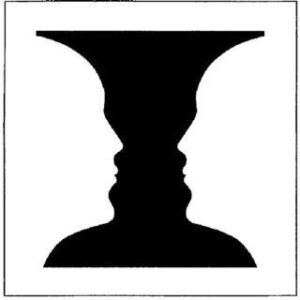
Remember this picture? What is it a picture of?
When we look out at a scene or see a picture, there is a foreground of objects that we look at. That’s the figure. There is a background, far less important, barely even noticed. That’s the ground.
It’s the same with time. There are the things we do; they are on the calendar and take up all our consciousness. Then there is the useless time in between. Driving from one thing to another. Walking up the stairs. Waiting on hold. Sitting in the waiting room. The pause between forkfuls. The white space on the calendar. Waiting for someone to answer the phone.
Try changing your awareness from the figure to the ground—not just with space but with time. Try becoming as aware of the time in between as the activity we are doing. You don’t know it’s there until you look for it.
I’m hoping that by mining this time in between, we can gain a hundred precious minutes a day.
-John (dr.john@ancan.org)