This essay has circulated among medical folks, and I thought we might benefit from it.
The Bridge
by KJ Ramsey
The medication you don’t want to take, the habit you don’t want to start, the conversation you don’t want to have, the test you don’t want to get. It’s a bridge.
You don’t have to love the bridge. You just have to walk across it.
I found this bridge on a hike and stood at the beginning of it for a minute thinking about all the times I’ve used this word in a room with a patient who was afraid of what came next.
A bridge is not the destination. Nobody moves to a bridge. Nobody stays on a bridge. A bridge is the thing between where you are and where you need to be and its only job is to get you across.
You don’t judge a bridge. You don’t stand at the beginning of one and criticize the materials or the design or the length. You don’t look at it and say this isn’t how I would have built it. You just step onto it because the other side has something you want and this is the way across.
You don’t judge how long the bridge is. Some bridges are short and you cross them in a day. A conversation, an appointment, a decision you’ve been avoiding. Some bridges take months. A recovery, a medication, a season of grief, a complete rebuilding of the way you eat or move or think. The length of the bridge is not the point. The crossing is the point.
Sometimes you stop in the middle. You stall. You stand there looking at how far you’ve come and how far you still have to go and neither distance feels manageable. That’s okay. Standing still on a bridge is not the same as going backward. You’re still on it. You’re still between where you were and where you’re going and standing there for a while doesn’t mean you’ve failed. It means you’re catching your breath.
There is no right way to cross a bridge. Some people walk fast with their eyes on the other side. Some people walk slow and look at the water underneath. Some people stop 4 times. Some people almost turn around and then don’t. All of them get across if they keep going and the bridge doesn’t care how long it takes.
The bridge is teaching you something while you’re on it. Not after. While. The medication you didn’t want to take is showing you what your body feels like when it has support. The habit you didn’t want to start is showing you that you’re capable of something you thought you weren’t. The conversation you didn’t want to have is showing you that the weight gets lighter once you share it. The bridge is not just the path to the lesson. The bridge is the lesson.
I’ve watched patients stand at the beginning of a bridge and refuse to step onto it because they couldn’t see the other side. I’ve watched patients step onto it and want to turn back because the middle felt worse than the beginning. I’ve watched patients get to the other side and turn around and look at the bridge and say “that wasn’t as bad as I thought it was going to be” and I’ve heard that sentence a thousand times and it’s true almost every time.
The thing you’re avoiding right now is a bridge. The thing that feels uncomfortable, inconvenient, or scary is a bridge. You don’t have to love it. You don’t have to understand why it was built this way or why it’s this long or why you’re the one who has to cross it.
You just have to take the next step. One step. Not the whole bridge. The next step. The bridge will hold you. It was built for this.
The original version of “The Bridge” by KJ Ramsey, as posted on her official website, kjramsey.com
This reminds me of an invite I wrote to you 3 years ago:
In Between
We work with our oncologists to maximize our survival.
In MSF, we have worked on maximizing the number of hours we enjoy each day by focusing on the present.
Here is my idea to find lots and lots of brand-new minutes to live in each hour:
Remember this picture? What is it a picture of?
When we look out at a scene or see a picture, there is a foreground of objects that we look at. That’s the figure. There is a background, far less important, barely even noticed. That’s the ground.
It’s the same with time. There are the things we do; they are on the calendar and take up all our consciousness. Then there is the useless time in between. Driving from one thing to another. Walking up the stairs. Waiting on hold. Sitting in the waiting room. The pause between forkfuls. The white space on the calendar. Waiting for someone to answer the phone.
Try changing your awareness from the figure to the ground—not just with space but with time. Try becoming as aware of the time in between as the activity we are doing. You don’t know it’s there until you look for it.
I’m hoping that by mining this time in between, we can gain a hundred precious minutes a day.
Living with cancer often means living with uncertainty, and for many patients, that uncertainty shows up as fear of recurrence and the very real stress of upcoming scans, tests, and follow-up appointments. In his introduction for the most recent Men Speaking Freely on June 4th, Dr. John provides a great summary of the Fear of Cancer Recurrence:
I thought I’d take a new look at a favorite topic of ours, Fear of Recurrence. Here is an update from recent literature.
Not that we need a definition, but FCR is defined in the literature as the fear, worry, or concern that cancer will return or progress. It’s among the most common and persistent concerns for cancer survivors, including men with prostate cancer. It seriously affects our quality of life, mental health, and even relationships.
Recent studies confirm that at least half of cancer survivors experience moderate to high FCR, with 10–20% experiencing severe, disabling FCR. Younger age, female gender, recent diagnosis, low social support, poor physical condition, and previous psychological difficulties are risk factors for higher FCR in general. For prostate cancer, younger patients and those with PSA increases or ambiguous test results are at higher risk. Of course, men may underreport FCR due to stigma or stoicism (fancy word for being stupid).
Cognitive Behavioral Therapy (CBT) and Mindfulness-Based Interventions are still the most evidence-based approaches. New trials support the efficacy of both in reducing FCR, including when delivered via telehealth.
Structured interventions like ConquerFear (iConquerFear) and SWORD (Survivors’ Worry Reduction) are scientifically validated in multiple countries and are worth looking at. There’s supposed to be an Australian intervention called iCanADAPT for prostate cancer, but I can’t seem to navigate to it from icandapt.adaptcancer.org.au. Meta-analyses show modest benefit for these interventions, with high patient acceptability.
Medications addressing fear of recurrence are still not supported as primary treatment, but they sure got me by those early months without adverse effects.
The International Psycho-Oncology Society and ASCO survivorship guidelines, as well as recent research, recommend regular assessment and referral for FCR. Tools like the Fear of Cancer Recurrence Inventory (FCRI), FCR-7, and Cancer Worry Scale are available, but I’ve never heard of anyone being screened. Wake up, docs.
On the horizon, studies are examining genetics, inflammation, and personality traits as predictors of FCR. Interventions are becoming culture-specific.
So, FCR is normal, and severe/persistent FCR is treatable. Routine discussion and screening for FCR should be part of survivorship care. Effective interventions (CBT, mindfulness, research-based web-based programs) are available and increasingly accessible. Patients should not hesitate to raise FCR concerns – help is available.
-Dr. John Antonucci MD
With thanks to one of our own, Andy Douglas, a recent webinar from Smilow Cancer Hospital at Yale, part of its Survivorship Series, goes into far more detail and is worth watching. In Unraveling Fear of Cancer Recurrence: Realities and Tools for Coping (https://www.youtube.com/watch?v=27aHVlFsgN4), presenters Gabriel Cartagena, PhD, Angela Khairallah, MSW, LCSW, and Susanne Lee-Baldassini, LCSW, examine fear of cancer recurrence and “scanxiety,” explaining how common these experiences are and offering practical coping strategies for managing them.
Not everyone will experience fear of cancer recurrence or scan-related anxiety in the same way, but these concerns are common across the cancer community. This webinar will not make uncertainty disappear, but it does offer grounded, practical tools that can help patients and families navigate it with more confidence. If you’re struggling with anxiety, read the recent Substack post by Howard Hertz: Anxiety and the Miscalibrated Mind. Hertz breaks down how our brains are evolutionarily hard-wired to prioritize survival over factual accuracy, meaning your brain would rather make the mistake of feeling anxious than risk being caught off guard.
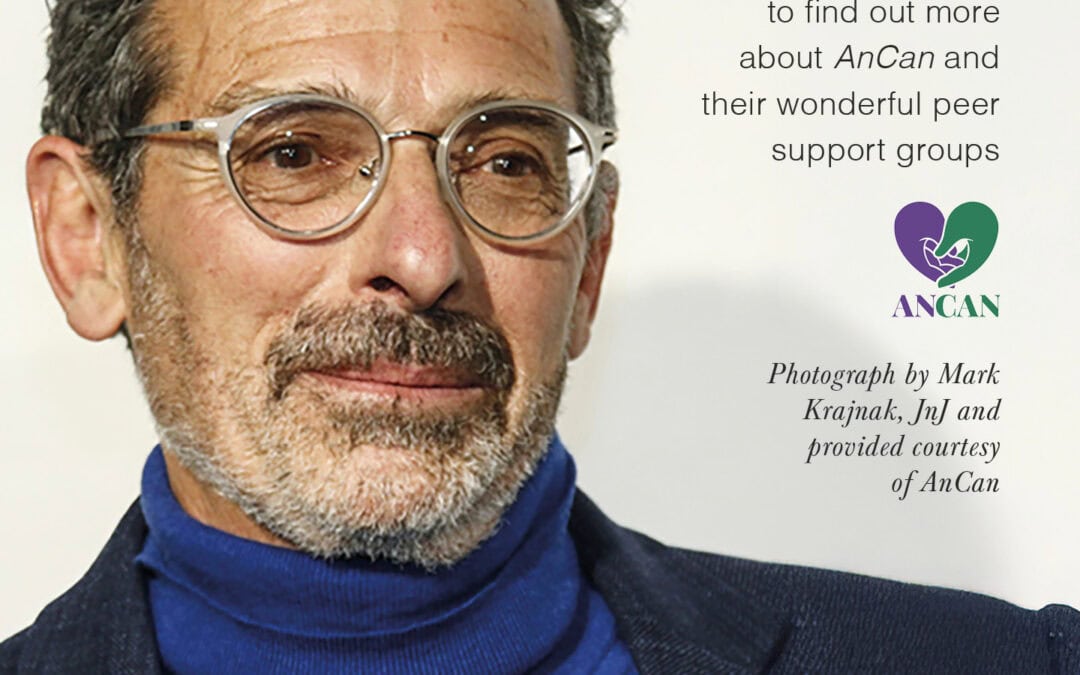
AnCan’s ambitious CEO and Founder, Rick Davis, recently sat down with Rarity Life, the magazine published by Same But Different Creative, to share the deeply personal journey that led to the creation of AnCan.
In the interview, Rick reflects on his early days navigating a prostate cancer diagnosis — a moment that reshaped his life & his understanding of what true support should look like. Like so many survivors and thrivers, he quickly discovered that information alone isn’t enough. What people often need most is connection — the chance to speak openly with others who truly understand the lived experience of cancer.
That realization became the foundation of AnCan.
Rick shares how traditional support models don’t always meet people where they are. Geographic limitations, physical health challenges, financial strain, rare diagnoses, and even the emotional weight of walking into an in-person group can all create barriers. For many, simply showing up can feel overwhelming.
AnCan was built to remove as many of those barriers as possible.
Rick’s full interview in Rarity Life offers an inspiring look at leadership shaped by lived experience, and a reminder that meaningful change often begins with one person asking: How can we do this better?
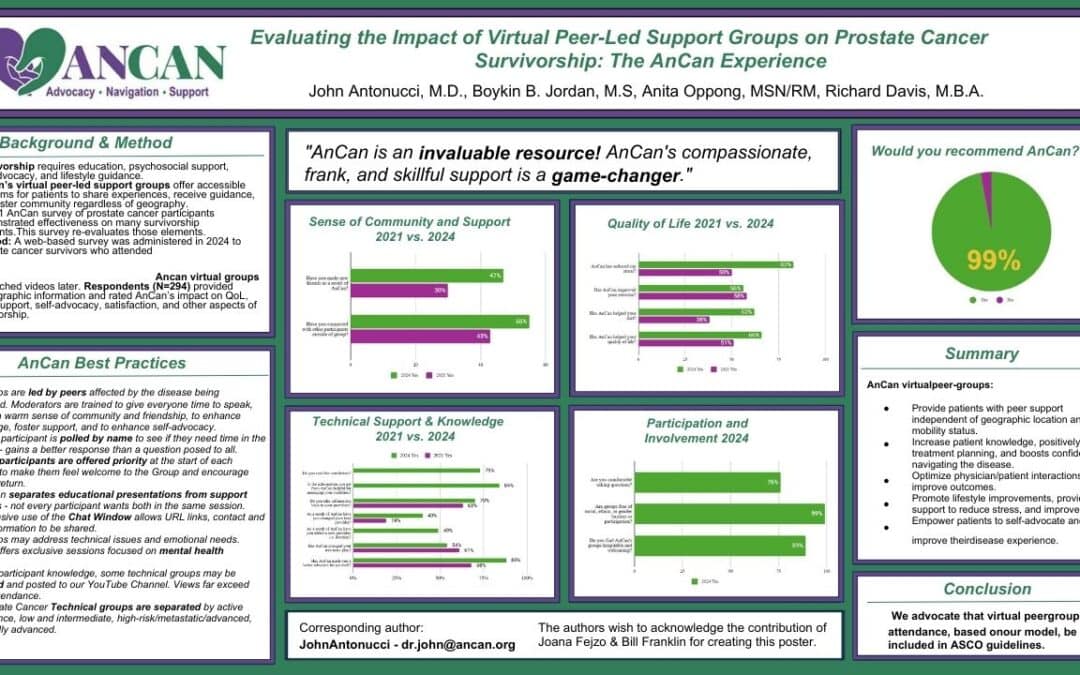
AnCan GU ASCO26 survivorship poster: participants strongly endorse our Groups
For release on Monday, Feb 23, 2026
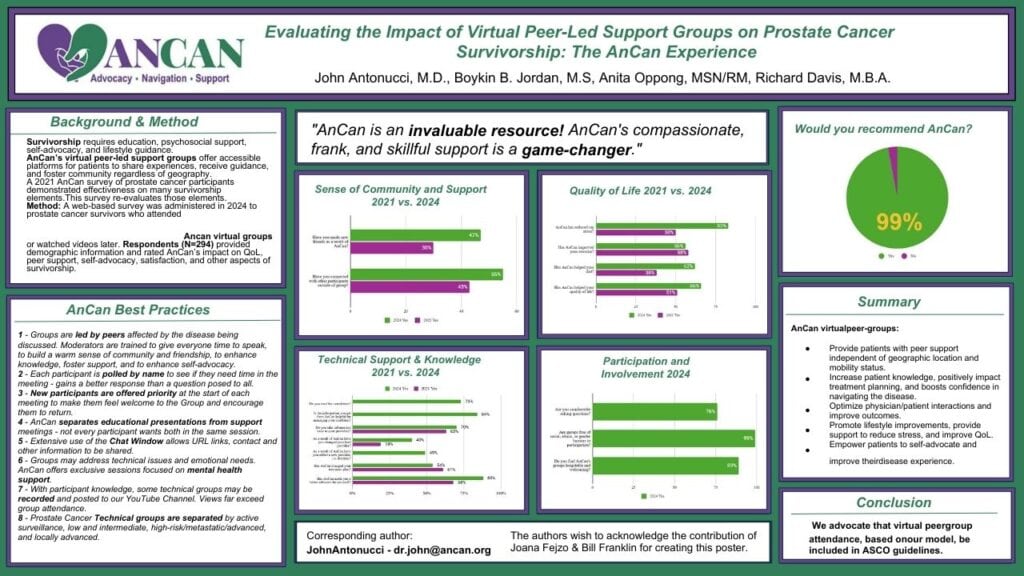
AnCan Foundation strongly believes we run the best support groups available!! We can now release the first results of our 2024 AnCan Participant Survey that confirms that our participants think so too. This first batch of results is taken from almost 300 prostate cancer responses at all levels of disease.
99% of respondents would recommend AnCan Groups
66% improved Quality of Life – 83% noted reduced stress; 62% improved nutrition; 56% increased exercise
88% advocated better for themselves and AnCan influenced over half (54%) the treatment paths
47% made new friendships – AnCan’s personal favorite since this extends support well beyond our Groups
If you’re attending GU ASCO26 , please stop by our poster on Friday, Feb 27 to meet Dr. John Antonucci, discuss these astonishing results and the AnCan method, and pick up a flyer of the poster.
Evaluating the impact of virtual peer-led support groups on prostate cancer survivorship: the AnCan experience.
John Antonucci*, Boykin B. Jordan, Anita Oppong, Richard Davis
Abstract Number: 265
Poster Board Number: A23
Session Title: Poster Session B: Prostate Cancer and Urothelial Carcinoma
Date and Time: February 27, 2026, 11:30 AM-12:45 PM; 4:45 PM-5:45 PM (PST)
Background: Comprehensive prostate cancer (PCa) survivorship requires more than just clinical care, including education, psychosocial support, self-advocacy, and lifestyle guidance—needs often unmet by traditional oncology visits. Virtual peer-led support groups, such as those offered by the AnCan Foundation, offer accessible, real-time platforms for patients to share experiences, receive guidance, and foster community, regardless of geography. This study evaluates the impact of AnCan participation on factors known to be associated with a better quality of life (QOL) among PCa survivors.
Methods: A web-based survey was administered in 2024 to PCa survivors who attended or expressed interest in AnCan meetings. Respondents (N=294) provided demographic information and rated AnCan’s impact on QOL, peer support, self-advocacy, and satisfaction. Data were analyzed to assess the subjective influence of AnCan’s virtual support model on survivorship.
Results: (2021 results are in brackets for comparison.) Most respondents were in their 60s–70s (75%), highly educated (82%), and 55% had incomes over $100,000. Eighty-three percent had someone in their lives they could rely on and with whom they maintained regular contact.
Nearly all (97%) found AnCan meetings helpful for disease understanding, learning options, and well-being. Sixty-six percent reported improved QOL; 83% [50%] noted reduced stress; 62% [38%] improved nutrition; and 56% [58%] increased exercise. Satisfaction was high, with 99% recommending AnCan.
AnCan involvement enhanced self-advocacy (88%), improved patient-provider communication, and improved decision-making. Seventy percent brought information from AnCan to their providers, 49% added new providers, and 40% changed their lead provider. Over half (54%) reported that AnCan influenced their treatment path.
Socially, 55% [43%] connected with peers outside meetings, and 47% made new friendships.
Conclusions: Survey responses indicate that the AnCan virtual peer-led model, to be described in the poster, meaningfully increases patient knowledge, empowers self-advocacy, reduces stress, and fosters healthy behaviors, improving quality of life for PCa survivors. We advocate for integrating such peer support into NCCN, AUA, and ASCO survivorship guidelines.
(Here is my take on this article Therapeutic Use of Cannabis and Cannabinoids A Review JAMA Network, 11/26/25. On a personal side, I use CBD to help me sleep, and with a little (5%) addition of THC, it is a great anxiety calmer – Sally Torgeson, AnCan Blood Cancer Moderator & Multiple Myeloma Coach)
Unapproved Cannabis
The FDA has NOT approved the cannabis plant (botanical marijuana) for any medical use or indication.
Because it is classified as a Schedule I controlled substance under federal law, the FDA has not found it to be safe or effective for the treatment of any disease or condition [1.1, 1.7].
It is currently illegal to market CBD by adding it to food or labeling it as a dietary supplement in interstate commerce [2.1, 2.5].
FDA-Approved Cannabinoid Drugs
The FDA has approved a small number of prescription drugs containing either a purified cannabis-derived compound or synthetic cannabinoids:
Epidiolex (Cannabidiol or CBD): The only FDA-approved drug that contains a purified substance derived directly from the cannabis plant. It is approved to treat seizures associated with Lennox-Gastaut syndrome, Dravet syndrome, and Tuberous Sclerosis Complex in patients one year of age and older [1.8, 2.1].
Marinol and Syndros (Dronabinol): Contain synthetic Δ9-tetrahydrocannabinol (THC). Approved for:
Nausea and vomiting associated with cancer chemotherapy in patients who have not responded to conventional antiemetic treatments [2.2, 2.3].
Anorexia associated with weight loss in patients with HIV/AIDS [2.3].
Cesamet (Nabilone): Contains a synthetic substance that is chemically similar to THC. Approved for chemotherapy-induced nausea and vomiting [1.1, 2.3].
Regulatory Context
The FDA maintains its authority to regulate products containing cannabis or cannabis-derived compounds, even those derived from hemp (cannabis with less than 0.3% THC), under the Federal Food, Drug, and Cosmetic (FD&C) Act [1.4].
The FDA supports the development of new drugs through proper clinical trials to ensure they meet standards for safety and effectiveness [1.1, 2.4].
FDA-Approved Cannabinoid Drugs and Their Conditions
* Nausea and vomiting caused by cancer chemotherapy (when other antiemetics have failed) * Anorexia (loss of appetite) associated with weight loss in patients with HIV/AIDS
Cesamet (Nabilone)
Synthetic cannabinoid (similar to THC)
* Nausea and vomiting caused by cancer chemotherapy (when other antiemetics have failed)
Key Takeaway
Epidiolex is the only drug approved that contains a substance derived directly from the Cannabis plant (CBD). It represents the strongest evidence for cannabinoid efficacy in reducing seizure frequency in certain rare forms of epilepsy [1.1, 1.2].
The synthetic THC compounds (Dronabinol and Nabilone) are used primarily as a last resort for severe nausea/vomiting related to chemotherapy and for appetite stimulation in AIDS patients [1.2, 2.8].
The FDA has not approved the use of the whole cannabis plant for any medical condition, stressing the importance of standardized, tested pharmaceuticals for patient safety and proven effectiveness [1.7].1
Off-Label Use vs. Unapproved Use
1. Off-Label Use (Legal and Regulated)
This applies only to drugs that the FDA has already approved.
What it is: Using an FDA-approved drug (like Epidiolex, Marinol, or Cesamet) for a condition, dose, or patient population that is not specifically listed on the drug’s official label.
Legality: It is legal for a licensed physician to prescribe an approved drug for an off-label use if they believe it is medically appropriate for their patient.
FDA Position: The FDA does not regulate the practice of medicine; however, the manufacturer cannot market or promote the drug for the off-label use. The safety and efficacy for the off-label use have not been verified by the FDA’s rigorous testing process.
Example: A doctor prescribing Marinol (Dronabinol), which is approved for nausea from chemotherapy, to a patient for chronic pain. The drug is approved, but the condition (chronic pain) is not on the label.
2. Unapproved Use (Non-FDA Approved Products)
This applies to the cannabis plant itself and most CBD/cannabinoid products on the market.
What it is: Using the whole cannabis plant (botanical marijuana) or non-FDA-approved cannabis-derived products (like most CBD oils, edibles, or topicals) for any medical purpose.
Legality:
Federal: The whole plant is a Schedule I controlled substance and is not federally approved for any medical use.
State: Use may be legal under state medical or recreational cannabis laws, but this does not change its status as an unapproved drug under federal FDA law.
FDA Position: The FDA considers these products unapproved drugs and/or illegally marketed products (especially when CBD is added to food or marketed as a dietary supplement), as they have not been tested for safety, effectiveness, or quality assurance.
Example: A patient using a CBD tincture (which is not Epidiolex) to treat anxiety, or using THC flower to help with multiple sclerosis symptoms.
To correspond with Sally, please send an email to info@ancan.org, and we’ll be sure to send along.
Should I Tell My Employer About My Cancer Diagnosis?
A recent article from Collaborative Cancer Care provides a view on the pros and cons of this complex question. Deciding whether to tell your employer about a cancer diagnosis is personal and depends on your situation. Sharing can bring benefits like workplace accommodations, flexibility, and support. However, it may also raise concerns about privacy, stigma, or job security.





 Off-Label Use vs. Unapproved Use