(first published on AnCanSpeak substack; subscribe for free)
Less than 50% of Patients trust their Providers. Now that’s a handpicked statistic from a survey conducted during Covid and published in JAMA Network in 2024. Healthcare professionals amongst our readers may have grounds to push back. That said, AnCan’s frequent experience from virtual conversations in our daily groups corroborates that anecdotally perhaps half our participants doubt the medical advice received. Our own 2024 survey backs that up. From our GU ASCO 2026 abstract4:
Seventy percent brought information from AnCan to their providers, 49% added new providers, and 40% changed their lead provider. Over half (54%) reported AnCan influenced their treatment path.
That doesn’t bode well for a trusting Patient-Provider relationship!
“Medicine is characterized by an inherent asymmetry of information and power between physicians and patients.” And goes on to say: “Demonstrating trustworthiness and restoring trust… requires reconsidering the balance of power between patients and health care professionals.”
This brings to mind a cartoon AnCan has employed in presentations:
Both JAMA pieces agree that our system is broken. They recite a fact that AnCan has previously noted… on average Providers interrupt Patients after a median of 11 seconds. In front of Providers, Patients can’t even begin to collect our thoughts, never mind express them.
The article troops out a whole bunch of remedies. Starting with teaching HCPs how to listen, it moves to improving health systems so you actually see your doc – not a surrogate practitioner, encouraging longer patient visits – so Providers have time to listen, and address mis- and disinformation. On a more grandiose scale, the article points out that differences in wealth, insurance status and education also influence Patient-Provider trust levels.
The closest either article comes to balancing the scales between Patient and Provider is to say:
Empowering patients through patient education and skill building, increased transparency in care, and shared clinical decision-making would also increase the collaboration in physician-patient relationships. Mutual partnerships between patients and their physicians may foster more stable patient trust instead of requiring patients to take a more tenuous leap of faith.
Noble words, but who is to take on this Sisyphean task?
AnCan likes to think we lead the way. Name one other organization whose mission is to make you your own best advocate. Already this week we fielded one call from a longtime legal Volunteer whose trust in an inestimable Medical Institution was violated because the Provider they spoke to committed the inexcusable and cardinal sin of simply failing to read the file. Or another Participant, a Medical Provider himself, who needed advice because an Institution was knowingly yet improperly billing him.
Being your own best advocate may not fully restore trust in our health system, but it goes a long way to leveling the playing field. It certainly improves patients’ self-esteem and in doing so, makes us feel immeasurably better.
rick davis rd@ancan.org
References
Perlis RH, Ognyanova K, Uslu A, et al. Trust in physicians and hospitals during the COVID-19 pandemic in a 50-state survey of US adults. JAMA Netw Open. 2024;7(7):e2424984. doi:10.1001/jamanetworkopen.2024.24984
Even little me speaks to a lot of people, some of whom have Prostate Cancer. And advanced Prostate Cancer and many of them are not acting as their own best advocate. It’s very important that people learn to take control and own and deal with their disease.
Maybe it’s a little long winded and boring, but it took me a year or 2, into my stage, 4, Prostate Cancer. Before I really took control and had one of those aggressive and idiot doctors who told me” i am a ph d in oncology, and you are a beginning student, ” and he tried to dictate to me everything, including his team of radiological, oncology, and his drugs and his procedures, and I watched a number of his patients who I know personally, because I worked with them die without doing all the things they could. Anyway, after a year two I was seeing consulting with good doctors and dana farber and at sloan, and I switched from advisors to sloan and very happy with my oncologist now…. It is very important for people to come to visit. Taking ownership and managing as their own number one, advocate. Okay, I’ll stop boring you because my doorbell is ringing. Thank you bye!”
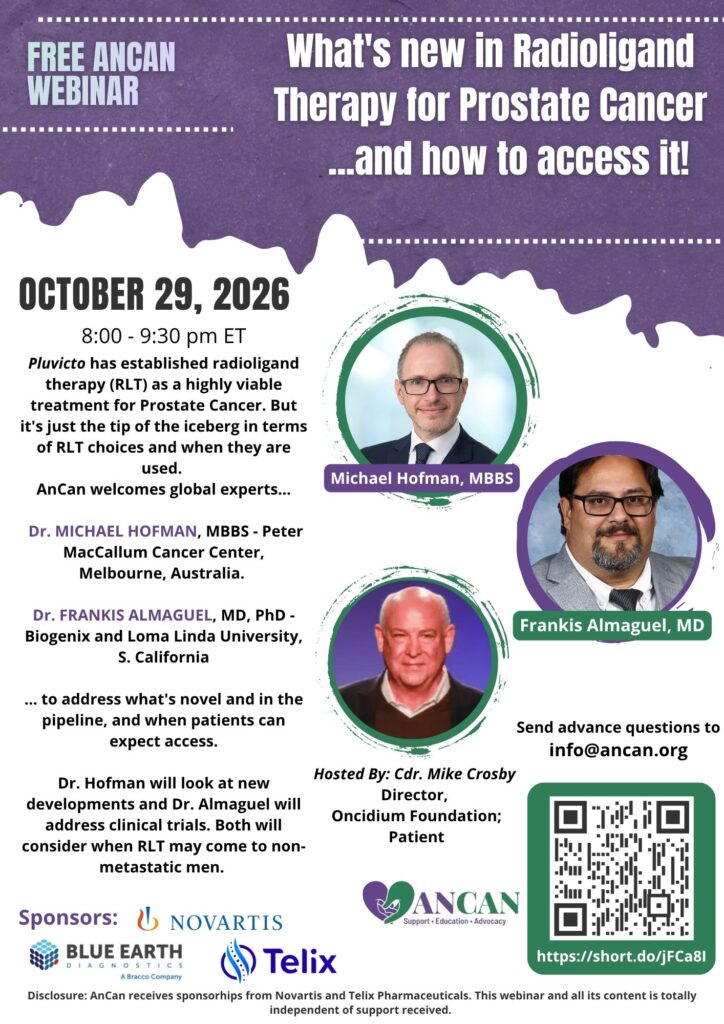
Webinar: New Developments in Prostate Cancer Radioligand Therapies and How to Access Them!
Pluvicto has established radioligand therapy (RLT) as a highly viable treatment for Prostate Cancer. But it’s just the tip of the iceberg when it comes to RLT options and when to use them.
Welcome experts Dr. Michael Hofman and Dr. Frankis Almaguel to address what’s novel and when patients can expect access. Dr. Hofman will cover new developments, and Dr. Almaguel will discuss clinical trials. Both will consider when RLT may come to non-metastatic men. This event was hosted by Cdr. Mike Crosby, Director of the Oncidium Foundation.
Click here for Dr. Michael Hofman’s presentation slides.
AnCan thanks the following sponsors for making this recording possible: Novartis, Telix and Blue Earth Diagnostics.
Views expressed in this Recording are solely the opinion of AnCan Foundation, our Moderators and Participants.
AnCan does not accept sponsored promotion. Any drugs, protocols or devices discussed are based solely on anecdotal peer experience or clinical evidence.
AnCan cannot and does not provide medical advice. We encourage you to discuss anything you hear in our sessions with your own medical team.
AnCan reminds all Participants that Adverse Events experienced from prescribed drugs or protocols should be reported to the pharmaceutical manufacturer or the FDA Adverse Event Reporting System (FAERS). To do so call 1-800-332-1066 or download interactive FDA Form 3500 https://www.fda.gov/media/76299/download
All AnCan’s groups are free and drop-in … join us in person sometime! You can find out more about our 12 monthly prostate cancer meetings at https://ancan.org/prostate-cancer/ Sign up to receive a weekly Reminder/Newsletter for this Group or others at https://ancan.org/contact-us/
Join our other free and drop in groups:
Men (Only) Speaking Freely…1st & 3rd Thursdays @ 8.00 pm Eastern https://ancan.org/men-speaking-freely/
Veterans Healthcare Navigation… 1st & 3rd Tuesdays @ 8.00 pm Eastern Schmier Room https://ancan.org/veterans/
Veterans Speaking freely… 4th Tuesday @ @ 8.00 pm Eastern Schmier Room
Editor’s Pick: Does the PROTEUS trial (RRP + doublet) set a good example?
Topics Discussed
Does surgery with doublet (PROTEUS trial) make sense for 72 yr old; Dana Farber visit raises questions about ‘diffuse’ cells and PSMA tracer agents; sensitive PSA test needed post surgery; VA approves daro but too early for Truqap; hormone resistance post triplet raises RLT vs chemo vs ???; Cu67 SAR-bisPSMA alternative to Pluvicto; switch to local GU PSMA for ease of treatment; small peritoneal lesions double in size to 4mm over 5 years – treat or not?; drug holiday success – PSA declines and T rises 🎉
Chat
Carl – Indiana sent: 6:12 PM
Tin Caps are welcome
Len Sierra sent: 6:40 PM
I’m at my son’s house in Maryland using his computer. Not sure what’s going on. I’ll just listen
Active Surveillance Prostate Cancer Video Chat, October 28th, 2026
AnCan is grateful to the following sponsors for making this recording possible: Novartis, Blue Earth Diagnostics, Telix, and Foundation Medicine.
Active Surveillance (AS) for low-risk prostate cancer involves unique challenges compared to other treatments. This online support group is designed for men and their caregivers who are currently on or considering AS. We hold four meetings monthly, recording only the second and fourth sessions. Our discussions cover a wide range of topics, including anxiety management, biopsy experiences, and the decision-making process around continuing or discontinuing AS. Newcomers are given priority to share their experiences, so we encourage you to join us.
You can find out more about our 12 monthly prostate cancer meetings at https://ancan.org/prostate-cancer/. Sign up to receive a weekly Reminder/Newsletter for this Group or others at https://ancan.org/contact-us/.
Hi-Risk/Recurrent/Advanced PrCa Video Chat, Oct. 27, 2026
AnCan WEBINAR Thu. Oct, 29 @ 8pm Eastern -” What’s new in radioligand therapy… and how to access it” w. Drs. Mike Hofman and Frankis Almaguel. Register https://short.do/jFCa8I
AnCan thanks the following sponsors for making this recording possible: Novartis, Telix and Blue Earth Diagnostics.
Views expressed in this Recording are solely the opinion of AnCan Foundation, our Moderators and Participants.
AnCan does not accept sponsored promotion. Any drugs, protocols or devices discussed are based solely on anecdotal peer experience or clinical evidence.
AnCan cannot and does not provide medical advice. We encourage you to discuss anything you hear in our sessions with your own medical team.
AnCan reminds all Participants that Adverse Events experienced from prescribed drugs or protocols should be reported to the pharmaceutical manufacturer or the FDA Adverse Event Reporting System (FAERS). To do so call 1-800-332-1066 or download interactive FDA Form 3500 https://www.fda.gov/media/76299/download
All AnCan’s groups are free and drop-in … join us in person sometime! You can find out more about our 12 monthly prostate cancer meetings at https://ancan.org/prostate-cancer/ Sign up to receive a weekly Reminder/Newsletter for this Group or others at https://ancan.org/contact-us/
Join our other free and drop in groups:
Men (Only) Speaking Freely…1st & 3rd Thursdays @ 8.00 pm Eastern https://ancan.org/men-speaking-freely/
Veterans Healthcare Navigation… 1st & 3rd Tuesdays @ 8.00 pm Eastern Schmier Room https://ancan.org/veterans/
Veterans Speaking freely… 4th Tuesday @ @ 8.00 pm Eastern Schmier Room
Editor’s Pick: Should minor presence of neuroendocrine cancer from lymph biopsy be a concern? And of course Dr. Paul on NCCN’s E2 approval
Topics Discussed
Inherited mutation makes RRP follow up protocol less clear; what comes after success with triplet but what comes next?; GG5 Newbie does 24 months doublet and wants to know likelihood of recurrence; Ki67 indicates slight presence of neuroendocrine cancer – implications; creatine helps with muscles and fatigue; leg lymphedema bothersome; is E2 available with salvage RT; how quickly does T return with E2; talking NCCN E2 approval with Dr. Paul; can E2 replace Prolia?; over-intensification may have caused heart issues; addressing hot flashes; maintaining exercise in the face of doublet HT; octogenarian does well post triplet and drug holiday; with 2+ bad boy mutations, who’s the best GU med onc to QB care?
Thank you for your help and input. I need to go, but look forward to connecting in the future.
Brian Haack – Eagle, ID sent: 4:28 PM
How long after drug holiday (9 months ADT doublet tx) should I wait until getting blood work? I’m on my 2nd recurrence btw. Don’t want to interrupt the great dialogue
Jim Marshall, Vet Sup Grp. Moderator sent: 4:32 PM
I get blood work every month now for 9+ years, the last 4+ years on Holiday. Kaiser permits it. Hopefully getting PSA test during the holiday to know when it starts to rise.
George Kander sent: 4:32 PM
thanks guys i have to go. see you next week
Len Sierra sent: 4:45 PM
Just a counter opinion: Clinical trials in patients with colorectal or prostate cancer found that creatine supplements generally failed to improve muscle mass, physical function, or quality of life during treatment.
Sam Kaufman (Oakland CA) sent: 4:47 PM
Sorry I cant stay until Im called. My questions can wait two weeks.
Jim Ekrut, Fort Worth TX sent: 5:03 PM
Thanks for another helpful and informational session!
Brian Haack – Eagle, ID sent: 5:05 PM
Gotta bounce… great discussion
TonyFig sent: 5:07 PM
Great meeting. See you next week
Frank D sent: 5:18 PM
Thanks for great meeting. Very helpful!
Bob Schwartz, USN, Venice, FL. sent: 5:19 PM
Another good mtg., have to go.
“Thomas” Matica sent: 5:21 PM
Great meeting. Dinner is on the table. Next time. Peace.
Erectile Dysfunction After Prostate Cancer Treatment: What Men Should Know
Sexual side effects don’t always get the attention they deserve when men face prostate cancer treatment decisions. At AnCan, we believe men should be as fully informed as possible about these potential consequences and their impact on quality of life. We hope this information encourages men to have these important conversations with their treatment teams before making decisions. – Stuart Jordan
Erectile Dysfunction After Prostate Cancer Treatment: What Men Should Know
Dr. John Mulhall, a leading specialist in male sexual medicine at Memorial Sloan Kettering, warns that men often begin prostate cancer treatment without fully understanding its potential effects on erections, sexual desire, orgasm, and intimacy. His central message: Protecting sexual function should begin before treatment, not after problems develop.
Surgery vs. Radiation: Different Timelines
Even with nerve-sparing surgery, erectile dysfunction frequently occurs immediately. Recovery can take 18–24 months, depending on pretreatment erectile function, the extent of nerve preservation, and surgeon experience.
After radiation, erections may initially remain intact but deteriorate during the second and third years due to progressive blood vessel damage caused by the radiation. Mulhall observes that by approximately three years, erectile dysfunction rates following nerve-sparing surgery and radiation without hormone therapy may become roughly comparable.
The Added Impact of Hormone Therapy
Androgen deprivation therapy (ADT) suppresses testosterone, potentially reducing sexual desire, impairing erections and orgasms, and contributing to deterioration of erectile tissue.
Testosterone may take months or years to recover after ADT ends, and some men never regain their previous levels. Mulhall urges patients to understand ADT’s expected cancer-control benefit and whether a shorter course might be appropriate.
Why Early Rehabilitation Matters
Mulhall warns that prolonged periods without erections may cause irreversible changes in penile tissue, including fibrosis.
His rehabilitation approach aims to maintain regular erections while nerves recover, using medications such as tadalafil (Cialis) or sildenafil (Viagra), or penile injections when pills fail. However, evidence that these approaches restore long-term spontaneous erectile function remains limited.
Other Important Considerations
Recovery depends partly on age, pretreatment erectile function, and conditions such as diabetes, cardiovascular disease, sleep apnea, and low testosterone.
Sexual function involves more than erections. Orgasm may remain possible despite ED, although its intensity or sensation may change. Performance anxiety can complicate recovery, while alternative forms of intimacy can help sustain relationships. Penile implants are an option when other ED treatments fail.
What Men Should Do Before Treatment
Mulhall strongly recommends that men concerned about preserving sexual function consult a sexual medicine specialist before beginning prostate cancer treatment, rather than waiting until problems develop.
Questions to Ask Before Treatment
Given my health and current erectile function, what can I expect at one, two, and three years?
With surgery, how much nerve sparing is possible, and what are my surgeon’s outcomes?
With radiation, what is my risk of delayed ED?
With ADT, what’s the added cancer-control benefit, and how long could side effects persist?
What rehabilitation and sexual medicine support is available?
How might treatment affect sexual desire, orgasm, ejaculation, penile length, and intimacy?
The essential takeaway: Men should understand their potential sexual side effects and have a plan to preserve sexual function before choosing prostate cancer treatment—not afterward.
Source: This article summarizes an interview between Dr. Geo Espinosa and Dr. John Mulhall on the Dr. Geo Prostate Podcast. Listen to the full episode at https://dr-geo-prostate-podcast.captivate.fm/. Our thanks to Low/Intermediate PrCa Moderator, Stuart Jordan for writing this up stuart@ancan.org
AnCan thanks the following sponsors for making this recording possible: Novartis, Telix and Blue Earth Diagnostics.
Views expressed in this Recording are solely the opinion of AnCan Foundation, our Moderators and Participants.
AnCan does not accept sponsored promotion. Any drugs, protocols or devices discussed are based solely on anecdotal peer experience or clinical evidence.
AnCan cannot and does not provide medical advice. We encourage you to discuss anything you hear in our sessions with your own medical team.
AnCan reminds all Participants that Adverse Events experienced from prescribed drugs or protocols should be reported to the pharmaceutical manufacturer or the FDA Adverse Event Reporting System (FAERS). To do so call 1-800-332-1066 or download interactive FDA Form 3500 https://www.fda.gov/media/76299/download
All AnCan’s groups are free and drop-in … join us in person sometime! You can find out more about our 12 monthly prostate cancer meetings at https://ancan.org/prostate-cancer/ Sign up to receive a weekly Reminder/Newsletter for this Group or others at https://ancan.org/contact-us/
Join our other free and drop in groups:
Men (Only) Speaking Freely…1st & 3rd Thursdays @ 8.00 pm Eastern https://ancan.org/men-speaking-freely/
Veterans Healthcare Navigation… 1st & 3rd Tuesdays @ 8.00 pm Eastern Schmier Room https://ancan.org/veterans/
Veterans Speaking freely… 4th Tuesday @ @ 8.00 pm Eastern Schmier Room
Editor’s Pick: E2 doublet discussion – closely followed by integrating psilocybin into HT doublet!
Topics Discussed
Newbie diagnosed 4 years back with PSA @ 4000 & BRCA+ might consider a different doublet -or PARP; Newbie responds but has 4 consecutive negative PSMA scans – consider Axumin; could E2 doublet be an option?; PTEN just indicated; 2 negative Bx confirm our hunch Gent is Mx ; can experienced user integrate psilocybin into his HT to treat depression; monotherapy daro works exceptionally well – but must make decision on ‘Long Game’ trial; how long to stay on mono daro?; 1st Pluvicto rings PSA down a little – what to expect next?; Dr. Guancial uses fewer tests making Gent anxious – T/W her!
I want to ask Dr A if I can do the psilocybin therapy again while receiving radiation
Bob Schwartz, USN, Venice, FL. sent: 6:33 PM
Danny, we’re all here for you brother.
Gary Martin sent: 6:42 PM
RT can impact bone marrow–lowering blood counts and possibly increasing fatigue. This happened to me–lowering blood counts further to below-normal–on top of impact of triplet prior to RT.
Read that ice packs have been shown to limit the effects of Pluvicto on salivary glands–study in Europe. Don’t have a reference to study yet.
Hank Zajic Springfield VA sent: 7:10 PM
Good night all. Thank you for the discussion. out of battery here. Hank
PCWG is the Prostate Cancer Working Group, an association of experts who meet to discuss and advise on Prostate Cancer research.
PCGW4, their recommendations for 2026, are not merely new terms for old concepts. There are fundamental changes in how to describe prostate cancer. These are meant mostly for research communication – at least until they percolate into the clinical world, which has started to happen.
PCGW4 emphasizes describing prostate cancer according to its measurable characteristics rather than relying only on broad disease labels, by calling for reports to clarify metastatic status, specify imaging methods used, provide the testosterone levels, describe symptoms and prior treatments, provide genetic features when relevant, and be very specific when describing the manifestation of progression.
Here are some of the PCGW4 recommendations:
Nonmetastatic cancer should be qualified according to the imaging used to establish the absence of metastases. A patient may have no metastases on conventional CT and bone scanning but have lesions detected by PSMA PET. Reports should therefore identify the imaging modality and, for PET, the tracer used. (Ed: addressing an old gripe heard often at AnCan).
Bone scan progression should use prostate cancer-specific confirmatory criteria designed to account for flare
PSMA PET findings and other next-generation imaging should identify the modality, tracer, and interpretation criteria and should not automatically be combined with conventional imaging endpoints.
PSA decline on treatment response of at least 50 percent (PSA50) is a commonly reported outcome and ordinarily requires confirmation, but it should not be equated with objective radiographic response or assumed to be a surrogate for survival
Treatment history should be clear and complete: identify the drugs received, disease setting, duration, response, and reason for discontinuation. Simple therapy labels may be inadequate when patients receive combinations or continue one component while changing another.
Let’s touch on some other PCGW4 recommendations and clarifications before getting to terminology below:
Patient-reported outcomes, such as symptoms, pain, physical functioning, quality of life, treatment burden, and toxicity, should be incorporated alongside survival and imaging outcomes. That’s our voices they are talking about.
Oligometastatic and oligoprogressive disease should be similarly pre-defined. PCWG4 recognizes this state, but stresses the need for standard definitions (e.g., number and location of metastases, imaging modality), the number and location of lesions, timing of disease, and imaging modality.
Composite endpoints, which we often see in research, should be prespecified, clinically justified, and reported together with their individual components. It encourages combining PSA, radiographic, and symptomatic progression.
Polyprogression: Term introduced for situations where progression occurs in multiple metastatic sites simultaneously.
Imaging Terminology has been clarified:
Conventional Imaging (CI): Refers specifically to bone scan and CT/MRI.
Next-Generation Imaging (NGI): Refers to PET-based and other novel modalities.
Imaging-Detected Progression: Requires specification of modality (CI or NGI) to avoid confusion.
PCWG4 uses “APM”to mean androgen pathway modulator, an umbrella term for treatments that inhibit androgen production or androgen receptor signaling. This means the “ides” and abiraterone, which we might have called ARPI or ARSI.
APM naïve (APMn) means the patient has never received an APM.
APM exposed means the patient previously received an APM. This term does not by itself indicate whether the cancer responded or progressed.
APM sensitive (APMs) means the cancer demonstrates clinical benefit or disease control during APM treatment. The specific response criteria and treatment setting should be stated.
APM resistant (APMr) means the cancer progresses during APM treatment despite continued castrate testosterone levels. Resistance should be linked to the particular drug and disease setting rather than assumed to apply equally to every APM.
Here are some closely related terms you’ll see
Primary APM resistance means progression from the beginning of APM treatment.
Acquired APM resistance means the cancer initially benefits from an APM but later progresses.
APM rechallenge means using an APM again after previously discontinued, ordinarily after intervening treatment or a meaningful treatment free interval.
The APM category generally does not refer to the foundational medical Androgen Deprivation Therapy including Estradiol/E2 (ADT), nor surgical castration used to maintain low testosterone.
Because PCWG terminology is intended for precise research reporting, authors should name the individual drug, disease state, prior exposure, response, and reason for discontinuation rather than relying on an APM label alone. Terms such as APM resistant should not be interpreted as proving resistance to every drug in the class.
Old vs New
mHSPC is now mAPMs or mAPMn.
nmHSPC is now nmAPMs or nmAPMn – per stated imaging technique
mCRPC is now mAPMr
nmCRPC is nmAPMr. – per stated imaging technique
‘n’ or ‘nm’ should be clarified by which imaging made the call, so while AnCan doesn’t much care for ‘nm’ we now know what produced that designation.
APMr should explain the testosterone level.
Progression explains the criteria used:
Clinical Progression: Now separated from biochemical (PSA) and radiographic progression. Clinical progression emphasizes symptom development or worsening.
PSA Progression: Now standardized for use with next-generation imaging and early relapse scenarios.
Radiographic Progression: Criteria refined for both bone and soft tissue lesions, especially with the adoption of next-generation imaging (NGI).
PSA, radiographic, symptomatic, and other forms of progression should be documented specifically. PSA progression should follow prespecified criteria and does not by itself necessarily require discontinuation of an otherwise beneficial treatment.
Remember, this is all designed to standardize language used ONLY to describe prostate cancer clinical trials. So what does that have to do with the patient, and why should our Gents be concerned about wrapping your head around these terms? Rick tells us why…
Thanks, Dr. John – what a new mouthful, but in the long run the new language will make us all more comfortable. Ironically, part of the unacknowledged rationale for the new terminology is very patient-centric. Doctors and patients alike wince over the use of one word – ‘castrate’. Whether physically, literally, or metaphorically, most everyone in the prostate cancer world resents its use – and understandably. Think about it – we don’t even employ that word when it comes to our animals, never mind adult men. Personally, I always try to substitute ‘hormone’ for ‘castrate’ – it makes me feel better.
When the language was first suggested at GU ASCO t this past February, Dr. John wrote up an explanation at my request. However, other Moderators and our Brains Trust vetoed us. They felt that the language was intended for clinical trials and that it would only confuse our AnCan’rs. Now that the FDA’s PSMAddition has incorporated the new terminology into its approval, we’ve made an executive decision to place this new medical speak on your radar.
The PSMAddition trial led to a new and potentially game-changing FDA Approval at the end of July for the use of radioligand therapy, Lutetium-177 vipivotide tetraxetan. That’s an even bigger mouthful, so we’ll call it Pluvicto. You recall the big news when Pluvicto was made available pre-chemo in March of 2025. BUT you still had to have metastatic castration-resistant prostate cancer (mCRPC). There’s that nasty word again.
This July’s approval was for (ready…) metastatic Androgen Pathway Modulation Sensitive/Naive (mAPMS/N) men. It’s taken a while, especially for those of you with a touch of ADHD, but now you see where we’ve been going.
As we said, the new language is forcing its way into our everyday prostate cancer lexicon. And what’s the bottom line? If you are early in disease progression, just found out you are metastatic, and are on an ARPI, you are eligible for Pluvicto, a systemic, non-chemo alternative. As far as we can tell from the FDA approval, it appears to cover monotherapy ARPI, but that remains to be seen in practice.
To refer to our chat with Novartis, you can understand now why it asked us about the new terminology and the PSMAddition approval. The video referenced is fairly short and worth a watch. It’s designed for HCPs, but we’re betting you’ll be able to follow along quite easily. Watch it HERE.
Active Surveillance Prostate Cancer Video Chat, October 14th, 2026
AnCan is grateful to the following sponsors for making this recording possible: Novartis, Blue Earth Diagnostics, Telix, and Foundation Medicine.
Active Surveillance (AS) for low-risk prostate cancer involves unique challenges compared to other treatments. This online support group is designed for men and their caregivers who are currently on or considering AS. We hold four meetings monthly, recording only the second and fourth sessions. Our discussions cover a wide range of topics, including anxiety management, biopsy experiences, and the decision-making process around continuing or discontinuing AS. Newcomers are given priority to share their experiences, so we encourage you to join us.
You can find out more about our 12 monthly prostate cancer meetings at https://ancan.org/prostate-cancer/. Sign up to receive a weekly Reminder/Newsletter for this Group or others at https://ancan.org/contact-us/.
Chat Log:
Hugh Houston 8:12 PM
https://ancan.org/prostate-cancer-and-gu-pathology-2nd-opinions/ • Jonathan Epstein, MD, Advanced Uro Pathology T: 516-760-2037 (jepstein@imppllc.com) https://advanceduropathology.com • Ming Zhou, MD, PHD, Mount Sinai (NYC) Health T: 516-760-2037 Ming.zhou@mountsinai.org • Jesse McKenney, MD, Cleveland Clinic https://clevelandcliniclabs.com/healthcare-provider-resources/pathology/ • Johns Hopkins Pathology https://pathology.jhu.edu/patient-care/second-opinions
Phil Segal 8:13 PM
mskaeley@gmail.com
Phil Segal 8:15 PM
dmclachlan@gmail.com
Ed C in California 8:18 PM
My charge from Dr Jonathan Epstein was $900 without an insurance payment
AnCan thanks the following sponsors for making this recording possible: Novartis, Telix and Blue Earth Diagnostics.
Views expressed in this Recording are solely the opinion of AnCan Foundation, our Moderators and Participants.
AnCan does not accept sponsored promotion. Any drugs, protocols or devices discussed are based solely on anecdotal peer experience or clinical evidence.
AnCan cannot and does not provide medical advice. We encourage you to discuss anything you hear in our sessions with your own medical team.
AnCan reminds all Participants that Adverse Events experienced from prescribed drugs or protocols should be reported to the pharmaceutical manufacturer or the FDA Adverse Event Reporting System (FAERS). To do so call 1-800-332-1066 or download interactive FDA Form 3500 https://www.fda.gov/media/76299/download
All AnCan’s groups are free and drop-in … join us in person sometime! You can find out more about our 12 monthly prostate cancer meetings at https://ancan.org/prostate-cancer/ Sign up to receive a weekly Reminder/Newsletter for this Group or others at https://ancan.org/contact-us/
Join our other free and drop in groups:
Men (Only) Speaking Freely…1st & 3rd Thursdays @ 8.00 pm Eastern https://ancan.org/men-speaking-freely/
Veterans Healthcare Navigation… 1st & 3rd Tuesdays @ 8.00 pm Eastern Schmier Room https://ancan.org/veterans/
Veterans Speaking freely… 4th Tuesday @ @ 8.00 pm Eastern Schmier Room
Editor’s Pick: Do you get PSMA PET after doublet then how often?; and, how to say Guancial!
Topics Discussed
Younger Newbie graduates to our Group post RRP; treated after 20 yrs of AS.. but in the wrong group; finding the best trial for Frank; Bx cannot confirm PrCa; spot RT may be the ticket; all sable during IHT; RT to commence this month; what’s in Dr. Guancial’s name?; PSMA scans pos doublet are negative; when and how often to PSM scan; GU MO denies Pluvicto post triplet though scans light up; Gent decides to start TRT; brief discussion of HLD-0915
Chat
Bob Schwartz, USN, Venice, FL. sent: 3:17 PM
I can agree as to the hospital sling I received last time, for my other shoulder surgery. Which was why I was glad to hear your recommendation of a better one, prior to my upcoming surgery. Wish I didn’t need the surgery, but old age & past injuries, are catching up with me.
Steve L…. Hold tight and we’ll have the mugs available in our shop before long. You can order and take care of biz.
Alfredo in Wimberley, TX sent: 4:31 PM
Family calling – I must drop off now. Best wishes to all!
Steve Schuler (Seattle) sent: 4:31 PM
I wondered why I hadn’t heard anything… Answer: beurocrac
(can’t spell it though… :^(
Len Sierra sent: 4:36 PM
JAMA Oncol. 2019, 5, 856-863. In the first prospective trial of 68Ga-PSMA-11 PET/CT for BRPC, which included 635 patients, detection rates were 38% for PSA levels of < 1.0 ng/mL (n = 79), 84% for 1.0 to 2.0 (n=89), 86% for 2.0 to 5.0 (n=158), and 94% for >5.0. (BRPC = Bio-Recurrent PC)
Steve Schuler (Seattle) sent: 4:41 PM
a meta-observation is that most therapies that are initially only for end stage move earlier in treatment where their use there improves things. improves at least in the CSS sense, not necessarily in the OS sense
Len Sierrasent: 4:46 PM
New Terminology: • Androgen Pathway Modulator Sensitive: Tumors that continue to respond to or are controlled by androgen pathway suppression/blockade. • Androgen Pathway Modulator Resistant: Tumors that progress despite treatment targeting the androgen pathway
Steve – Seattle sent: 4:49 PM
My Calendar has the Ancan Seattle dinner scheduled for Sunday but I don’t have any details.
rick davis sent: 4:51 PM
Stand by as I said.
Steve Schuler (Seattle) sent: 4:53 PM
I’ve got to drop, but I will “stand by” to hear about Sunday. I will be at the conference Saturday, probably at Fred Hutch which I assume must be a video screen but in the FH building… That way I get a free sandwich I think :^)
RJ Smith (Seattle) sent: 4:54 PM
Same here–see you there Steve!
rick davis sent: 4:54 PM
: NCT06800313 HLD0915
George Kander
sent: 4:56 PM
Family calls – have to go. Thanks everyone and hopefully see you at dinner Friday in Portland – Chhers