Hi-Risk/Recurrent/Advanced PrCa Video Chat, Sep 1, 2026
Are you in DelMarVa?? Reserve Wednesday night, Sep 16 for an AnCan get-together. We’ll meet for a ‘dutch’ dinner in the Chevy Chase area – location TBD. If you have not received an email invitation and would like to attend, please drop a note to boykin@ancan.org. Partners/spouses welcome!
Substack is coming to AnCan… or maybe AnCan is coming to Substack. We’ll be posting the best of all our Reminders. Watch our for more details.
COMING IN SEPTEMBER… AnCan Heart Group – new support group for all things cardio and open to all! To sign up for Reminder at https://ancan.org/contact-us/. For ProsCard mailing list, please write to dr.john@ancan.org.
AnCan thanks the following sponsors for making this recording possible: Novartis, Blue Earth Diagnostics and Foundation Medicine.
Views expressed in this Recording are solely the opinion of AnCan Foundation, our Moderators and Participants.
AnCan does not accept sponsored promotion. Any drugs, protocols or devices discussed are based solely on anecdotal peer experience or clinical evidence.
AnCan cannot and does not provide medical advice. We encourage you to discuss anything you hear in our sessions with your own medical team.
AnCan reminds all Participants that Adverse Events experienced from prescribed drugs or protocols should be reported to the pharmaceutical manufacturer or the FDA Adverse Event Reporting System (FAERS). To do so call 1-800-332-1066 or download interactive FDA Form 3500 https://www.fda.gov/media/76299/download
All AnCan’s groups are free and drop-in … join us in person sometime! You can find out more about our 12 monthly prostate cancer meetings at https://ancan.org/prostate-cancer/ Sign up to receive a weekly Reminder/Newsletter for this Group or others at https://ancan.org/contact-us/
Join our other free and drop in groups:
Men (Only) Speaking Freely…1st & 3rd Thursdays @ 8.00 pm Eastern https://ancan.org/men-speaking-freely/
Veterans Healthcare Navigation… 1st & 3rd Tuesdays @ 8.00 pm Eastern Schmier Room https://ancan.org/veterans/
Veterans Speaking freely… 4th Tuesday @ @ 8.00 pm Eastern Schmier Room
Editor’s Pick: 1) when your pituitary goes dormant 2) is debulking the primary right?
Topics Discussed
Stable disease but treatment leads to one atrophied kidney; is a GU med onc needed at this juncture?; pituitary never recovered post prednisone/abi – what next?; pros and cons of RT debulking for higher volume denovo Mx Gents; Tony Fig’s shoulder surgery; RT cystitis causes hospitalization and deferral of clinical trial; is Testosterone replacement appropriate?; heart issues defer advocating for a PSMA update
Chat
Pierre D., Olean NY sent: 3:11 PM
$50 \hr
Alfredo in Wimberley, TXsent: 3:55 PM
gadolinium
jeff wood sent: 4:04 PM
What are the repercussions of debulking?
RJ Smith (Seattle) sent: 4:07 PM
Standard side-effects and long-term risks of side-effects from the radiation.
Len Sierra sent: 4:20 PM
The Bardo Thodol – Tibetan Book of the Dead — kudos to Dr. John!
Hi-Risk/Recurrent/Advanced PrCa Video Chat, Aug 25, 2026
Substack is coming to AnCan… or maybe AnCan is coming to Substack. We’ll be posting the best of all our Reminders. Watch our for more details.
COMING IN SEPTEMBER… AnCan Heart Group – new support group for all things cardio and open to all! To sign up for Reminder at https://ancan.org/contact-us/. For ProsCard mailing list, please write to rd@ancan.org.
AnCan thanks the following sponsors for making this recording possible: Novartis, Blue Earth Diagnostics and Foundation Medicine.
Views expressed in this Recording are solely the opinion of AnCan Foundation, our Moderators and Participants.
AnCan does not accept sponsored promotion. Any drugs, protocols or devices discussed are based solely on anecdotal peer experience or clinical evidence.
AnCan cannot and does not provide medical advice. We encourage you to discuss anything you hear in our sessions with your own medical team.
AnCan reminds all Participants that Adverse Events experienced from prescribed drugs or protocols should be reported to the pharmaceutical manufacturer or the FDA Adverse Event Reporting System (FAERS). To do so call 1-800-332-1066 or download interactive FDA Form 3500 https://www.fda.gov/media/76299/download
All AnCan’s groups are free and drop-in … join us in person sometime! You can find out more about our 12 monthly prostate cancer meetings at https://ancan.org/prostate-cancer/ Sign up to receive a weekly Reminder/Newsletter for this Group or others at https://ancan.org/contact-us/
Join our other free and drop in groups:
Men (Only) Speaking Freely…1st & 3rd Thursdays @ 8.00 pm Eastern https://ancan.org/men-speaking-freely/
Veterans Healthcare Navigation… 1st & 3rd Tuesdays @ 8.00 pm Eastern Schmier Room https://ancan.org/veterans/
Veterans Speaking freely… 4th Tuesday @ @ 8.00 pm Eastern Schmier Room
Editor’s Pick: We burst his bubble that advanced prostate cancer can be cured! 😕
Topics Discussed
Newbie #1 skirts triplet but discuss debulking; Newbie #2 encouraged to rethink surgery decision; PSA falls from HT and RT right ahead; whaddya mean, there’s no cure!?!; RT ‘torture’ (really???) vs ADT for life; GUMO will consider E2; weird disease needs a 2nd opinion; Orgovyx not worth $700 for this Gent; walking helps restore muscle loss; Orgovyx produces different hot flashes; changing ARSI before Pluvicto may rock the boat; personal evaporative cooler demo
Chat
AnCan Barniskis – rick sent: 3:10 PM
Dr. John is at a medical appointment, and Len is on his way home.
AnCan Barniskis – rick sent: 3:28 PM
Orgovyx
AnCan Barniskis – rick sent: 3:35 PM
in that case, we won’t add you to the heart group unless you wish?
Here is a more recent reference https://mydoctor.kaiserpermanente.org/mas/news/a-new-era-in-prostate-cancer-surgery-retzius-sparing-technique-delivers-life-changing-results-2941449
Jim Marshall, Vet Sup Grp. Moderator sent: 4:07 PM
Did 5 years of ADT + Abiraterone and tolerated it quite well. jim
Alfredo in Wimberley, TX sent: 4:09 PM
What did the recent JAMA Oncology ProtecT study show? A 2025 secondary analysis looked at 15-year outcomes in men with localized prostate cancer and compared those with cribriform-positive disease to those with cribriform-negative disease. I The findings were important: Among men with cribriform-positive prostate cancer, the 15-year risk of metastasis was 25% with active monitoring, 26% with surgery, and 8% with radiotherapy plus short-term hormone therapy. Among men with cribriform-negative disease, the metastasis rates were much lower: 7% with active monitoring, 4% with surgery, and 3% with radiotherapy. Overall, cribriform-positive disease was linked to a significantly higher risk of metastasis, while outcomes for cribriform-negative disease were favorable across treatment groups.
Bill Lawler sent: 4:45 PM
Dr. Atish Choudury, Dana Farber
Bill Lawler sent: 4:49 PM
What time?
Jeff Marchi – San Francisco sent: 4:49 PM
3pm pacific
Robert sent: 4:53 PM
My update is not critical I can wait til next week.
Stay in shape with FIT Together in your own living room!
Mark and Kathy Baldridge are avid birders, and as a result, frequent visitors to “Deep Southern Arizona” from their home in University Place, Washington. You may have seen them in an AnCan Group – we’ve been supporting the Baldridges since 2021.
Recently Mark mentioned an at home exercise program in a group, so we encouraged him to tell us more so all AnCan’rs living with cancer could participate… with or without their care partner.
This October 17th, AnCan will participate in the OHSU-Fred Hutch Prostate Cancer Summit. Dr. Kerri Winters is also speaking, and Dr. E (Eleni Efstathiou), the new Chief of Genitourinary Cancer at OHSU, has already set up a time for us to meet. We’ll be writing about the Summit closer to the date. (rick davis)
Back in high school, I did multiple pushups before I went to bed. Fast-forward 50 years and I was unable to do a single pushup. Over the years, I’d fooled myself into thinking I was in ‘decent shape’ because I took long walks several times a week. The truth was that after being diagnosed with osteoporosis, 24 months of Hormone Therapy and a lack of upper body exercise, my overall strength had significantly declined.
Fortunately, I discovered an online exercise program FIT Together for cancer survivors and their partners. FIT Together is a 501(c)(3) nonprofit organization founded in 2014 under the leadership of Dr. Kerri Winters-Stone and Jessica Sitemba. Dr. Winters-Stone has a PhD in Human Performance and has been conducting research in exercise oncology for 20 years. She has run over 15 clinical trials funded by NIH and cancer non-profits. I have participated in two of Dr. Winters-Stone’s clinical trials run through Oregon Health Sciences University – OHSU.
I’ve attended FIT Together classes for a year and can attest that the instructors are excellent. They demonstrate each exercise and then give tips to ensure each participant correctly performs the exercise. The instructors individualize and tailor movements and exercises to accommodate each person’s needs—no matter what the person’s fitness level. For instance, pushups can be performed in many different ways (e.g. against a wall/desk/chair or on hands and knees/feet).
The classes are held twice per week at various times virtually. I love the convenience of performing these exercises at home and look forward to each class. All you need for the classes are dumbbells, a resistance band, stretch strap and an exercise mat. The cost for this equipment is quite reasonable—less than $75.
There are several classes to choose from: strength training, strength/cardio and an exercise class for couples. Classes are very reasonably priced— around $5 per session for a 12 week/24 session class… even less if two of you join together.
I participate in the strength training class and physically feel much better about myself. It’s been really encouraging to see that I’ve slowly gained upper body strength. While I still can’t do a pushup on my hands and toes, I can perform 12 pushups on my hands and knees—I’m on my way to performing a full pushup.
I highly recommend these classes and hope to see some of you in a class—you won’t be disappointed!
Keeping cool in the heat of Summer… and tackling hot flashes year round
We hear it time and time again – keeping cool is not easy.
Many people across our communities complain about how much the heat impacts their ability to function at all – whether it’s from outside heat or internal flashes.
I can talk about this one pretty confidently myself, as I’ve been living with MS for 9 years now (wow!). It’s a known heat and cold -intolerant disease that causes temporary symptom flares known as Uhthoff’s Phenomenon. But I’m not the only one. Heat impacts many of us frequently – especially MS’rs and men on hormone therapy.
It’s a consistent and persistent problem for so many of us, so I’d like to dedicate this blog post to the hot, sweaty, brain-fogged, but brilliant AnCan community.
Below you’ll find some recommendations for wearable cooling products and other resources that we hope will ease your summer; not to mention your Quality of Life all year round.
The first part is a list of specific products that are tried and tested by either myself or someone in one of our community groups – with many of them coming from one of our lead moderators, Kim Stroeh. Thank you, Kim! Other suggestions come from AnCan Gents wrestling with hot flashes in the prostate cancer world, like Barry Blomquist and Bob Alvord… thank you!
Second is a list of products that we’ve heard about, but so far we don’t know of anyone who’s tried them; also products that maybe we have tried and tested, but don’t really have a specific link for.
Third is small list of tips and resources. I’m going to keep this part relatively small because it will probably need a completely separate blog post. Since Kim and I both have a chronic illness (MS) that makes us much more susceptible to the heat, a lot of our resources come from organizations that deal with it specifically. I’ve included those orgs that may be helpful no matter what our community may be living with.
Pro Tip:
Did you know that some insurance companies may cover the cost of a cooling product? That’s because it’s considered a DME (durable medical equipment). It may be tedious, but call them up and ask.
We don’t get any financial benefit from these products; these are just some things that our community members have recommended because they actually work for them. Hopefully they work for you too!
I’ll be including a lot of links from Amazon because it’s simply easier to see a wider range of products and brands in one spot. I know Amazon may not be everyone’s favorite shopping platform, so feel free to use these ideas as a springboard to your preferred shopping platform or store.
Have a product to add or a link to a product listed below? Email me at Hannah@ancan.org
1. Tried and True
Specific products that are tried and tested by someone in one of our community groups
I just got one at the start of the summer and I absolutely love it!! I wonder why I didn’t get one sooner. Keeps me cool under the blanket when I move around. When I’m still, it keeps me warm. – Hannah
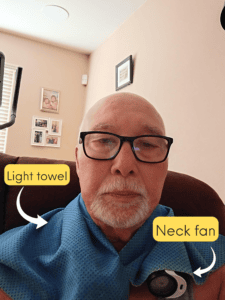
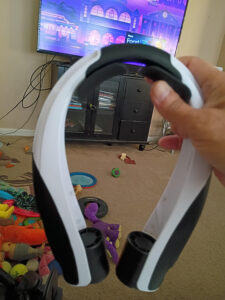
Recommended by Bob Alvord (High Risk Prostate Cancer). See section 3 below for his favorite way to use this rechargeable neck fan when combined with a wet cooling towel!
“If indoors with extended cooling packs will stay cool for 2-3 hours or longer. Outside, it depends on how hot it is. I think the melting temperature is 72 degrees vs 32 degrees of water. Can become solid again at room temperature if the ambient temperature is cool enough.”
“Don’t waste your money on slim packs, buy the extended packs and by an extra set so you can switch out in between (you can buy in bundle and save money). The one reason I like this cooling vest is that its cooling packs are only on your back so it weighs around 2 lb versus a prior cooling vest that had them both on the front and the back and weighed 8 lb that was very bulky and made me feel like a bulky football player. For me, heavy weight can make my fatigue worse/drain me faster and that is one of the reasons I did not like the heavier one. I wear this when I need it (now if I am outside for any length of time in summer or attempting to do yard work) and have to wear it when I train with my personal trainer twice weekly at the gym. It is not really noticeable visually wearing under a t-shirt unless it is body hugging, it has a relatively low profile.” – Kim
“It looks like they changed the design since I bought it so you are using the smaller individual packs versus 4 larger packs. Remember, smaller compartments will melt faster and not last as long. Cooling vests are nice because you stay dry. Store in freezer/fridge so always ready to go.” -Kim
2. Products to Try
A list of products that we’ve heard about, but so far we don’t know of anyone who’s tried them; also products that maybe we have tried and tested, but don’t really have a specific link for.
Please use the search method or store of your choice. You can copy/paste from here to get more targeted results
Folding Hand Fan – the manual kind
“Carrying a portable foldable hand fan can go a long way. Incredibly grateful I bought mine into Target field. Lightweight, cheap, takes up little space and easy to transport.” – Kim
Portable Rechargeable Handheld Fan
I never use it because – it needs to be charged, bulkier and heavier than the foldable fan. – Kim
Portable Rechargeable Neck Fan
Click the link here for Bob Alvord’s top choice. Then, scroll down to section 3 to see his genius way of using it.
“I am not a fan of the neck fans because they tend to be loud (so harder to hear) and don’t give enough breeze for me to be very effective. May be effective for others that are not as extreme as me.” – Kim
I have one that I use on occasion. It’s a cheap one. I like it well enough to bring with me on the rare summer hike, but not enough to recommend a specific one. It’s a little bulky and makes my neck sweaty where it hangs on my neck. Can also be a little bit loud, but I don’t usually mind. – Hannah
Cooling wrist wraps
Cooling Bra inserts
Cooling Hats
With a built-in fan
Water activated
Or just the gel inserts
Cooling headband/ wraps – can also search for cooling migraine relief
Cooling Scarves / towels
Cooling Eye Masks – Great for migraines too
Cooling Vests – see above for specific products
Cooling Pad for Car
Gel seat pads
Electric car seat covers
Cooling Pad for Seat– This set of search terms brings up a lot of the same links as above
Cooling pillowcases – side note- this will be my next purchase after the success of the cooling blanket I recently purchased! – Hannah
Cooling pillows
Cooling mattress
Cooling mattress topper
Cooling blanket
Bamboo sheets and bamboo pajamas
“If have issues being overheated while sleeping, I highly recommend getting both bamboo sheets and pajamas. They not only keep you cooler but will help wick away the moisture so you don’t feel drenched when you wake up.” – Kim
REON POCKET PRO Plus
Not yet on the market, but Barry Blomquist (Prostate Cancer community) mentioned it. Sensors actively adjust to temperature shifts maintaining your personalized comfort, while dual thermo-modules deliver efficient on-the-go cooling and warming.
You’ll find tips + even more links to cooling products they recommend (including cooling bra inserts, eco- friendly products, cooling hats & wrist wraps, & others). Some even come with discount codes!
Advice for sleeping at night. Lots of mention of products that I’ve listed above
Tips for Sleep
“The ceiling fan is your friend. I have also learned I need to turn the air down to 70 degrees from 72 degrees when I sleep because it is still too hot where my body touches the mattress.” – Kim
I use a slim floor fan, but have it set up on top of a nightstand at the foot of my bed. I also turn the AC down to 71F at night. I also make it a habit to use lotion on my feet and legs right before I get into bed. It has a soothing, cooling effect that keeps the heat away for a while – especially with the fan blowing directly on me. – Hannah
Tips & Habits to Sprinkle Throughout Your Day
“Drinking heavily iced water/beverages or frozen food can go a long ways. Most metal water bottles the ice will last most of the day.” – Kim
“I use floor fans when I am hanging outside on the highest setting. Helps keep bugs away too. Need outlet/extension cord available to access electricity. Can be kinda loud.” – Kim
Kim’s Ice Crown
“A new thing I tried 3 weeks ago because using the cooling vest, heavy iced drinking water, and a spray bottle/fan that I keep in the fridge and add ice cubes before I left the house was not enough to keep my cool enough while training for 30min (I told you it was extreme!) I take bandana, open it up, line up ice cubes to two opposite diagonal corners (10-12 ice cubes for me from my ice maker), roll it up and tie around my head or neck. Will last about 30 -45 min wearing indoors. You will be wet from it and dripping with water and your t-shirt will get wet but that is okay for me during the summer. Store in ziplock bag when traveling with it and make ahead of time and store in freezer. I have it my thermapparel cooler when transporting so it doesn’t melt until I put it on. I call it my ice crown. Leave some space at the ends so you can tie it around your head or neck. Also rewetting bandana with icy water if hiking, etc helps after ice cubes melt. Cheap if you have ice maker but you will get wet from the chest up and doesn’t last as long as a cooling vest.”
Bob Alvord’s (High-Risk Prostate Cancer community) neck fan- towel combo
Bob Alvord with his cooling towel and rechargeable neck fan combo
“… I use a well hydrated cooling towel, large one and a wearable neck fan to alleviate hot flashes. You wear the fan around your neck and then place the cooling towel over the fan. This system greatly lowers the towel temperature. My measurement of the towel with the fan is around 65 degrees, using a thermometer. Placing the towel against your corotid, with a 65 degree temperature source is enough to lower exposure to heat. ”
Have a product, tip or URL to recommend? Email me at Hannah@ancan.org
Hi-Risk/Recurrent/Advanced PrCa Video Chat, July 28, 2026
AnCan thanks the following sponsors for making this recording possible: Novartis, Blue Earth Diagnostics and Foundation Medicine.
Views expressed in this Recording are solely the opinion of AnCan Foundation, our Moderators and Participants.
AnCan does not accept sponsored promotion. Any drugs, protocols or devices discussed are based solely on anecdotal peer experience or clinical evidence.
AnCan cannot and does not provide medical advice. We encourage you to discuss anything you hear in our sessions with your own medical team.
AnCan reminds all Participants that Adverse Events experienced from prescribed drugs or protocols should be reported to the pharmaceutical manufacturer or the FDA Adverse Event Reporting System (FAERS). To do so call 1-800-332-1066 or download interactive FDA Form 3500 https://www.fda.gov/media/76299/download
All AnCan’s groups are free and drop-in … join us in person sometime! You can find out more about our 12 monthly prostate cancer meetings at https://ancan.org/prostate-cancer/ Sign up to receive a weekly Reminder/Newsletter for this Group or others at https://ancan.org/contact-us/
Join our other free and drop in groups:
Men (Only) Speaking Freely…1st & 3rd Thursdays @ 8.00 pm Eastern https://ancan.org/men-speaking-freely/
Veterans Healthcare Navigation… 1st & 3rd Tuesdays @ 8.00 pm Eastern Schmier Room https://ancan.org/veterans/
Veterans Speaking freely… 4th Tuesday @ @ 8.00 pm Eastern Schmier Room
Editor’s Pick: Dr. Paul allowed PSA to rise to 160, and then kept 3x Pluvicto back that he now plans to use!
Topics Discussed
Newbie has local care that is not up to SoC; “Oldie” needs to replace Dr. E; how frequently and which scans when monitoring during drug holiday; successful AUS installation; Gent is successfully post RT/HT but when will T. return?; v. high cholesterol calls for statins – don’t fuss about fatigue side effects; mirabegron has few side effects for our user; clinical trial delay is a stressor; PSMA scan has great results… but cardio issues are for another group; remaining Pluvicto sessions preferred to SBRT; PSA got to 160 on drug vacation; E2 discussion featuring Dr. Paul coming soon – see Reminder;
Chat
AnCan – rick sent: 3:08 PM
The E2 Session with Dr. Paul is on Thu Aug 20. My apologies for the error.
Bob Schwartz, USN, Venice, FL. sent: 3:09 PM
No apologies necessary. Nice to see that your Human.
Jim Marshall, Vet Sup Grp. Moderator sent: 3:28 PM
Dr Channing Paller, Sibley Hospital, Johns Hopkins. Wash DC
Federal Blue Cross Insurance is top notch.
Morgan Brooke sent: 3:30 PM
Can Rick speak more about what is wrong with the 6-month Eligard shot?
I believe the Predinsone is to assist with controlling blood pressure
Jeff Marchi – San Francisco sent: 3:32 PM
the prednisone is to restore cortisol which zytiga stops production of without cortisol you have severe fatigue
Wes – San Diego sent: 3:33 PM
PSMA could have a false positive for the shoulder, but that might depend where the other sites are.
Jeff Marchi – San Francisco sent: 3:34 PM
rick does not feel the 6 month shot lasts the full 6 months (Ed: ‘may not’)
I had a 6 month shot for 6 years, had testosterone tests every month had it stayed undetectable the whole 6 months results may vary
Wes – San Diego sent: 3:38 PM
I was on federal BC/BS, and was on Orgovyx.
Bob Faulkner sent: 3:38 PM
I am a new member also Bob Faulkner
AnCan – rick sent: 3:41 PM
Bob – we can’t assure new men of time unless here in the first 5 minutes. Either we may be able to take you at the end, or we can definitely do an intake next week.
Wes – San Diego sent: 3:53 PM
Orgovyx and other ADT have potential cardio side effects, lengthened ST being one. I chose Orgovyx because I had cardio issues, and Orgovyx had fewer issues than Firmagon. Ironically, PSA did not drop sufficiently, so after about 6 weeks, I switched to Firmagon.
Rick S sent: 3:54 PM
I have a lot to learn!
Pierre D., Olean, NY sent: 3:56 PM
Another advantage of Orgovyx over the injectables is if you do develop side effects from Orgovyx you can stop it and it’l clear out of your system within weeks not months.
Wes – San Diego sent: 3:57 PM
V true; Firmagon has 1/2 life of 53 days.
Jeff Marchi – San Francisco sent: 4:03 PM
Orgovyx half life is 25 hours
AnCan – ricksent: 4:11 PM
Artificial Urinary Sphincter AUS
Morgan Brooke sent: 4:14 PM
Thank you all for your time. I need to run. I’ll to join more often.
From PCa commentary – After 3 – 9 months of ADT nearly all men fully recover by about 10 months; – After 18 – 24 months of ADT only 60% fully recover by about 3 years; and – After 36 months of ADT exposure only 50% fully recover by ~ 5 year
Wes – San Diego sent: 4:31 PM
Thanks Jeff, that conforms to my experience after 8 months on Orgovyx and Firmagon. After about 60 days being off, I felt substantially better (feel more like myself, peripheral vision is better, libido slowly coming back)
Repatha has far fewer side effects than statins. Repatha is remarkably expensive.
Alfredo in Sacramento sent: 4:33 PM
yes, my wife had bad reaction to Repatha but does fine on Praluent
Wes – San Diego sent: 4:35 PM
I had a bit of not having land legs on Repatha; not bad, but dropped LDL from 100+ to 30.
Steve Roux, Up North, Michigan sent: 4:41 PM
I need to run. As usual – GREAT meeting gang! See all of you next week.
Alfredo in Sacramento sent: 4:41 PM
my wife had total cholesterol of 309 mg/dl 5 years ago (did not tolerate any of several different statins); 180 mg/dl 2 weeks ago on Praluent . we believe she has Familial (inherited) hypercholesterolemia
Jeff Marchi – San Francisco sent: 4:46 PM
I have low cholesterol and my doctor put me on a statin and it crippled me. added at least 10 years to my life while on it. Friends asked my wife if I had much more time.


 Mark and Kathy Baldridge are avid birders, and as a result, frequent visitors to “Deep Southern Arizona” from their home in University Place, Washington. You may have seen them in an AnCan Group – we’ve been supporting the Baldridges since 2021.
 We hear it time and time again – keeping cool is not easy.