by Hannah Garrison | Jul 30, 2026 | Advocacy, AYA, Cancer Resources, Complementary Medicine, Health Resources
Keeping cool in the heat of Summer… and tackling hot flashes year round
 We hear it time and time again – keeping cool is not easy.
Many people across our communities complain about how much the heat impacts their ability to function at all – whether it’s from outside heat or internal flashes.
I can talk about this one pretty confidently myself, as I’ve been living with MS for 9 years now (wow!). It’s a known heat and cold -intolerant disease that causes temporary symptom flares known as Uhthoff’s Phenomenon. But I’m not the only one. Heat impacts many of us frequently – especially MS’rs and men on hormone therapy.
It’s a consistent and persistent problem for so many of us, so I’d like to dedicate this blog post to the hot, sweaty, brain-fogged, but brilliant AnCan community.
Below you’ll find some recommendations for wearable cooling products and other resources that we hope will ease your summer; not to mention your Quality of Life all year round.
The first part is a list of specific products that are tried and tested by either myself or someone in one of our community groups – with many of them coming from one of our lead moderators, Kim Stroeh. Thank you, Kim! Other suggestions come from AnCan Gents wrestling with hot flashes in the prostate cancer world, like Barry Blomquist and Bob Alvord… thank you!
Second is a list of products that we’ve heard about, but so far we don’t know of anyone who’s tried them; also products that maybe we have tried and tested, but don’t really have a specific link for.
Third is small list of tips and resources. I’m going to keep this part relatively small because it will probably need a completely separate blog post. Since Kim and I both have a chronic illness (MS) that makes us much more susceptible to the heat, a lot of our resources come from organizations that deal with it specifically. I’ve included those orgs that may be helpful no matter what our community may be living with.
Pro Tip:
Did you know that some insurance companies may cover the cost of a cooling product? That’s because it’s considered a DME (durable medical equipment). It may be tedious, but call them up and ask.
We don’t get any financial benefit from these products; these are just some things that our community members have recommended because they actually work for them. Hopefully they work for you too!
I’ll be including a lot of links from Amazon because it’s simply easier to see a wider range of products and brands in one spot. I know Amazon may not be everyone’s favorite shopping platform, so feel free to use these ideas as a springboard to your preferred shopping platform or store.
Have a product to add or a link to a product listed below? Email me at Hannah@ancan.org
1. Tried and True
Specific products that are tried and tested by someone in one of our community groups
Cooling Blanket
https://a.co/d/0hJIdVa7
- I just got one at the start of the summer and I absolutely love it!! I wonder why I didn’t get one sooner. Keeps me cool under the blanket when I move around. When I’m still, it keeps me warm. – Hannah
Portable Rechargeable Neck Fan
https://www.lowes.com/pd/Ropilly-Neck-Fan-Rechargeable-Wearable-Fan-6-Speed-Hands-Free-Portable-Personal-Fan-USB-C-for-Travel-Office-Outdoor/6363936
- Recommended by Bob Alvord (High Risk Prostate Cancer). See section 3 below for his favorite way to use this rechargeable neck fan when combined with a wet cooling towel!
MIDIAN Air Conditioning Vests
https://a.co/d/048mVjgA
- An air conditioning vest. Recommendation from Barry Blomquist of our High Risk Prostate Cancer group.
Embr Wave 2
https://embrlabs.com/products/embr-wave-2
Cooling Products
- these are products that use some kind of gel or other substance sewn into an insert that you tuck into a larger item, such as a vest, hat, etc.
A note from Kim:
“If indoors with extended cooling packs will stay cool for 2-3 hours or longer. Outside, it depends on how hot it is. I think the melting temperature is 72 degrees vs 32 degrees of water. Can become solid again at room temperature if the ambient temperature is cool enough.”
Thermapparel Undercool 3 cooling vest
https://www.thermapparel.com/products/undercool-3?srsltid=AfmBOoqL5mu0GVd1NXc-Sinc_ysIvf0HOF1_I4_493kDiAJNuGncwSGW
- “Don’t waste your money on slim packs, buy the extended packs and by an extra set so you can switch out in between (you can buy in bundle and save money). The one reason I like this cooling vest is that its cooling packs are only on your back so it weighs around 2 lb versus a prior cooling vest that had them both on the front and the back and weighed 8 lb that was very bulky and made me feel like a bulky football player. For me, heavy weight can make my fatigue worse/drain me faster and that is one of the reasons I did not like the heavier one. I wear this when I need it (now if I am outside for any length of time in summer or attempting to do yard work) and have to wear it when I train with my personal trainer twice weekly at the gym. It is not really noticeable visually wearing under a t-shirt unless it is body hugging, it has a relatively low profile.” – Kim
Other Thermapparel Products
https://www.thermapparel.com/collections/all
- “I feel the grab and go packs are worthless (at least from my needs). But my needs are extreme. :-D” – Kim
Adjustable Zipper Cooling Vest with (5-12) 4.5″ x 6″ Kool Max® Packs
https://www.polarproducts.com/polarshop/pc/viewPrd.asp?idproduct=32&idcategory=508
- “It looks like they changed the design since I bought it so you are using the smaller individual packs versus 4 larger packs. Remember, smaller compartments will melt faster and not last as long. Cooling vests are nice because you stay dry. Store in freezer/fridge so always ready to go.” -Kim
2. Products to Try
A list of products that we’ve heard about, but so far we don’t know of anyone who’s tried them; also products that maybe we have tried and tested, but don’t really have a specific link for.
Please use the search method or store of your choice. You can copy/paste from here to get more targeted results
Folding Hand Fan – the manual kind
- “Carrying a portable foldable hand fan can go a long way. Incredibly grateful I bought mine into Target field. Lightweight, cheap, takes up little space and easy to transport.” – Kim
Portable Rechargeable Handheld Fan
- I never use it because – it needs to be charged, bulkier and heavier than the foldable fan. – Kim
Portable Rechargeable Neck Fan
Click the link here for Bob Alvord’s top choice. Then, scroll down to section 3 to see his genius way of using it.
- “I am not a fan of the neck fans because they tend to be loud (so harder to hear) and don’t give enough breeze for me to be very effective. May be effective for others that are not as extreme as me.” – Kim
- I have one that I use on occasion. It’s a cheap one. I like it well enough to bring with me on the rare summer hike, but not enough to recommend a specific one. It’s a little bulky and makes my neck sweaty where it hangs on my neck. Can also be a little bit loud, but I don’t usually mind. – Hannah
Cooling wrist wraps
Cooling Bra inserts
Cooling Hats
- With a built-in fan
- Water activated
- Or just the gel inserts
Cooling headband/ wraps – can also search for cooling migraine relief
Cooling Scarves / towels
Cooling Eye Masks – Great for migraines too
Cooling Vests – see above for specific products
Cooling Pad for Car
- Gel seat pads
- Electric car seat covers
Cooling Pad for Seat– This set of search terms brings up a lot of the same links as above
Cooling pillowcases – side note- this will be my next purchase after the success of the cooling blanket I recently purchased! – Hannah
Cooling pillows
Cooling mattress
Cooling mattress topper
Cooling blanket
Bamboo sheets and bamboo pajamas
- “If have issues being overheated while sleeping, I highly recommend getting both bamboo sheets and pajamas. They not only keep you cooler but will help wick away the moisture so you don’t feel drenched when you wake up.” – Kim
REON POCKET PRO Plus
Not yet on the market, but Barry Blomquist (Prostate Cancer community) mentioned it. Sensors actively adjust to temperature shifts maintaining your personalized comfort, while dual thermo-modules deliver efficient on-the-go cooling and warming.
https://electronics.sony.com/t/reonpocket
3. Resources
I’ve included those orgs that may be helpful no matter what our community may be living with. Just good, practical advice to beat the heat.
MS Society
https://www.nationalmssociety.org/managing-ms/living-with-ms/diet-exercise-and-healthy-behaviors/heat-temperature
- You’ll find tips + even more links to cooling products they recommend (including cooling bra inserts, eco- friendly products, cooling hats & wrist wraps, & others). Some even come with discount codes!
Tips for staying cool
https://www.nationalmssociety.org/news-and-magazine/momentum-magazine/living-well/20-ways-to-survive-summer
- Good, practical advice that seems a little bit obvious at times, but there’s some surprising tips in there as well.
https://msfocus.org/Magazine/Magazine-Items/Posted/Sound-Summer-Sleep-with-MS.aspx
- Advice for sleeping at night. Lots of mention of products that I’ve listed above
Tips for Sleep
“The ceiling fan is your friend. I have also learned I need to turn the air down to 70 degrees from 72 degrees when I sleep because it is still too hot where my body touches the mattress.” – Kim
I use a slim floor fan, but have it set up on top of a nightstand at the foot of my bed. I also turn the AC down to 71F at night. I also make it a habit to use lotion on my feet and legs right before I get into bed. It has a soothing, cooling effect that keeps the heat away for a while – especially with the fan blowing directly on me. – Hannah
Tips & Habits to Sprinkle Throughout Your Day
“Drinking heavily iced water/beverages or frozen food can go a long ways. Most metal water bottles the ice will last most of the day.” – Kim
“I use floor fans when I am hanging outside on the highest setting. Helps keep bugs away too. Need outlet/extension cord available to access electricity. Can be kinda loud.” – Kim
Kim’s Ice Crown
- “A new thing I tried 3 weeks ago because using the cooling vest, heavy iced drinking water, and a spray bottle/fan that I keep in the fridge and add ice cubes before I left the house was not enough to keep my cool enough while training for 30min (I told you it was extreme!) I take bandana, open it up, line up ice cubes to two opposite diagonal corners (10-12 ice cubes for me from my ice maker), roll it up and tie around my head or neck. Will last about 30 -45 min wearing indoors. You will be wet from it and dripping with water and your t-shirt will get wet but that is okay for me during the summer. Store in ziplock bag when traveling with it and make ahead of time and store in freezer. I have it my thermapparel cooler when transporting so it doesn’t melt until I put it on. I call it my ice crown. Leave some space at the ends so you can tie it around your head or neck. Also rewetting bandana with icy water if hiking, etc helps after ice cubes melt. Cheap if you have ice maker but you will get wet from the chest up and doesn’t last as long as a cooling vest.”
Bob Alvord’s (High-Risk Prostate Cancer community) neck fan- towel combo
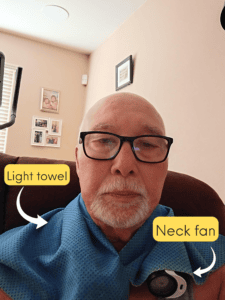
Bob Alvord with his cooling towel and rechargeable neck fan combo
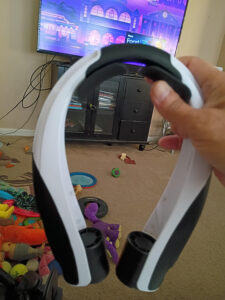
“… I use a well hydrated cooling towel, large one and a wearable neck fan to alleviate hot flashes. You wear the fan around your neck and then place the cooling towel over the fan. This system greatly lowers the towel temperature. My measurement of the towel with the fan is around 65 degrees, using a thermometer. Placing the towel against your corotid, with a 65 degree temperature source is enough to lower exposure to heat. ”
Have a product, tip or URL to recommend? Email me at Hannah@ancan.org
We’ll update this post as needed
by Rick Davis | Mar 25, 2026 | Advocacy, Blood Cancers, Cancer Caregivers, Cancer Resources, High Risk/Recurrent/Advanced Prostate Cancer, Low/Intermediate Prostate Cancer, MedaFit, Men 'Speaking Freely', Multiple Sclerosis, Ovarian Cancer, Pancreatic Cancer, Prostate Cancer, Uncategorized, Visual Snow Syndrome, Webinars
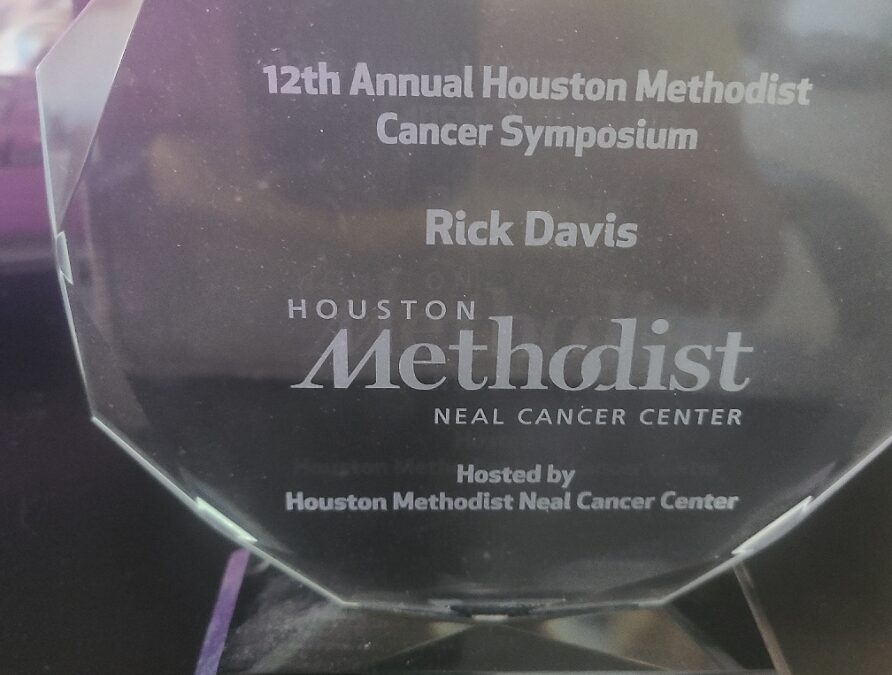
AnCan Keynote at Houston Methodist, Aug 2024 – Can you hear us? Amplifying the patient voice.
Can You Hear Us?? How AnCan helps patients make their voice heard – amplifying the patient voice!
Rick Davis gives keynote address at Houston Methodist Neal Cancer Center 12th Annual Cancer Symposium. August 2024.

by Hannah Garrison | Feb 27, 2026 | Advocacy, Blood Cancers, Brain Tumors, Cancer Caregivers, Cancer Resources, Exercise, Health Resources, High Risk/Recurrent/Advanced Prostate Cancer, Low/Intermediate Prostate Cancer, mCRPC, Men 'Speaking Freely', Men's Breast Cancer, Mental Health, mHSPC, Multiple Sclerosis, Pancreatic Cancer, Prostate Cancer, Recent News, RMC, Sarcoidosis, Veterans
Rarity Life Magazine Feature: Rick Davis

AnCan’s ambitious CEO and Founder, Rick Davis, recently sat down with Rarity Life, the magazine published by Same But Different Creative, to share the deeply personal journey that led to the creation of AnCan.
In the interview, Rick reflects on his early days navigating a prostate cancer diagnosis — a moment that reshaped his life & his understanding of what true support should look like. Like so many survivors and thrivers, he quickly discovered that information alone isn’t enough. What people often need most is connection — the chance to speak openly with others who truly understand the lived experience of cancer.
That realization became the foundation of AnCan.
Rick shares how traditional support models don’t always meet people where they are. Geographic limitations, physical health challenges, financial strain, rare diagnoses, and even the emotional weight of walking into an in-person group can all create barriers. For many, simply showing up can feel overwhelming.
AnCan was built to remove as many of those barriers as possible.
Rick’s full interview in Rarity Life offers an inspiring look at leadership shaped by lived experience, and a reminder that meaningful change often begins with one person asking: How can we do this better?
Read more stories & Rick’s article here:
https://www.samebutdifferentcic.org.uk/raritylife
by Kiernan Mehan | Feb 23, 2026 | Active Surveillance PCa, Advocacy, Cancer Caregivers, Cancer Resources, Exercise, Low/Intermediate Prostate Cancer, mCRPC, Men 'Speaking Freely', Mental Health, mHSPC, Nutrition, Press, Prostate Cancer, Recent News, Uncategorized

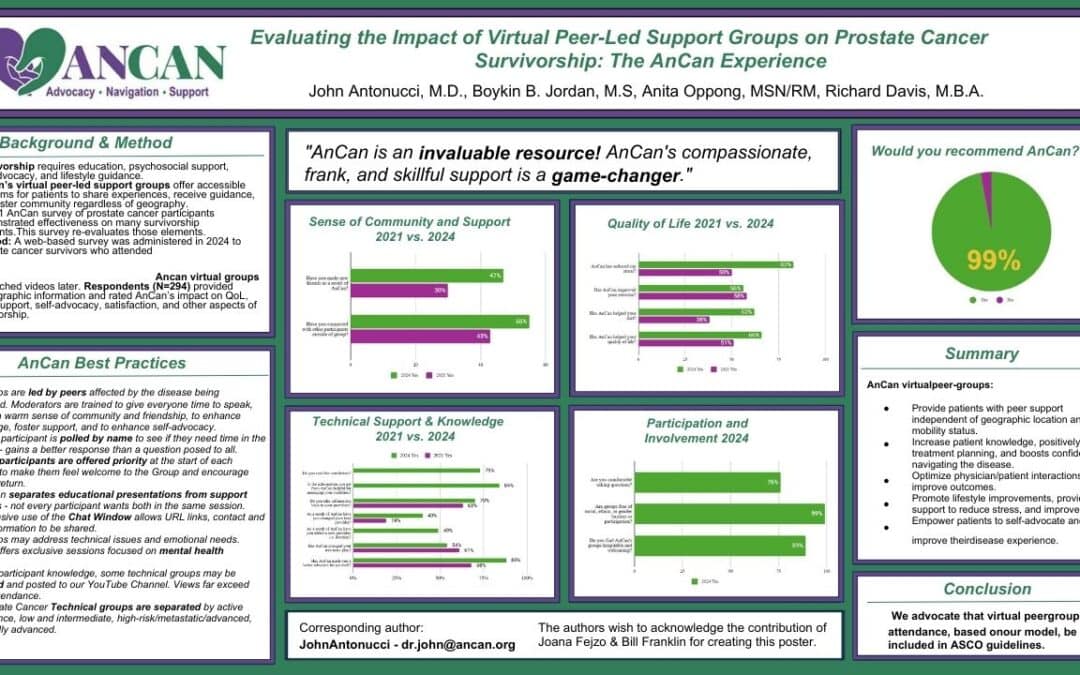
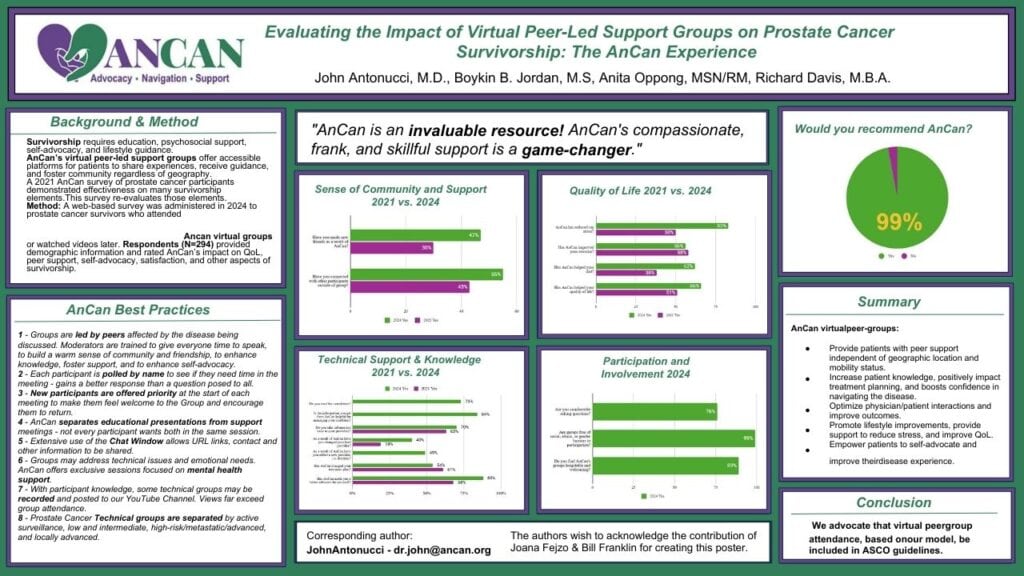
AnCan GU ASCO26 survivorship poster: participants strongly endorse our Groups
For release on Monday, Feb 23, 2026
AnCan Foundation strongly believes we run the best support groups available!! We can now release the first results of our 2024 AnCan Participant Survey that confirms that our participants think so too. This first batch of results is taken from almost 300 prostate cancer responses at all levels of disease.
- 99% of respondents would recommend AnCan Groups
- 66% improved Quality of Life – 83% noted reduced stress; 62% improved nutrition; 56% increased exercise
- 88% advocated better for themselves and AnCan influenced over half (54%) the treatment paths
- 47% made new friendships – AnCan’s personal favorite since this extends support well beyond our Groups
If you’re attending GU ASCO26 , please stop by our poster on Friday, Feb 27 to meet Dr. John Antonucci, discuss these astonishing results and the AnCan method, and pick up a flyer of the poster.
CONTACT
ABSTRACT
Evaluating the impact of virtual peer-led support groups on prostate cancer survivorship: the AnCan experience.
John Antonucci*, Boykin B. Jordan, Anita Oppong, Richard Davis
- Abstract Number: 265
- Poster Board Number: A23
- Session Title: Poster Session B: Prostate Cancer and Urothelial Carcinoma
- Date and Time: February 27, 2026, 11:30 AM-12:45 PM; 4:45 PM-5:45 PM (PST)
Background: Comprehensive prostate cancer (PCa) survivorship requires more than just clinical care, including education, psychosocial support, self-advocacy, and lifestyle guidance—needs often unmet by traditional oncology visits. Virtual peer-led support groups, such as those offered by the AnCan Foundation, offer accessible, real-time platforms for patients to share experiences, receive guidance, and foster community, regardless of geography. This study evaluates the impact of AnCan participation on factors known to be associated with a better quality of life (QOL) among PCa survivors.
Methods: A web-based survey was administered in 2024 to PCa survivors who attended or expressed interest in AnCan meetings. Respondents (N=294) provided demographic information and rated AnCan’s impact on QOL, peer support, self-advocacy, and satisfaction. Data were analyzed to assess the subjective influence of AnCan’s virtual support model on survivorship.
Results: (2021 results are in brackets for comparison.) Most respondents were in their 60s–70s (75%), highly educated (82%), and 55% had incomes over $100,000. Eighty-three percent had someone in their lives they could rely on and with whom they maintained regular contact.
Nearly all (97%) found AnCan meetings helpful for disease understanding, learning options, and well-being. Sixty-six percent reported improved QOL; 83% [50%] noted reduced stress; 62% [38%] improved nutrition; and 56% [58%] increased exercise. Satisfaction was high, with 99% recommending AnCan.
AnCan involvement enhanced self-advocacy (88%), improved patient-provider communication, and improved decision-making. Seventy percent brought information from AnCan to their providers, 49% added new providers, and 40% changed their lead provider. Over half (54%) reported that AnCan influenced their treatment path.
Socially, 55% [43%] connected with peers outside meetings, and 47% made new friendships.
Conclusions: Survey responses indicate that the AnCan virtual peer-led model, to be described in the poster, meaningfully increases patient knowledge, empowers self-advocacy, reduces stress, and fosters healthy behaviors, improving quality of life for PCa survivors. We advocate for integrating such peer support into NCCN, AUA, and ASCO survivorship guidelines.
POSTER

by Rick Davis | Feb 19, 2026 | Active Surveillance PCa, Advocacy, Blood Cancers, Cancer Caregivers, Cancer Resources, Health Resources, Men's Breast Cancer, Pancreatic Cancer, Prostate Cancer, Recent News, Thyroid Cancer, Uncategorized
Telehealth gets extended through 2027!
As some of you may know, the liberal telehealth rules to conduct medical appointments remotely that were enabled during Covid, sunsetted late last year. AnCan was upset and vocal that many of our patient advocacy organizations active on The Hill did not campaign more widely to extend it. Organizations like ZERO (prostate cancer) have significant and expensive government relations groups precisely to address such issues on behalf of us patients. AnCan had to bring it to ZERO’s attention to move the ball at a time when ZERO’s high paid CEO was self-admittedly sleeping on the switch.
Telehealth was temporarily extended for those living in rural areas. Then one of our newly minted prostate cancer Moderators, David Sharpe, brought it to AnCan’s attention that legislation was passed on Feb 3, 2026 that has extended comprehensive telehealth through the end of 2027. We asked David to blog its welcome return to wider availability and tell his story around telehealth – thank you Mr. Sharpe!
Medicare Telehealth Coverage Is Extended
The federal government has restored Medicare coverage for telehealth until the end of 2027. That means you can now possibly consult with your doctors online rather than having to meet with them in-person.
Why did I say possibly? Because state medical licensing laws still apply. Often, they can undermine your doctor’s ability to join you on the call. Here’s why: (Don’t construe the following comments as legal or medical advice. This is general information only.)
Telehealth consultations are easiest to arrange when a patient and doctor are in the same state. For instance, if you live in Springfield, Illinois, and want to have a virtual chat with an oncologist in Chicago, no legal impediments are likely to stand in your way.
Things can get tougher if the doctor practices in another state. Physicians are typically required to be licensed in the state where the patient is physically located during the consult. Therein lies a common problem: the doctor is licensed in one state, and you’re in another.
But loopholes exist. According to the Center for Connected Health Policy (CCHP), “A few states have licenses or telehealth-specific exceptions that allow an out-of-state provider to render services via telemedicine in a state where they are not located, or allow a clinician to provide services via telehealth in a state if certain conditions are met (such as agreeing that they will not open an office in that state). Still other states have laws that don’t specifically address telehealth and/or telemedicine licensing, but make allowances for practicing in contiguous states. . . .” For specifics about your state’s rules, explore CCHP’s handy state-by-state guide: https://www.cchpca.org/topic/cross-state-licensing-professional-requirements/.
Despite those exceptions, many physicians and medical centers require patients to be in the same state as the doctor during telehealth appointments. I wish I’d known that last year, before trying to set up virtual consultations from my home in Portland, Oregon, with Fred Hutch (Washington), UCSF, City of Hope (both California), and MD Anderson (Texas0—all of whom turned me down. Oregon Health & Science University (OHSU, Oregon)) would have refused, too, if I had been in any other state.
But some physicians and hospitals were more relaxed about it. Despite remaining in Portland, I wrangled a telehealth visit with a UCLA specialist. Two AnCan buddies of mine in Oregon and Arizona did so as well. I had even better luck with out-of-state doctors in community practices. Two agreed to confer with me online, and one declined.
If you live near—but not in—the state where your doctor practices, perhaps the easiest option is to make a run for the border. One AnCan member has adopted that strategy as a convenient means of communicating with his faraway medical team in an adjacent state while also satisfying the legal requirements. To have that meeting, he travels a few miles from home to a casino just across the state line; the casino lets him conduct telehealth consultations there. That approach shaves hours off what would otherwise be a protracted road trip to talk with his doctors face-to-face. # # #
David Sharp davidsharp1@me.com

by Kiernan Mehan | Dec 28, 2025 | Advocacy, Cancer Resources, Press, Recent News
Empowered Patient Podcast: Virtual Support Groups Remove Barriers Encourage Sharing Honest Experiences to Fight Misinformation with Rick Davis, AnCan
AnCan founder, Rick Davis, was recently featured in the Empowered Patient Podcast with Karen Jagoda. This show explores the cutting edge of healthcare, highlighting innovations in generative AI and the latest breakthroughs in therapeutics and vaccines, and explores a shifting landscape where providers, pharma, and payers are prioritizing patient empowerment.
Rick explains, “The mission is to make each person and each patient a better advocate for themselves. That’s really what we try to do, and we do that through empowering patients with peer knowledge. We introduce patients to other peers who have been through what these people are facing right now, not only patients, but also their care partners, and through their experience, we hope that these patients and care partners will become more expert in managing their own situation.”
If you have 20 minutes, click here to listen to the podcast. If you’d like to read the conversation, click here for the transcript.