AnCan thanks the following sponsors for making this recording possible: Novartis, Telix and Blue Earth Diagnostics.
Views expressed in this Recording are solely the opinion of AnCan Foundation, our Moderators and Participants.
AnCan does not accept sponsored promotion. Any drugs, protocols or devices discussed are based solely on anecdotal peer experience or clinical evidence.
AnCan cannot and does not provide medical advice. We encourage you to discuss anything you hear in our sessions with your own medical team.
AnCan reminds all Participants that Adverse Events experienced from prescribed drugs or protocols should be reported to the pharmaceutical manufacturer or the FDA Adverse Event Reporting System (FAERS). To do so call 1-800-332-1066 or download interactive FDA Form 3500 https://www.fda.gov/media/76299/download
All AnCan’s groups are free and drop-in … join us in person sometime! You can find out more about our 12 monthly prostate cancer meetings at https://ancan.org/prostate-cancer/ Sign up to receive a weekly Reminder/Newsletter for this Group or others at https://ancan.org/contact-us/
Join our other free and drop in groups:
Men (Only) Speaking Freely…1st & 3rd Thursdays @ 8.00 pm Eastern https://ancan.org/men-speaking-freely/
Veterans Healthcare Navigation… 1st & 3rd Tuesdays @ 8.00 pm Eastern Schmier Room https://ancan.org/veterans/
Veterans Speaking freely… 4th Tuesday @ @ 8.00 pm Eastern Schmier Room
Editor’s Pick: E2 doublet discussion – closely followed by integrating psilocybin into HT doublet!
Topics Discussed
Newbie diagnosed 4 years back with PSA @ 4000 & BRCA+ might consider a different doublet -or PARP; Newbie responds but has 4 consecutive negative PSMA scans – consider Axumin; could E2 doublet be an option?; PTEN just indicated; 2 negative Bx confirm our hunch Gent is Mx ; can experienced user integrate psilocybin into his HT to treat depression; monotherapy daro works exceptionally well – but must make decision on ‘Long Game’ trial; how long to stay on mono daro?; 1st Pluvicto rings PSA down a little – what to expect next?; Dr. Guancial uses fewer tests making Gent anxious – T/W her!
I want to ask Dr A if I can do the psilocybin therapy again while receiving radiation
Bob Schwartz, USN, Venice, FL. sent: 6:33 PM
Danny, we’re all here for you brother.
Gary Martin sent: 6:42 PM
RT can impact bone marrow–lowering blood counts and possibly increasing fatigue. This happened to me–lowering blood counts further to below-normal–on top of impact of triplet prior to RT.
Read that ice packs have been shown to limit the effects of Pluvicto on salivary glands–study in Europe. Don’t have a reference to study yet.
Hank Zajic Springfield VA sent: 7:10 PM
Good night all. Thank you for the discussion. out of battery here. Hank
Stay in shape with FIT Together in your own living room!
Mark and Kathy Baldridge are avid birders, and as a result, frequent visitors to “Deep Southern Arizona” from their home in University Place, Washington. You may have seen them in an AnCan Group – we’ve been supporting the Baldridges since 2021.
Recently Mark mentioned an at home exercise program in a group, so we encouraged him to tell us more so all AnCan’rs living with cancer could participate… with or without their care partner.
This October 17th, AnCan will participate in the OHSU-Fred Hutch Prostate Cancer Summit. Dr. Kerri Winters is also speaking, and Dr. E (Eleni Efstathiou), the new Chief of Genitourinary Cancer at OHSU, has already set up a time for us to meet. We’ll be writing about the Summit closer to the date. (rick davis)
Back in high school, I did multiple pushups before I went to bed. Fast-forward 50 years and I was unable to do a single pushup. Over the years, I’d fooled myself into thinking I was in ‘decent shape’ because I took long walks several times a week. The truth was that after being diagnosed with osteoporosis, 24 months of Hormone Therapy and a lack of upper body exercise, my overall strength had significantly declined.
Fortunately, I discovered an online exercise program FIT Together for cancer survivors and their partners. FIT Together is a 501(c)(3) nonprofit organization founded in 2014 under the leadership of Dr. Kerri Winters-Stone and Jessica Sitemba. Dr. Winters-Stone has a PhD in Human Performance and has been conducting research in exercise oncology for 20 years. She has run over 15 clinical trials funded by NIH and cancer non-profits. I have participated in two of Dr. Winters-Stone’s clinical trials run through Oregon Health Sciences University – OHSU.
I’ve attended FIT Together classes for a year and can attest that the instructors are excellent. They demonstrate each exercise and then give tips to ensure each participant correctly performs the exercise. The instructors individualize and tailor movements and exercises to accommodate each person’s needs—no matter what the person’s fitness level. For instance, pushups can be performed in many different ways (e.g. against a wall/desk/chair or on hands and knees/feet).
The classes are held twice per week at various times virtually. I love the convenience of performing these exercises at home and look forward to each class. All you need for the classes are dumbbells, a resistance band, stretch strap and an exercise mat. The cost for this equipment is quite reasonable—less than $75.
There are several classes to choose from: strength training, strength/cardio and an exercise class for couples. Classes are very reasonably priced— around $5 per session for a 12 week/24 session class… even less if two of you join together.
I participate in the strength training class and physically feel much better about myself. It’s been really encouraging to see that I’ve slowly gained upper body strength. While I still can’t do a pushup on my hands and toes, I can perform 12 pushups on my hands and knees—I’m on my way to performing a full pushup.
I highly recommend these classes and hope to see some of you in a class—you won’t be disappointed!
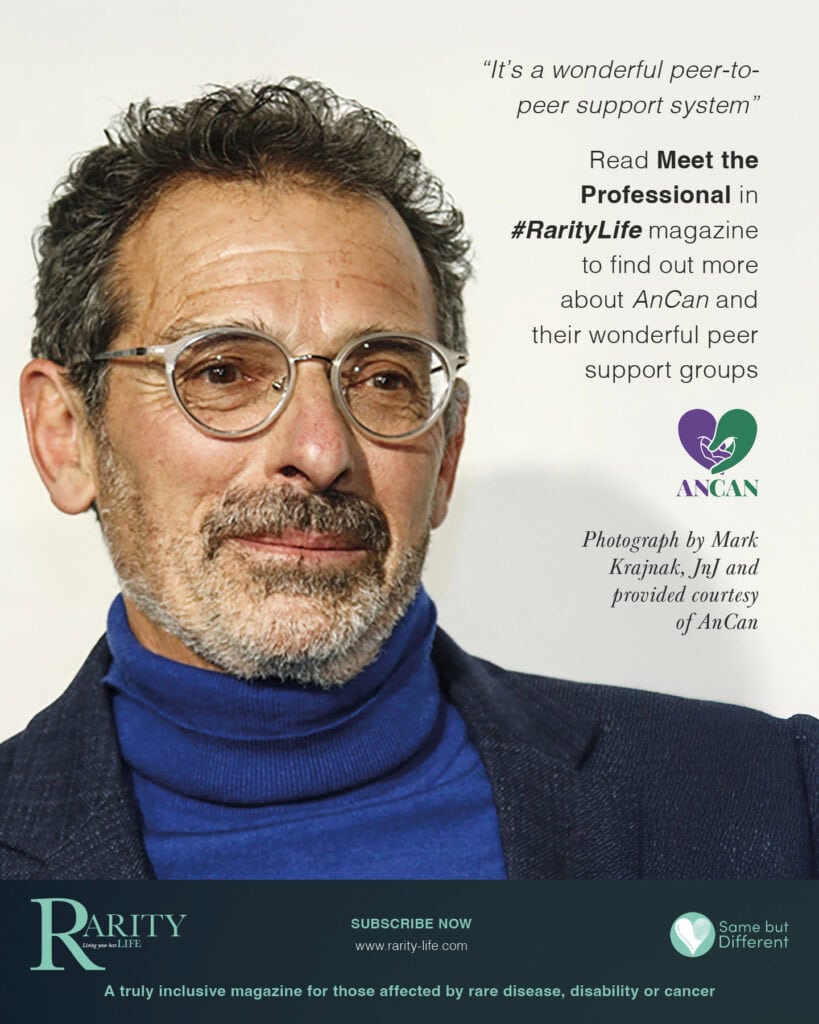
AnCan’s ambitious CEO and Founder, Rick Davis, recently sat down with Rarity Life, the magazine published by Same But Different Creative, to share the deeply personal journey that led to the creation of AnCan.
In the interview, Rick reflects on his early days navigating a prostate cancer diagnosis — a moment that reshaped his life & his understanding of what true support should look like. Like so many survivors and thrivers, he quickly discovered that information alone isn’t enough. What people often need most is connection — the chance to speak openly with others who truly understand the lived experience of cancer.
That realization became the foundation of AnCan.
Rick shares how traditional support models don’t always meet people where they are. Geographic limitations, physical health challenges, financial strain, rare diagnoses, and even the emotional weight of walking into an in-person group can all create barriers. For many, simply showing up can feel overwhelming.
AnCan was built to remove as many of those barriers as possible.
Rick’s full interview in Rarity Life offers an inspiring look at leadership shaped by lived experience, and a reminder that meaningful change often begins with one person asking: How can we do this better?
AnCan GU ASCO26 survivorship poster: participants strongly endorse our Groups
For release on Monday, Feb 23, 2026
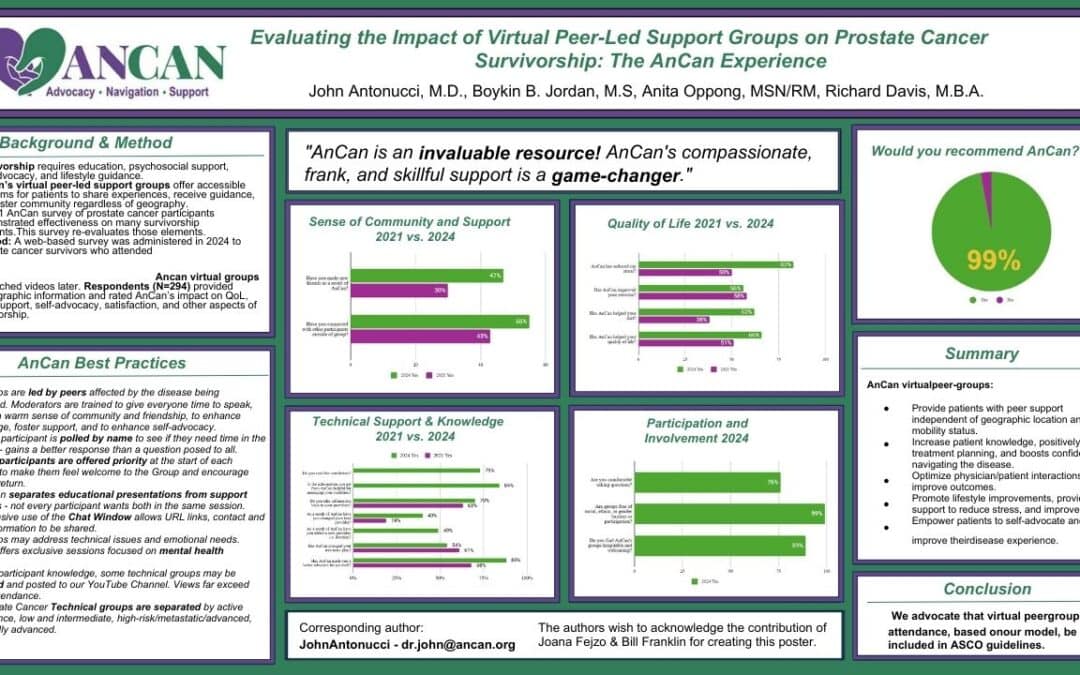
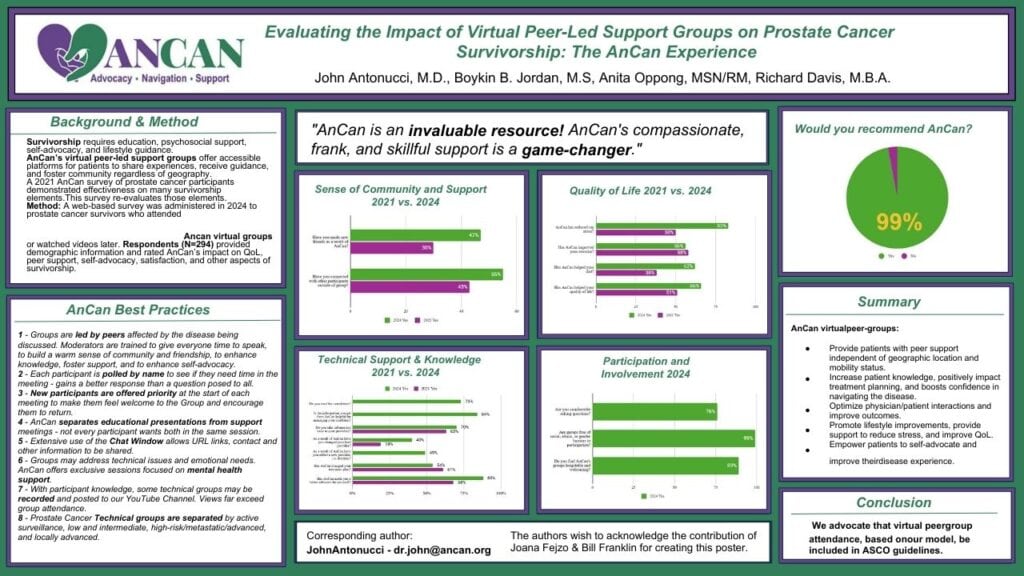
AnCan Foundation strongly believes we run the best support groups available!! We can now release the first results of our 2024 AnCan Participant Survey that confirms that our participants think so too. This first batch of results is taken from almost 300 prostate cancer responses at all levels of disease.
99% of respondents would recommend AnCan Groups
66% improved Quality of Life – 83% noted reduced stress; 62% improved nutrition; 56% increased exercise
88% advocated better for themselves and AnCan influenced over half (54%) the treatment paths
47% made new friendships – AnCan’s personal favorite since this extends support well beyond our Groups
If you’re attending GU ASCO26 , please stop by our poster on Friday, Feb 27 to meet Dr. John Antonucci, discuss these astonishing results and the AnCan method, and pick up a flyer of the poster.
Evaluating the impact of virtual peer-led support groups on prostate cancer survivorship: the AnCan experience.
John Antonucci*, Boykin B. Jordan, Anita Oppong, Richard Davis
Abstract Number: 265
Poster Board Number: A23
Session Title: Poster Session B: Prostate Cancer and Urothelial Carcinoma
Date and Time: February 27, 2026, 11:30 AM-12:45 PM; 4:45 PM-5:45 PM (PST)
Background: Comprehensive prostate cancer (PCa) survivorship requires more than just clinical care, including education, psychosocial support, self-advocacy, and lifestyle guidance—needs often unmet by traditional oncology visits. Virtual peer-led support groups, such as those offered by the AnCan Foundation, offer accessible, real-time platforms for patients to share experiences, receive guidance, and foster community, regardless of geography. This study evaluates the impact of AnCan participation on factors known to be associated with a better quality of life (QOL) among PCa survivors.
Methods: A web-based survey was administered in 2024 to PCa survivors who attended or expressed interest in AnCan meetings. Respondents (N=294) provided demographic information and rated AnCan’s impact on QOL, peer support, self-advocacy, and satisfaction. Data were analyzed to assess the subjective influence of AnCan’s virtual support model on survivorship.
Results: (2021 results are in brackets for comparison.) Most respondents were in their 60s–70s (75%), highly educated (82%), and 55% had incomes over $100,000. Eighty-three percent had someone in their lives they could rely on and with whom they maintained regular contact.
Nearly all (97%) found AnCan meetings helpful for disease understanding, learning options, and well-being. Sixty-six percent reported improved QOL; 83% [50%] noted reduced stress; 62% [38%] improved nutrition; and 56% [58%] increased exercise. Satisfaction was high, with 99% recommending AnCan.
AnCan involvement enhanced self-advocacy (88%), improved patient-provider communication, and improved decision-making. Seventy percent brought information from AnCan to their providers, 49% added new providers, and 40% changed their lead provider. Over half (54%) reported that AnCan influenced their treatment path.
Socially, 55% [43%] connected with peers outside meetings, and 47% made new friendships.
Conclusions: Survey responses indicate that the AnCan virtual peer-led model, to be described in the poster, meaningfully increases patient knowledge, empowers self-advocacy, reduces stress, and fosters healthy behaviors, improving quality of life for PCa survivors. We advocate for integrating such peer support into NCCN, AUA, and ASCO survivorship guidelines.
AnCan thanks the following sponsors for making this recording possible: Novartis, Telix, Blue Earth Diagnostics and Foundation Medicine.
Views expressed in this Recording are solely the opinion of AnCan Foundation, our Moderators and Participants.
AnCan does not accept sponsored promotion. Any drugs, protocols or devices discussed are based solely on anecdotal peer experience or clinical evidence.
AnCan cannot and does not provide medical advice. We encourage you to discuss anything you hear in our sessions with your own medical team.
AnCan reminds all Participants that Adverse Events experienced from prescribed drugs or protocols should be reported to the pharmaceutical manufacturer or the FDA Adverse Event Reporting System (FAERS). To do so call 1-800-332-1066 or download interactive FDA Form 3500 https://www.fda.gov/media/76299/download
All AnCan’s groups are free and drop-in … join us in person sometime! You can find out more about our 12 monthly prostate cancer meetings at https://ancan.org/prostate-cancer/ Sign up to receive a weekly Reminder/Newsletter for this Group or others at https://ancan.org/contact-us/
Join our other free and drop in groups:
Men (Only) Speaking Freely…1st & 3rd Thursdays @ 8.00 pm Eastern https://ancan.org/men-speaking-freely/
Veterans Healthcare Navigation… 1st & 3rd Tuesdays @ 8.00 pm Eastern Schmier Room https://ancan.org/veterans/
Veterans Speaking freely… 4th Tuesday @ @ 8.00 pm Eastern Schmier Room
Editor’s Pick: Unrelated Newbies from either Coast have almost identical issues.
Topics Discussed
Our two Newbies are ‘twins’ – both denovo Mx on the cusp between high and low volume mets, and both with less experienced GU med oncs; 4x chemo down doing well with a full head of hair!; finding an exercise program; contacting NCI; Orgovyx trumps a 6-mo. depot shot; early radiation cystitis; finding Dr. E; with heart history, Orgovyx or Lupron?; discussing NCI trial & adaptive therapy
Chat
AnCan – Rick sent: 5:55 PM
Technical assistance 877 582 7011
AnCan – Rick sent: 5:56 PM
Playing the Long Game https://www.youtube.com/watch?v=v4jzyAeOtNI
Great Meeting again gang! I’m out – time to walk the dog.
michael perillo sent: 7:21 PM
Hi all, need to leave the meeting. Obviously have quite a bit of work to do re possible change to orggovyx, possible use of radiation, chemo or other triplet approach, possible somatic testing as well as second opinion. Will follw up on future meetings. Thanks Michael
AnCan–John A sent: 7:21 PM
Ok Michael, welcome
Eric James; Tyler TX sent: 7:25 PM
The weight you use is relative to your strength. Weight is usually selected based on how many reps you are to do.
Steve Schuler (Go Seahawks!) sent: 7:31 PM
Did you have doubling time data before going on the ADT?
The reason I ask is that there will be a lag after going off ADT before the DT data will be reliable
Eric James; Tyler TX sent: 7:33 PM
The NCI doc presentation has some overlap with Adaptive Therapy
Steve Schuler (Go Seahawks!) sent: 7:38 PM
Orgovyx will restore your T faster once you get off it
RJ Smith (Seattle) sent: 7:48 PM
ChatGPT, etc.) is not a GU Med Onc. Not even a urologist or MD of any kind.
Steve Schuler (Go Seahawks!) sent: 7:56 PM
gotta drop, love to hear more discussion of the NCI YT video at some point. If that happens after I drop, I’ll view the recording of this session later
Richard B, Silver Spring, MD sent: 8:02 PM
I need to step away due to an early start tomorrow morning. Nothing new to report but more assessments this week. So possible report next week. ‘Appreciate all the conversations. Good night.
dan-s alexandria sent: 8:03 PM
gotta go, gents…. good conversations.
Bruce Schrimpf sent: 8:11 PM
As always it was very informative. Thanks for being “there” for those of us struggling through!
Taking on the role of a care partner can feel overwhelming, but you don’t have to navigate it alone. Many experienced care partners will tell you that with a little guidance, it can also be a deeply fulfilling experience. To help you on your journey, we’ve compiled some helpful resources available online.
1.Leaning Into Grief: An Interview With Claire Bidwell Smith
Claire Bidwell Smith is a therapist, grief expert, and author. Click here for her interview about leaning into grief.
2. Cancer Today: Addressing Anger
Anger and Irritability are normal responses to a cancer diagnosis, and this article offers guidance for care partners of cancer patients.
3. NCCN Guidelines for Patients: Palliative Care
The National Comprehensive Cancer Network released an easy to read, patient-centric Palliative Care guidelines that you can view and download. Click here.
4. “Caregiver Life Hacks”
There’s no one-size-fits-all way to care for someone because every care partner and situation is different. What helps one person might not work for another, but many care partners deal with similar challenges. Click here for some simple “life hacks” that might make your day a little easier.
5. “Caregivers Need Care Too”
“However, primary care partners are also thrust into an unfamiliar world of medical treatments, terminology, and appointments. This is why mutual support between the patient and the primary care partner is important—it is a partnership through thick and thin because both the patient and primary care partner need to learn about the complexities of the disease and treatments needed, as well as make important decisions together.” Click here for the full article.
6. Triage Health Caregiver Resources
Click here for a full list of resources about legal and practical matters like taking time off from work, managing family finances and medical bills, replacing lost wages, estate planning, and other resources.
7. Cancer Straight Talk Podcast: Advice and Support for Cancer Caregivers
The podcast Cancer Straight Talk features host Dr. Diane Reidy-Lagunes speaking with Dr. Allison Applebaum, the founder of the Caregivers Clinic at Memorial Sloan Kettering Cancer Center (MSK). This episode covers navigating the healthcare system and managing the emotions of caregiving.
8. Patient Power: Power of Care Partners: Who Has your Back?
This article is about the crucial role of care partners for people with chronic illness. It distinguishes a “care partner” as a full member of the care team, not just a caregiver. The article also provides advice on practical matters, like having a designated care partner with access to medical records, and emphasizes the importance of care partners looking after their own well-being.


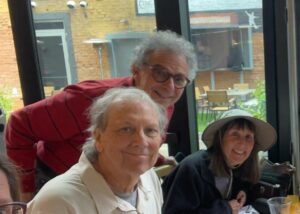 Mark and Kathy Baldridge are avid birders, and as a result, frequent visitors to “Deep Southern Arizona” from their home in University Place, Washington. You may have seen them in an AnCan Group – we’ve been supporting the Baldridges since 2021.