
Cribriform, Revisited: What’s New and Who Should Care
Written by: Stuart Jordan
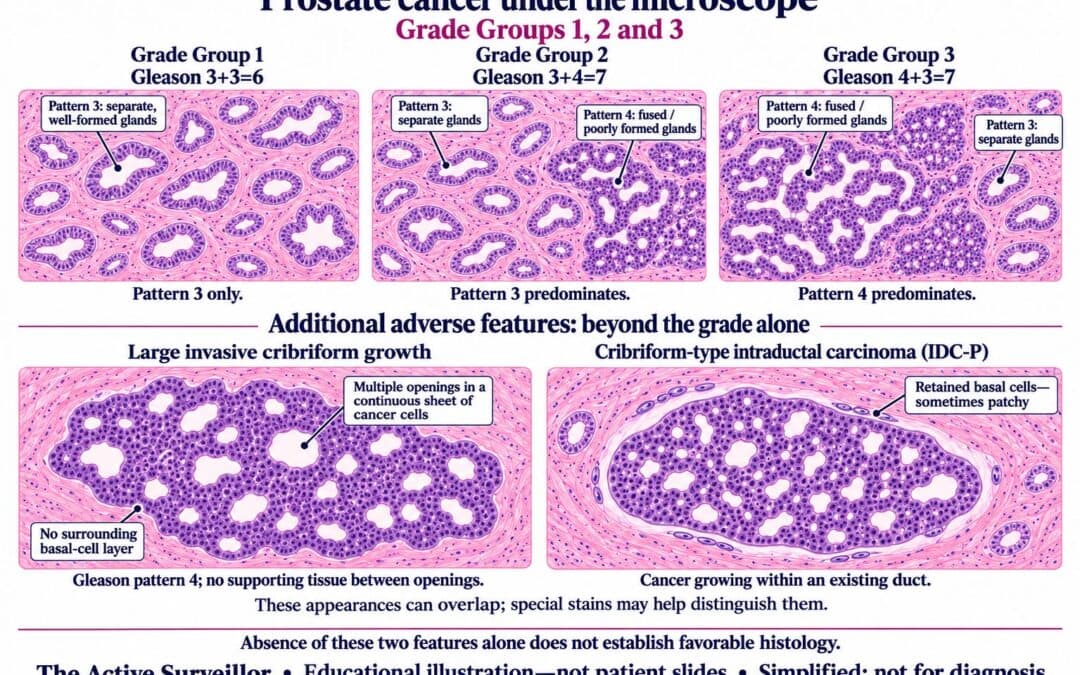
Cribriform comes up often in our group, and for good reason. It’s a pattern pathologists can identify in prostate cancer biopsy tissue, and its presence is associated with a greater risk that the cancer will recur or spread. That’s why it can weigh heavily in the decision between active surveillance and treatment.
The discussion used to focus on whether cribriform was present. Then it became a question of whether it was large or small. Now Cleveland Clinic’s Dr. Jesse McKenney, a leading expert in prostate cancer pathology, has developed a broader approach to evaluating biopsy slides for what he calls “unfavorable histology.” It looks beyond cribriform for other patterns associated with more aggressive disease.
Howard Wolinsky has been following this work closely in The Active Surveillor. McKenney’s approach is still being studied and is not standard of care, so your doctor has to request the review. Ask your doctor to order an “Unfavorable histology evaluation by Jesse K McKenney, MD (JMCKENNEY consult)” at Cleveland Clinic, and check on cost and insurance coverage first. Details can be found here.
The review can identify unfavorable features in the biopsy tissue that was sampled. It cannot rule out their presence in parts of the prostate that weren’t sampled. Finding a red flag is meaningful; not finding one may be reassuring, but it’s not conclusive.
Who should care? Mostly men with Gleason 3+4 (Grade Group 2). This review addresses the gray zone between surveillance and treatment. Pattern 4 covers several kinds of growth, some relatively quiet, others more dangerous. The review checks whether the more dangerous kinds are in your biopsy, which can help you and your doctor decide whether you need treatment.
If your initial biopsy showed Gleason 3+3 (Grade Group 1), it would not include invasive cribriform cancer, which is graded as pattern 4 or higher. Still, a second opinion from an experienced prostate pathologist is necessary to confirm there’s no pattern 4. If that review identifies pattern 4, the cribriform question comes back into play, along with whether McKenney’s evaluation makes sense for you.
For men with Gleason 4+3 (Grade Group 3) or higher, active surveillance generally isn’t recommended, regardless of whether cribriform is present. This additional review is unlikely to change that recommendation.
The bottom line: Cribriform matters, and McKenney’s approach offers another way to look for potentially dangerous features, particularly for men in the Gleason 3+4 gray zone. It’s a tool for identifying potential trouble, not a guarantee that none exists.