
Build Trust – Be Your Own Best Advocate!
(first published on AnCanSpeak substack; subscribe for free)
Less than 50% of Patients trust their Providers. Now that’s a handpicked statistic from a survey conducted during Covid and published in JAMA Network in 2024. Healthcare professionals amongst our readers may have grounds to push back. That said, AnCan’s frequent experience from virtual conversations in our daily groups corroborates that anecdotally perhaps half our participants doubt the medical advice received. Our own 2024 survey backs that up. From our GU ASCO 2026 abstract4:
Seventy percent brought information from AnCan to their providers, 49% added new providers, and 40% changed their lead provider. Over half (54%) reported AnCan influenced their treatment path.
That doesn’t bode well for a trusting Patient-Provider relationship!
Where there’s smoke, there’s fire. Two pieces in Sept. 8, 2026 JAMA Internal Medicine caught our digital eye. Rebuilding Trust in the Patient-Physician Relationship (Viewpoint2) and Rebuilding Trust in Medicine Requires Structural Change (Editorial3) reiterate the essence of what AnCan strives to achieve – navigate our participants to “Be Your Own Best Advocate”.
The Editorial opens with these words:
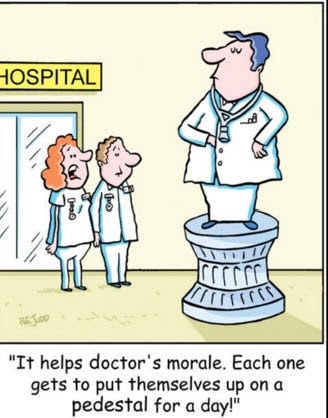
“Medicine is characterized by an inherent asymmetry of information and power between physicians and patients.” And goes on to say: “Demonstrating trustworthiness and restoring trust… requires reconsidering the balance of power between patients and health care professionals.”
This brings to mind a cartoon AnCan has employed in presentations:
 |
Both JAMA pieces agree that our system is broken. They recite a fact that AnCan has previously noted… on average Providers interrupt Patients after a median of 11 seconds. In front of Providers, Patients can’t even begin to collect our thoughts, never mind express them.
The article troops out a whole bunch of remedies. Starting with teaching HCPs how to listen, it moves to improving health systems so you actually see your doc – not a surrogate practitioner, encouraging longer patient visits – so Providers have time to listen, and address mis- and disinformation. On a more grandiose scale, the article points out that differences in wealth, insurance status and education also influence Patient-Provider trust levels.
The closest either article comes to balancing the scales between Patient and Provider is to say:
Empowering patients through patient education and skill building, increased transparency in care, and shared clinical decision-making would also increase the collaboration in physician-patient relationships. Mutual partnerships between patients and their physicians may foster more stable patient trust instead of requiring patients to take a more tenuous leap of faith.
Noble words, but who is to take on this Sisyphean task?
AnCan likes to think we lead the way. Name one other organization whose mission is to make you your own best advocate. Already this week we fielded one call from a longtime legal Volunteer whose trust in an inestimable Medical Institution was violated because the Provider they spoke to committed the inexcusable and cardinal sin of simply failing to read the file. Or another Participant, a Medical Provider himself, who needed advice because an Institution was knowingly yet improperly billing him.
Being your own best advocate may not fully restore trust in our health system, but it goes a long way to leveling the playing field. It certainly improves patients’ self-esteem and in doing so, makes us feel immeasurably better.
rick davis rd@ancan.org
References
- Perlis RH, Ognyanova K, Uslu A, et al. Trust in physicians and hospitals during the COVID-19 pandemic in a 50-state survey of US adults. JAMA Netw Open. 2024;7(7):e2424984. doi:10.1001/jamanetworkopen.
2024.24984 - Rebuilding Trust in the Patient-Physician Relationship Rotenstein, L et al, JAMA Network Internal Medicine, Sep 8 2026
- Rebuilding Trust in Medicine Requires Structural Change Richman, I et al, JAMA Network Internal Medicine, Sep 8 2026
- Evaluating the impact of virtual peer-led support groups on prostate cancer survivorship—The AnCan experience Antonucci, J et al GU ASCO 2026 Poster & Abstract
Comments
(Larry F) ….. Right on, ANCAN!