(first published on AnCanSpeak substack; subscribe for free)
Less than 50% of Patients trust their Providers. Now that’s a handpicked statistic from a survey conducted during Covid and published in JAMA Network in 2024. Healthcare professionals amongst our readers may have grounds to push back. That said, AnCan’s frequent experience from virtual conversations in our daily groups corroborates that anecdotally perhaps half our participants doubt the medical advice received. Our own 2024 survey backs that up. From our GU ASCO 2026 abstract4:
Seventy percent brought information from AnCan to their providers, 49% added new providers, and 40% changed their lead provider. Over half (54%) reported AnCan influenced their treatment path.
That doesn’t bode well for a trusting Patient-Provider relationship!
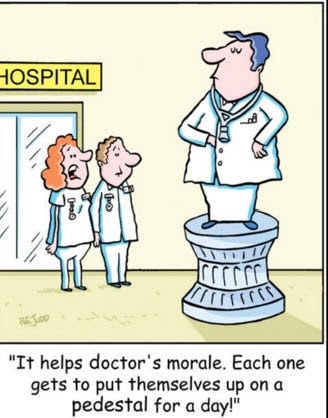
“Medicine is characterized by an inherent asymmetry of information and power between physicians and patients.” And goes on to say: “Demonstrating trustworthiness and restoring trust… requires reconsidering the balance of power between patients and health care professionals.”
This brings to mind a cartoon AnCan has employed in presentations:
Both JAMA pieces agree that our system is broken. They recite a fact that AnCan has previously noted… on average Providers interrupt Patients after a median of 11 seconds. In front of Providers, Patients can’t even begin to collect our thoughts, never mind express them.
The article troops out a whole bunch of remedies. Starting with teaching HCPs how to listen, it moves to improving health systems so you actually see your doc – not a surrogate practitioner, encouraging longer patient visits – so Providers have time to listen, and address mis- and disinformation. On a more grandiose scale, the article points out that differences in wealth, insurance status and education also influence Patient-Provider trust levels.
The closest either article comes to balancing the scales between Patient and Provider is to say:
Empowering patients through patient education and skill building, increased transparency in care, and shared clinical decision-making would also increase the collaboration in physician-patient relationships. Mutual partnerships between patients and their physicians may foster more stable patient trust instead of requiring patients to take a more tenuous leap of faith.
Noble words, but who is to take on this Sisyphean task?
AnCan likes to think we lead the way. Name one other organization whose mission is to make you your own best advocate. Already this week we fielded one call from a longtime legal Volunteer whose trust in an inestimable Medical Institution was violated because the Provider they spoke to committed the inexcusable and cardinal sin of simply failing to read the file. Or another Participant, a Medical Provider himself, who needed advice because an Institution was knowingly yet improperly billing him.
Being your own best advocate may not fully restore trust in our health system, but it goes a long way to leveling the playing field. It certainly improves patients’ self-esteem and in doing so, makes us feel immeasurably better.
rick davis rd@ancan.org
References
Perlis RH, Ognyanova K, Uslu A, et al. Trust in physicians and hospitals during the COVID-19 pandemic in a 50-state survey of US adults. JAMA Netw Open. 2024;7(7):e2424984. doi:10.1001/jamanetworkopen.2024.24984
Even little me speaks to a lot of people, some of whom have Prostate Cancer. And advanced Prostate Cancer and many of them are not acting as their own best advocate. It’s very important that people learn to take control and own and deal with their disease.
Maybe it’s a little long winded and boring, but it took me a year or 2, into my stage, 4, Prostate Cancer. Before I really took control and had one of those aggressive and idiot doctors who told me” i am a ph d in oncology, and you are a beginning student, ” and he tried to dictate to me everything, including his team of radiological, oncology, and his drugs and his procedures, and I watched a number of his patients who I know personally, because I worked with them die without doing all the things they could. Anyway, after a year two I was seeing consulting with good doctors and dana farber and at sloan, and I switched from advisors to sloan and very happy with my oncologist now…. It is very important for people to come to visit. Taking ownership and managing as their own number one, advocate. Okay, I’ll stop boring you because my doorbell is ringing. Thank you bye!”
Living with Visual Snow – a Therapist’s Perspective with Dr. Paula Hechinger
“My approach to Visual Snow Syndrome was born from my own journey from being a depressed and isolated mother of two to becoming a resilient psychoanalyst. Today, I not only help individuals navigate VSS but also support those facing a wide range of mental health challenges, including depression, bipolar disorder, anxiety, borderline personality disorder, trauma, and more. What once felt like a limitation became the foundation of my purpose to guide others toward healing with empathy, depth, and lived understanding.” -Dr. Paula Hechinger
Join us for a special presentation with Dr. Paula Hechinger, a psychoanalyst who is living with Visual Snow Syndrome. She shares her personal journey, insights, and practical tips for managing VSS. Click Here to view her personal testimony and presentation.
For a list of resources on Visual Snow Syndrome (VSS), click here.
AnCan Founder Rick Davis Discovers He Has VSS in Video Support Group
Here’s an interview with AnCan founder, Rick Davis made by the Visual Snow Initiative. Watch Rick talk about the moment he realized he ALSO has visual snow syndrome – AFTER the group’s formation. In Rick’s own words, “It’s crazy how these things come together!”
Davis believes he has lived with Visual Snow Syndrome (VSS) since childhood, but learned to accommodate. His personal symptoms – seeing a “veil” of small dots, floaters, and light sensitivity – have given him deeper insight into the VSS support group. Davis strongly advocates for the medical community to formally recognize VSS and research a cure, while affirming AnCan’s role in providing a crucial, judgment-free virtual community where VSS sufferers realize they are not alone.
CNTV’s recent video features an interview with AnCan founder, Rick Davis. He explains that he started AnCan after his own diagnosis in 2007, after realizing inadequate support options, especially for those in remote areas. AnCan aims to eliminate barriers to entry for its various support groups, which range from cancer to chronic diseases. AnCan empowers patients to “Be your own best advocate” by providing them with the knowledge to speak confidently with their healthcare providers and offering peer-to-peer support.
AnCan Foundation, the innovator of virtual support groups, is coming to our 10th Anniversary in less than 10 months. We’ve grown – about one-third of US nonprofits fail in that time, and we have flourished. Starting with 3, or was it 4, meetings, AnCan now boasts 33 virtual monthly events for 16 different conditions. If that’s not evidence enough, annually we serve around 7,000 live; approx. 33,000 through our recordings, and we have close to a half-million who make contact with the AnCan logo somehow or other annually. That’s a lot. Watch out for our new Impact Report that’s in the works.
It’s certainly more than one person can handle. In fact, it’s more than myself, a volunteer, plus 4 contract people and an outside bookkeeper can handle. I’m not the only volunteer. I am so honored and privileged to say it’s more than around 100 volunteers can handle, and we could not manage without your efforts – much gratitude.
For some time, the executive function has been too much for me to manage alone, even with the help of our volunteer Executive Board made up right now of Bill Franklin, David Muslin and Stuart Jordan – btw, we’re looking to add to that too. We’ve been looking to hire executive help and the perfect solution has presented itself.
Some of you may be aware of the term, Fractional Executives – The Charity CFO just ran a podcast. AnCan has been fortunate enough to find one who knows us intimately. Courtesy of the USAF and subsequently, extensive consulting experience at The Mitre Corporation, our Board President, Bill Franklin, is voluntarily reducing his hours at Mitre to take on a contract position of 16-20 hours a week with lil’ ol’ AnCan.
As our Board President since August 2021, Bill knows all the ins and out, he’s seen us grow, and most significantly he’s willing to work with me! Bill’s also looking to phase out of Mitre and find new challenges as he approaches retirement. AnCan provided a great solution and we welcome him as our new Chief Operating Officer.
Bill will continue as Board President as well as assuming oversight over many of the operating and administrative duties, from finance and control to insurance, compliance and many special projects – viz. the Impact Report !?! To be honest, Bill’s been doing a lot of this informally but can now spend legitimate time a couple of days a week to help us put our ship, or maybe we should say ‘our bird’, in better order.
Personally, I am thrilled and excited. There’s no one I can think I would rather work with. I welcome him sharing this job with me, and keeping me on the straight and narrow as he has done since joining the Board many years ago. One other person to thank – another aviator, Bill’s wife Misa. If she hadn’t gotten on his case for spending many volunteer hours with AnCan, Bill wouldn’t have come up with this great solution.
Welcome aboard, Sarge… or should I say, Mr. Prez! AnCan welcomes Air Relief




 AnCan Foundation, the innovator of virtual support groups, is coming to our 10th Anniversary in less than 10 months. We’ve grown – about one-third of US nonprofits fail in that time, and we have flourished. Starting with 3, or was it 4, meetings, AnCan now boasts 33 virtual monthly events for 16 different conditions. If that’s not evidence enough, annually we serve around 7,000 live; approx. 33,000 through our recordings, and we have close to a half-million who make contact with the AnCan logo somehow or other annually. That’s a lot. Watch out for our new Impact Report that’s in the works.