by Kiernan Mehan | Sep 4, 2025 | Men 'Speaking Freely', Prostate Cancer
Written by: Dr. John Antonucci
As we always emphasize, taking care of our hearts (the actual organ) is very important to us PCa guys. For metastatic men, a very substantial minority of us will die of heart disease before our PCa gets us. For non-metastatic, more than half will.
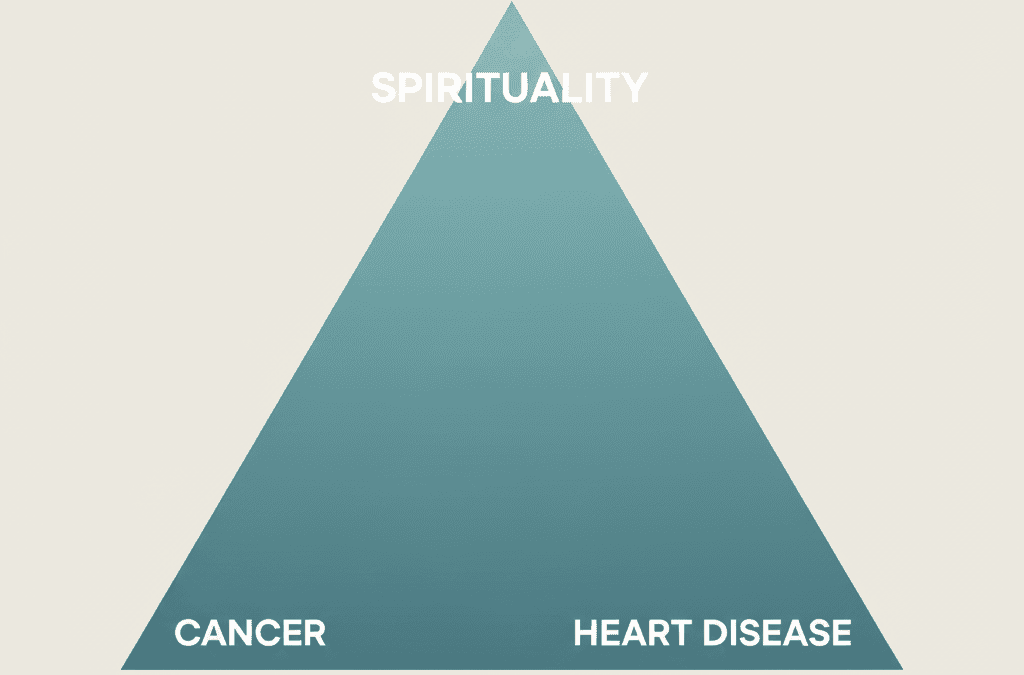
So when Rick saw an article about the Cardiology Society of Sao Paulo devoting a seminar to Spirituality in the treatment of heart disease, he sent it right over to me with a suggestion to make it an invitation. The cardiologists reported that there are spiritual factors that benefit cardiovascular health, reduce cardiac hospitalizations, lower blood pressure, and even improve survival.
The “spiritual” factors the Sao Paulo group discussed are things like purpose in life, gratitude, hope, and “moral, emotional, and mental values that shape an individual’s behavior and decision-making.”
“Spirituality cuts across and transcends a person’s life, shaping their choices and way of living.” There are scales to measure spirituality for research purposes.* High scores on these scales correlate with the “depth of spirituality” with less hypertension, better cardiac output, better compliance with treatments, lower levels of fight-or-flight nervous activity, lower stress hormones, less inflammation, fewer hospitalizations, less anger, less anxiety, and longer life. Actual heart attacks are linked to acute stress, and spirituality helps lower that risk.
Treatment for spiritual distress has been tried. In one study, videos about spiritual reflection, gratitude, forgiveness, life purpose, and optimism produced drops in BP and better blood vessel endothelial function.
Since there is an overlap between “spirituality” and “religiosity”, several studies have separated the two, and the benefits described above do not extend to “religious” practices like attendance at services, religious rituals, or structured participation in a religion.
It is the same for cancer; research shows that spirituality plays a significant role in cancer. Spirituality practices made their way into Palliative Care Medicine years ago, particularly in end-of-life care and acceptance. “Spiritual distress,” however defined, is very common in cancer patients. And patients believe that their healthcare providers should consider their spiritual needs, and that this is often not done.
Let’s look in the NCCN and ASCO** cancer treatment guidelines for the word “spirituality”:
NCCN now has a “distress management” section where they recommend screening for distress, including spiritual concerns, as part of routine oncology care. If spiritual or existential concerns are found, they encourage referral to chaplains, spiritual counselors, or mental health professionals trained in spiritual issues. NCCN states that spirituality practices can improve quality of life, coping strategies, and treatment adherence.
ASCO also calls for psycho-social screening in oncologic care, which should encompass spiritual health. They advocate addressing spiritual concerns as an integral part of supportive care, and encourage open communication about spiritual and existential concerns, respecting patient preferences and cultural backgrounds.
Neither group provides detailed protocols for spirituality practices like they do for, say, chemotherapy, but both call for the integration of spiritual assessment and support in cancer care. They acknowledge that addressing spiritual needs can improve emotional well-being, coping, and overall quality of life for cancer patients.
We in MSF are wary of discussing religion. However, both cardiology and oncology sources separate religion from spirituality. It seems we should tactfully inquire about this together, since it is correlated with cardiac and oncologic outcomes and quality of life.
*We don’t have to use other folks’ definitions of spirituality, but here are a few of the assessments you can try out:
**The National Comprehensive Cancer Network and the American Society of Clinical Oncology.
by Rick Davis | Jun 6, 2025 | AYA, Blood Cancers, Brain Tumors, Cancer Caregivers, Cancer Resources, High Risk/Recurrent/Advanced, High Risk/Recurrent/Advanced Prostate Cancer, hospice and palliative, mCRPC, Men 'Speaking Freely', Men's Breast Cancer, mHSPC, Multiple Sclerosis, nmCRPC, Ovarian Cancer, Pancreatic Cancer, Prostate Cancer, RMC, Thyroid Cancer, Uncategorized, Veterans, Women's Breast Cancer
Dr. John Antonucci on “Grief”
“Someone I once loved gave me a box of darkness” –Mary Oliver
I was at a 12-Step-oriented workshop about grief recently, and it made me think about Men Speaking Freely (MSF). We are vaguely aware of grief in all MSF groups, it hangs over us, and we have at times focused on some specific griefs/losses, such as vitality, or a longer life. It is commonly thought that not thinking about a loss, not talking about it is the manly thing to do. Here in MSF we get relief by sharing our common losses with each other.
The presenter of that workshop, Marcia C., had some ways to specifically talk about grief that were new to me. She gave me permission to use some of her material here. She pointed out some types of losses that I hadn’t realized. For example, the loss of who I would have been if cancer didn’t happen, the grief of estrangement, loss of work, of status, of friendship; the loss of never having had something, that of aging, of trust, or of giving up something.
She said there is “unacknowledged grief” when such losses are never fully brought to consciousness. When I looked at her long list of examples I saw many that I have. We ought to watch for unacknowledged grief.
She described “non-finite” grief, which has no end-point other than death. Ours could be in that category, since as time goes by our loss increases instead of lessens.
Marcia said, ‘’Sharing your grief is a way to receive validation and compassionate witnessing. It can help you begin a path to healing and/or finding a way to live with grief.
Consider the questions below:
1. Are there griefs you haven’t realized you have or have been afraid to face?
2. Are there griefs about which you’d like to share?
3. Do you have grief practices that might be helpful to others?
4. Make a list of griefs you’ve experienced.
5. Choose a tool from the list that might help you process your grief.”
That list of “tools” was long; it included things like: write a letter or poem describing our loss…Create a ritual of letting go…Share with others who have had similar losses…Visit a place that is meaningful…Make or buy a talisman that helps you feel protected…Dance, run, yell to get your feelings out of your body…Plant something in remembrance or as a new beginning…Start a new tradition…Do an intentional funeral… These are ways to bring acknowledged, unacknowledged, and non-finite grief out for a conscious conversation. Moving from covert to overt, with the goal of making a relationship with the loss, and getting rid of the unconscious silent prolonged scream that I, for example, think I harbor.
We think of grief as emotional, but in “Dealing With the Physical Impact of Intense Grief” by Batya Swift Yasgur, the author describes the variety of physical reactions to grief. Ranging from elevated blood pressure to takotsubo cardiomyopathy — sometimes called “broken heart syndrome” — which is a “stress response that balloons the heart.” We often wonder about the reaction on our immune system, and its implications to our overall survival. In fact, probably nearly all our systems react to grief in some way.
There is a fairly new grief-related diagnosis in the Diagnostic and Statistical Manual and the International Classification of Diseases, describing a “persistent and pervasive grief response” that goes on longer than a year., and is now called Prolonged Grief Disorder. In order to be diagnosed with Prolonged Grief Disorder, a person must experience at least three of eight additional symptoms that include “disbelief, intense emotional pain, feeling of identity confusion, avoidance of reminders of the loss, feelings of numbness, intense loneliness, meaninglessness, or difficulty engaging in ongoing life” according to Columbia University’s Center for Prolonged Grief. For an adult to meet the criteria for a PGD diagnosis, the death of a loved one must have occurred at least one year ago, and the symptoms must be present most days since the loss and nearly every day for at least the last month.
Our situation is different from losing a loved one (although it includes that) and waiting for the grief to go away. Instead of a major loss which goes farther and farther into the past, our major loss is in the future. We have sort of a reverse Prolonged Grief Disorder. For instance, I expect my losses to get worse and worse until death.
November 1, 2023
by Rick Davis | May 30, 2025 | Active Surveillance PCa, Art, Blood Cancers, Cancer Caregivers, High Risk/Recurrent/Advanced, High Risk/Recurrent/Advanced Prostate Cancer, Low/Intermediate Prostate Cancer, Men 'Speaking Freely', Multiple Sclerosis, Pancreatic Cancer, Prostate Cancer, Recent News, RMC, Sarcoidosis, Solo Arts Heal, Thyroid Cancer, Uncategorized, Veterans, Visual Snow Syndrome
AnCan welcomes Air Relief!
 AnCan Foundation, the innovator of virtual support groups, is coming to our 10th Anniversary in less than 10 months. We’ve grown – about one-third of US nonprofits fail in that time, and we have flourished. Starting with 3, or was it 4, meetings, AnCan now boasts 33 virtual monthly events for 16 different conditions. If that’s not evidence enough, annually we serve around 7,000 live; approx. 33,000 through our recordings, and we have close to a half-million who make contact with the AnCan logo somehow or other annually. That’s a lot. Watch out for our new Impact Report that’s in the works.
It’s certainly more than one person can handle. In fact, it’s more than myself, a volunteer, plus 4 contract people and an outside bookkeeper can handle. I’m not the only volunteer. I am so honored and privileged to say it’s more than around 100 volunteers can handle, and we could not manage without your efforts – much gratitude.
For some time, the executive function has been too much for me to manage alone, even with the help of our volunteer Executive Board made up right now of Bill Franklin, David Muslin and Stuart Jordan – btw, we’re looking to add to that too. We’ve been looking to hire executive help and the perfect solution has presented itself.
Some of you may be aware of the term, Fractional Executives – The Charity CFO just ran a podcast. AnCan has been fortunate enough to find one who knows us intimately. Courtesy of the USAF and subsequently, extensive consulting experience at The Mitre Corporation, our Board President, Bill Franklin, is voluntarily reducing his hours at Mitre to take on a contract position of 16-20 hours a week with lil’ ol’ AnCan.
As our Board President since August 2021, Bill knows all the ins and out, he’s seen us grow, and most significantly he’s willing to work with me! Bill’s also looking to phase out of Mitre and find new challenges as he approaches retirement. AnCan provided a great solution and we welcome him as our new Chief Operating Officer.
Bill will continue as Board President as well as assuming oversight over many of the operating and administrative duties, from finance and control to insurance, compliance and many special projects – viz. the Impact Report !?! To be honest, Bill’s been doing a lot of this informally but can now spend legitimate time a couple of days a week to help us put our ship, or maybe we should say ‘our bird’, in better order.
Personally, I am thrilled and excited. There’s no one I can think I would rather work with. I welcome him sharing this job with me, and keeping me on the straight and narrow as he has done since joining the Board many years ago. One other person to thank – another aviator, Bill’s wife Misa. If she hadn’t gotten on his case for spending many volunteer hours with AnCan, Bill wouldn’t have come up with this great solution.
Welcome aboard, Sarge… or should I say, Mr. Prez! AnCan welcomes Air Relief
(rd)
by Rick Davis | May 26, 2025 | Active Surveillance PCa, Cancer Caregivers, Cancer Resources, High Risk/Recurrent/Advanced, High Risk/Recurrent/Advanced Prostate Cancer, Low/Intermediate Prostate Cancer, mCRPC, Men 'Speaking Freely', mHSPC, nmCRPC, Prostate Cancer, Recent News, Uncategorized
AnCan’s take on the Biden Diagnosis
Non-Conspiratorial Questions around the Biden diagnosis?
One of the things AnCan does best is ask questions. We ask them of you, and we suggest you ask them of others. We do that to make you your own best advocate, and we do it to represent our constituency and keep others honest. We do not do it, by and large, to make political waves although I have been known to voice my deep displeasure and distrust of the current Administration and its Leader.
When I, on behalf of AnCan, raised significant questions around Joe Biden’s diagnosis of metastatic hormone sensitive prostate cancer (mHSPC), it was to make it clear that rarely does this arise out of the blue unless someone has been sleeping on the switch. I stated it smelled fishy and there had to be more to disclose. Sure enough,there was.
As one of the first to question, it was reassuring to see the legitimate press, including the Washington Press and the New York Times, asked very similar questions and quoted highly recognized experts, who posed the same questions.
Several articles also interviewed inappropriate subjects. Urologists who should not be treating advanced prostate cancer, medical oncologists who don’t treat prostate cancer, and worst of all blow hard doctors with blood on their hands.
The NYT’s choice of Hopkins Professor Otis Brawley is the most notable offender. Dr. Brawley, a 66-yr old African American, boasts that he has never tested his own PSA. During his time as Chief Medical Ofice at American Cancer Society, Brawley stopped all patient suport for our disease, and spearheaded efforts to stop PSA screening. He was the driving force behind the USPSTF recommendations not to screen. I place the 35% increase in prostate cancer specific deaths over the past 10 years squarely at his feet.
What are some of these important questions?
Why wasn’t Joe Biden screened after 2013?
Don’t even raise the fact that he turned 70 and the ‘Guidelines’ don’t require it. #1 – they are just guidelines as Dr. Peter Carroll pointed out in his interview with The Active Surveillor, AnCan Advisory Boardie, Howard Wolinsky. #2, continued screening to at least 75 is recommended if risk factors are present. It’s reported that Biden did have risk factors including urinary issues, and a previous cancer that could have been related to prostate. And #3… he’s no ordinary Joe! As a holder of high elected office, Biden should be held to a higher standard.
By the way AnCan believes all men are entitled to a PSA test no matter their age. PSA testing is about information not treatment. Results and treatment are definitely subject to Shared Decision Making.
Who was running Biden’s medical welfare as VP and President?
AnCan would hazard a guess the NIH or the Military (Walter Reade, Fort Belvoir) had a hand… or perhaps an index finger involved. We have our own experience of these facilities. Last time AnCan raised valid questions publicly about their care we were asked to back off.
How long has Biden been in treatment – do we know it’s mHSPC?
We hope it is but won’t know until he’s been in treatment for a while. Yet his Office tells us it is mHSPC. That gives us reason to ask if he’s been on treatment for a while and more is known. No conspiracy – a question based on public disclosures.President Biden’s poor executive function in his debate performance is very typical of men who have been on Androgen Deprivation Therapy (or more extensive hormone therapy) for a period of time. Yes – it could have been flu/covid/ cold; it could also have been MS or Parkinson’s; and it could have been HT now we know his diagnosis.
There are more questions, and there is probably more to come to light. What gave me pause for thought were the critics who came down on me and AnCan hard. We were accused of conspiracy theory and disrespect to the Bidens… just for asking these questions.
One more question… is this a malevolent sign of our times? People are too quick to assign political motive and divisive intent. It’s sad when enquiring and educated minds are lambasted for raising valid questions that deserve answers.
AnCan, and I personally, wish the Bidens well. I have always supported and held him in regard. His disease progression may throw light on what was known on Friday, May 16 so keep an open mind. If anything is to come out of this, better screening guidelines for men over 70, and better supervision of Presidential health would be two good outcomes.
Also more focus on how an orange man of 77 with an intact prostate can possibly have a PSA of 0.10 – or is this just another lie the American public has to eat.
onward & upwards, rick davis, founder AnCan Foundation

by Alexa Jett | Dec 4, 2024 | Cancer Resources, hospice and palliative, mCRPC, Men 'Speaking Freely', Multiple Sclerosis, Ovarian Cancer, Pancreatic Cancer, Prostate Cancer, RMC, Sarcoidosis, Veterans
Has eating become a challenge due to fatigue or a lack of interest in food? Have you noticed a significant change in your or your loved one’s appearance since starting treatment or diagnosis?
It’s a common misconception that weight loss during cancer treatment is solely due to treatment side effects. While this can certainly be a factor, a more serious condition known as cachexia (kuh·kek·see·uh) can significantly impact a patient’s health.
What is Cachexia and Who is at Risk?
Cachexia, often referred to as cancer cachexia or wasting syndrome, is a complex condition characterized by severe weight loss, muscle wasting, and loss of appetite. It’s not a direct side effect of cancer treatment but rather a consequence of the cancer itself. While it’s commonly associated with cancer, it’s important to note that cachexia can affect individuals with various chronic illnesses, including: Multiple Sclerosis, Sarcoidosis, heart failure, chronic kidney disease, COPD, and more. Certain types of cancer are more likely to lead to cachexia than others. These include: Pancreatic, Lung, Head and Neck, Colorectal, Ovarian, and Liver.
Signs and Symptoms of Cachexia: What Should You Look For?
Recognizing the signs of cachexia is crucial for early intervention and effective management. Here are some key symptoms to watch for:
- Unexplained weight loss: A significant and unintentional decrease in weight.
- Muscle loss: A noticeable loss of muscle mass, often leading to weakness and fatigue.
- Decreased appetite: A reduced desire to eat, even when hungry.
- Fatigue: Persistent tiredness and a lack of energy.
- Metabolic changes: Alterations in metabolism, including changes in appetite, weight, and energy levels.
- Changes in Routine: Unable to do the activities you once could.
If you or a loved one is experiencing these symptoms, it’s important to let your care team know your concerns as soon as possible.
Managing Cachexia
While there’s no one-size-fits-all solution, a multidisciplinary approach can help manage the condition. This may involve:
- Dietary interventions: A registered dietitian can provide personalized meal plans to maximize nutrient intake.
- Medical treatments: In some cases, medications may be prescribed to stimulate appetite or reduce inflammation.
- Supportive care: This includes strategies to manage pain, fatigue, and other symptoms.
- Psychological support: Counseling can help address emotional challenges associated with cachexia.
This may mean adding more people to your careteam to support you, such as a dietician (as shown above), physical or occupational therapist, endocrinologist, or palliative care (editors note: we hope you already have a palliative care doctor, AnCan loves them and they can offer you so much support during your treatment!)
Coping with the Emotional Impact
Cachexia can take a significant toll on both physical and emotional well-being for the patient, care-partner, and their families. It’s important to seek support to manage the emotional side effects of the condition. Consider:
- Counseling: Individual, couples, or family therapy can provide guidance and coping strategies.
- Support groups: Connecting with others who have similar experiences can offer comfort and understanding, At AnCan we offer condition specific groups, Cancer Carepartners, and pan-condition groups separated by gender.
- Mind-body techniques: Practices like yoga, meditation, and deep breathing can help reduce stress and anxiety. We encourage you to join us for one our visual art support sessions. Our participants have repeatedly shared how much these classes have helped them.
- You can also ask your social worker (or for a social worker if you do not have one) for additional resources.
Want to Learn More?
We highly recommend this webpage and fact sheet from our friends at Cancer Support Community / Gilda’s Club. While it is cancer centric, all of the information will be of helpful no matter what your diagnosis is.
Click here for the webpage
Click here for the fact sheet
By understanding the complexities of cachexia and seeking appropriate support, individuals can significantly improve their quality of life. Effective management of cachexia can help alleviate debilitating symptoms, enhance overall well-being, and improve the ability to participate in daily activities.
Special thanks to CSC for their assistance and incredible resources with this blog post.

by Rick Davis | Oct 11, 2024 | Blood Cancers, Health Resources, High Risk/Recurrent/Advanced, High Risk/Recurrent/Advanced Prostate Cancer, Low/Intermediate Prostate Cancer, mCRPC, Men 'Speaking Freely', Men's Breast Cancer, Multiple Sclerosis, Pancreatic Cancer, Prostate Cancer, Recent News, RMC, Sarcoidosis, Thyroid Cancer, Veterans
Medicare Health Insurance Choices
With Open Enrollment starting on October 15, two AnCan’rs asked for advice this week on Medicare plans – and yes it’s complicated. AnCan recommends you watch the webinar we held last October to help understand the difference between traditional Medicare and Medicare Advantage. The dollar details are different for 2025 but not the principles.
We also suggest you visit the Triage website and attend its free webinars. Many of their resources can be found at https://triagecancer.org/medicare-cancer
Lastly, my own health insurance broker, Kim Umphres, is licensed to write in 15 States. He offered his help to all in last year’s webinar, so take him up umphres100@yahoo.com
Since the same questions are likely in the mind of many others, I have written this Blog Post. I am no expert but this may illustrate how I think about my own health insurance. Sadly, I cannot help you all individually – consult with your own Medicare health insurance for the best advice.
Onward & upwards, rick
Many of us on Medicare are faced with renewing our plans – or buying a plan for the first time. If you choose not to buy a plan to supplement Medicare, it leaves you exposed to roughly 20% of your medical costs. That can amount to very big bucks!
The main choice is whether to opt for Traditional Medicare + a Supplement (Medigap) Plan + a Drug Plan. Alternatively, a Medicare Advantage Plan can look attractive but comes with warts.
If you are low income and cannot afford the available plans, there are Medicaid alternatives for Medicare supplements.
Advantage Plans (Plan C) restrict your choice of Health Care Providers since they are based on Provider Networks. If you need a particular type of specialist, for example a genitourinary medical oncologist, or a neurologist who specializes in MS, this can be a problem with Advantage. Community Standard of Care is often the byword. If you choose an Advantage Plan, be sure it covers HCPs who practice at a Center of Excellence.
Advantage Plans usually have small monthly premiums, sometimes zero. They also include co-pays when you visit a Provider. Co-pays can be anywhere from Zero dollars to several hundred for fancy scans like PSMA, so you have to look carefully at the coverage. The more you use the plan, the more you pay. Some may include coinsurance – avoid those altogether. It’s a nuance we won’t get into here.
You can also go out of network to a Provider of your choice, but copays will be significantly higher. For example, you may pay $50 for a visit to a specialist in-network. Out-of-network, the cost can be significantly higher – often 40% of the approved Medicare fee for the service sought.
Advantage Plans often have a Gatekeeper who must approve any referral. You may not be able to self refer. Also there can be stricter intervention by the Plan to pre-approve procedures.
Drugs are included, however there is also a co-pay for some generic and all branded drugs that depends on the tier in which they are classified in the Plan’s drug formulary. List the drugs you use and find the cost. That said, the good news in 2025 is that drug out-of-pocket costs cannot exceed $2,000.
Traditional Medicare with a Supplement (Plans F,G,K,L,M,N) may not restrict your choice of HCPs – you can go anywhere in or out of state provided the Provider accepts Medicare.
Traditional Medicare Supplement Plans cover the 20% not covered by Medicare A and B. You pay a monthly premium that varies according to the plan chosen. The different supplement plans have different features. The more you pay in monthly premium, the less the restrictions and the lower the deductibles.
In addition you will need drug coverage (Plan D). Again that includes a monthly premium, plus a charge for each drug, so you have to shop plans against your Rx. For 2025, drug out-of-pocket costs cannot exceed $2,000.
As long as your chosen Provider accepts self-referrals, there may be no Gatekeeper. Procedures and protocols may still be subject to pre-approval.
Since Advantage Plans can be more profitable for the Payer, they offer lots of bells and whistles to sell the plan – for example subsidies for OTC products. One plan I was offered recently, actually pays the Holder $5/month!
I’m trained as an economist so I look at risk reward. I compare the annual maximum out-of-pocket cost between the Advantage Plan and the Traditional Medicare Plans (inc. the drug plan).
For traditional Medicare There is a required monthly premium for both the Supplement and the Drug Plan. Add those together and multiply by 12. In addition you can have out-of-pocket drug costs, especially if you are using expensive cancer drugs, but that cannot exceed $2,000 in 2025. Btw, the $2000 will decrease in subsequent years.
Each Advantage Plan has a stipulated maximum out-of-pocket cost for in-network and out-of-network Providers. In-network will be less. I look at the out-of-network max, and add to that any monthly premiums that are usually minimal. Drugs are included with a co-pay, but that co-pay cannot exceed $2,000 in 2025.
Now that I know what I HAVE to pay with Traditional + Supplement vs what I could pay with Advantage depending on my usage, I can compare whether I want to roll the dice to save money.
If the Traditional route costs me $500 in monthly premiums, I know I am out-of-pocket $6,000 plus my drug copay costs capped at $2,000.
Say my Advantage Plan has a monthly premium of $25, then for sure I am out of pocket $300. The rest depends on how much medical care I use. Assume ( the economist’s favorite word) the out-of-pocket for out-of-network in my plan is $8,000, that is my max. I still have to consider up to $2,000 for drugs.
Let’s compare!
IN THE WORST CASE I am spending $6,000 (+ drugs) for Traditional Supplement versus $8,300 (+ drugs) for Advantage. The Advantage could be $2,300 more pricey.
IN THE BEST CASE, I am out-of-pocket $300 (+ drugs) for Advantage vs $6,000 (+ drugs) for Traditional Supplement, so I could save $5,700 with Advantage.
Risk-Reward… do I want to roll the dice to save up to $5,700 that could cost me an extra $2,300??
Each person has to make that decision.
There’s more to it than this. For example HMO’s like Kaiser Permanente may make it even harder to go out of network. And with KP, you are guarantied to only get community Standard of Care medicine . As I often say, KP is great as long as you don’t get seriously ill.
AnCan strongly suggests finding a local Medicare Health Insurance Agent to help you sort through this morass. Plans change by State, so your agent must be licensed in your State.
And one last thing. The first time you enter Medicare there is NO underwriting. No matter your preconditions, you are accepted to any Traditional supplement or Advantage Plan. In subsequent years, you may be subject to underwriting should you choose to switch plans. You can be restricted from changing between an Advantage and Traditional Supplement Plan.
AnCan recommends
watching our webinar from last October to help understand the difference between traditional Medicare and Medicare Advantage. 2025 details are different but not the principles.
For differences between the Traditional Supplement Plans, consult with a specialized Medicare Health Insurance agent. F and G are the best options. There are also high deductible options. An agent can also help you compare Advantage plans by various criteria, like maximum out-of-pocket for out-of-network care.