by Rick Davis | Sep 23, 2020 | Press, Health Resources, Recent News
Recently a very good friend of AnCan’s introduced me to Dr. Moyez Jiwad the Co-Editor for The Journal of Health Design. Dr. Jiwad has a podcast interviewing interesting and unusual actors in the healthcare field. I guess he concluded that “Yours Truly” qualified on both accounts, so Dr. J and I sat down about 3 weeks ago – late on a Sunday afternoon, early Monday morning for him in Oz.
The first time I listened to one of Moyez’ interviews, and many are worth a listen, his Irish accent stood right out – probably because I was not expecting to hear those gentle, melodic tones from a Kenyan born Asian living in Melbourne, Australia!
Dr. J was a delight to speak with, and you can hear the results by listening to our audio interview. https://www.journalofhealthdesign.com/JHD/podcasts/view/319 We delve into what motivated me to work in this field and how AnCan came about.
Onward & upwards
by Rick Davis | Mar 3, 2020 | Press, Advocacy, Prostate Cancer, Recent News
Jane Brody, the New York Times doyenne of medical journalists, has recently penned two articles on the PSA test and Prostate Cancer Active Surveillance (AS). I use the term ‘doyenne’ with the greatest respect to our Advisory Board Member and AS Moderator, Howard Wolinsky, another fine medical writer, who ironically Brody prominently biographies in her second piece. Congrats to Mr. W !!
The two articles are:
The articles, while informative and generally helpful, lack perspective and accuracy. I would not go quite so far as to be grouped a bedfellow of “The Chumpster” and charge this widely read and esteemed daily with ‘Fake News’ ; but errors of inclusion and ommission are all the more significant given the prestige of the New York Times. Here are just a few suggested corrections:
- The PSA test is about information NOT treatment . At AnCan we strongly endorse widespread PSA testing because if you don’t know, you can’t treat. Overtreatment is down to poor communication between doctor and patient …..NOT the test.
- The quoted European PSA study was actually corrected post intial publication and its results endorse PSA testing.
- Epidemiological measures like the number of tests needed to save one life are infuriating to this pundit …… how do you value a life?
- There is no mention that prostate cancer specific deaths have actually risen in the past couple of years. Is it a coincidental correlation that this follows the USPSTF recommendations against testing by a suitably long enough time period to allow disease specific death? Both Howard (on MedPage Today) and I have written about this – see these Blog post.
- Dr. Eggener at my alma mater, the University of Chicago, is reported to have indicated about 5-10% of men choosing active surveillance progress and require treatment. In our view that number is grossly understated – Dr. Peter Carroll’s UCSF cohort reports it at much closer to one-third, and I believe that has been endorsed by other studies like the Canary Trial, and Dr. Klotz’ Sunnybrook cohort
- Gleason 7 disease, whether it be 3+4 or 4+3, is never low risk. Anytime you have a 4 in your Gleason score, you are at least intermediate risk, and your prostate cancer must be treated seriously ….. that does not mean certain men with 3+4 Gleasons cannot consider AS. They can, and there is extensive literature.
- Not all Gleason 6 disease should be reclassified IDLE , Dr. Eggener- it depends vey much on volume.
I could go on … but you get the idea! And it does not take away from the deserved kudos for our intrepid AS Warrior, Howard Wolinsky, who we recently welcomed as an additonal moderator to our Active Surveillance Prostate Cancer Virtual Group. That is becasue we are expanding the AS moderator team to accomodate a second meeting in response to the enthusiastically large atttendance for just one meeting a month! That, by the way, is this Wednesday, March 3 …. please join us.
by Rick Davis | Jan 22, 2020 | Advocacy, Cancer Resources, Press, Prostate Cancer, Recent News
When in Boston mid-December for Foundation Medicine Inc’s (FMI) Patient Community Council, David Marshak and I sat down for an interview; David is FMI’s Senior Manager for Patient Engagement and a member of AnCan’s Advisory Board. FMI is gradually introducing all 5 members of the Council to their 1,500 employees; they want to encourage patient and advocate interaction to maximise FMI’s patient-centricity.
For those not familiar with FMI, it provides cancer genomic sequencing from either solid or liquid biopsies. Since 2018, FMI is a 100% subsidiary of Genentech that in turn is wholly owned by Roche. One item front and center on my radar is to initiate a repeat testing program for those who have already been sequenced once. Certain cancers, like prostate, are known to morph over time, so more than a single lifetime sequencing may be advisable.
Here’s the interview as it appeared in FMI’s online employee magazine FoundationHub earlier this month:
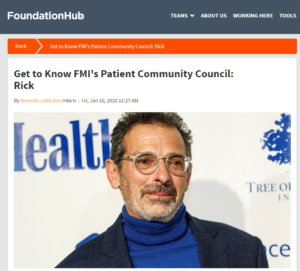
In December, 2018, FMI’s Patient Advocacy team launched the Patient Community Council (PCC). We have since been introducing patients and advocates on the PCC who work closely with FMI. Rick Davis is a member of our PCC and also leads the patient advocacy group AnCan. A longtime prostate cancer survivor, Rick reflects on the evolution of precision medicine, the importance of peer-to-peer support, and gives us a peek into his life in Southern Arizona. Read a full Q&A with PCC member Rick, below.
Can you talk about your diagnosis and treatment?
My own diagnosis was a total surprise. Largely because I had a doc who didn’t believe in PSA testing. Between tests, I went from a very low PSA to one that was quite high. It turned out that I had Stage III prostate cancer. I had to do a lot of treatment – two types of radiation and two years of hormone therapy. That was the bad news. The good news is, after the hormone therapy, I’ve had a durable and continuous remission, since 2010.
How did you get involved in patient advocacy?
As soon as I got my high PSA, I found a support group with a weekly meeting. I was living in Marin, California at the time. Within a year I was leading that meeting. That’s how I learned the ropes.
I started doing some advocacy at UCSF and then I got the idea to see what existed in terms of virtual online groups. Not written groups, but actual peer-to-peer conversations in real time. I found there was very little of that available. Building off of a community on Inspire (a health social networking site), we started having calls. Before long we were getting 10, 20, 30 people joining the calls, and it grew from there. We split the calls into more specific groups and added more meetings.
In 2016, our group split off and became a 501c3. We created Answer Cancer Foundation, which is now known as AnCan. We’re now running 8 prostate cancer groups a month, and we’ve got a few other groups too outside of prostate cancer.
What do the participants get out of the interactions in the virtual peer support groups?
I’d say a few things. First, we keep them up to date on technical advances in the field – whether it’s a new drug or a new test. Secondly, we help them in interacting with their medical professionals and taking charge of their treatment. If we had a catch line, it would be “you are your own best advocate.” And thirdly, we create a lot of camaraderie and peer support. Our meetings have to be peer-led. You’re talking about situations you’ve been through because that gives you credibility with everyone. They know you understand and they know you can relate.
What have been the major advances you’ve seen in precision medicine over the last few years?
I would say the major advancement in cancer treatment has been precision medicine. Precision medicine has really gotten established. I can remember 6 or 7 years ago, sitting in UCSF with a buddy of mine who was very sick, and talking about how he should get sequenced, and it seemed like a relatively new concept at the time.
What has it meant to participate in the Patient Community Council at Foundation Medicine?
I love your mission. I feel that a lot of the future of treatment will depend on germline or somatic testing. The opportunity to give you input and improve your interface with the patients is really rewarding. Because we hear from the patient side. If something’s not working, I’ll call you up and say – how can we improve this? Then you see the improvement happen. And then you don’t hear anything because it works.
Tell us about where you live
I live in Southern Arizona, 20 miles north of the Mexican border, in a small town called Tubac. My favorite part is the incredibly unique scenery. And the atmosphere and the ethos. It’s a really old community. There’s a trail near me that’s the original trail that the Spanish settlers took to trek up to San Francisco.
What are your hobbies?
I’ve been an endurance athlete for years. I do a lot of mountain biking and rowing. I’m probably the only rower south of Phoenix.
A recent book that you liked reading?
BJ Miller is a palliative care doc who’s also a triple amputee. He recently wrote a book called A Beginner’s Guide to the End. He’s a pretty amazing guy.
What’s something about you that most of your friends don’t know?
That I was a rugby hooker in high school. (Rick grew up in the UK.) It’s a position where you’re the little guy who’s right in the middle of the scrum. You just have big guys piling on top of you.
What advice do you have for someone working at FMI?
Admit to what you don’t know and ask for help. It’s a really good quality and it helps you gain respect.