
Sharing AnCan with cancer researchers
What ASCO is to cancer doctors, AACR (American Association for Cancer Research) is to cancer researchers. When AACR held its annual convention in April, a small number of patient advocates were invited to participate as part of AACR’s Scientist-Survivor Program.
Representing AnCan, I was one of 42 advocates chosen from more than 200 applicants. The AACR has long recognized the need for patient involvement in cancer research — the SSP program began 28 years ago.
It’s a convention within a convention. Every day we heard from lucid and charismatic speakers, some of them presenting slides that they would later present at the convention. Talks included
-
State of the Art of Precision Oncology – Edward Kim, a chief physician at City of Hope
-
Very Early Cancer Detection Assays – Caris Life Sciences president David Spetzler
-
Drug Discovery and Development – Paul Workman, of the Institute of Cancer Research in London
-
Evolution of Resistance – Carlo Maley of Arizona State University
Each talk was inspiring, but my favorite was Workman’s. A legendary figure in cancer drug discovery, he argued that by probing deeply into how a drug works before clinical trials, researchers can identify in advance which patients are most likely to benefit. Many drugs written off as failures actually work remarkably well for a small subset of patients. Yet those patients will never get the treatment, because the drug was judged on its lack of effect in the wider population.
We were split into 6-person groups, each assigned a mentor scientist. In my group, that was Jeremy Mason, a young computational biologist at UCLA.
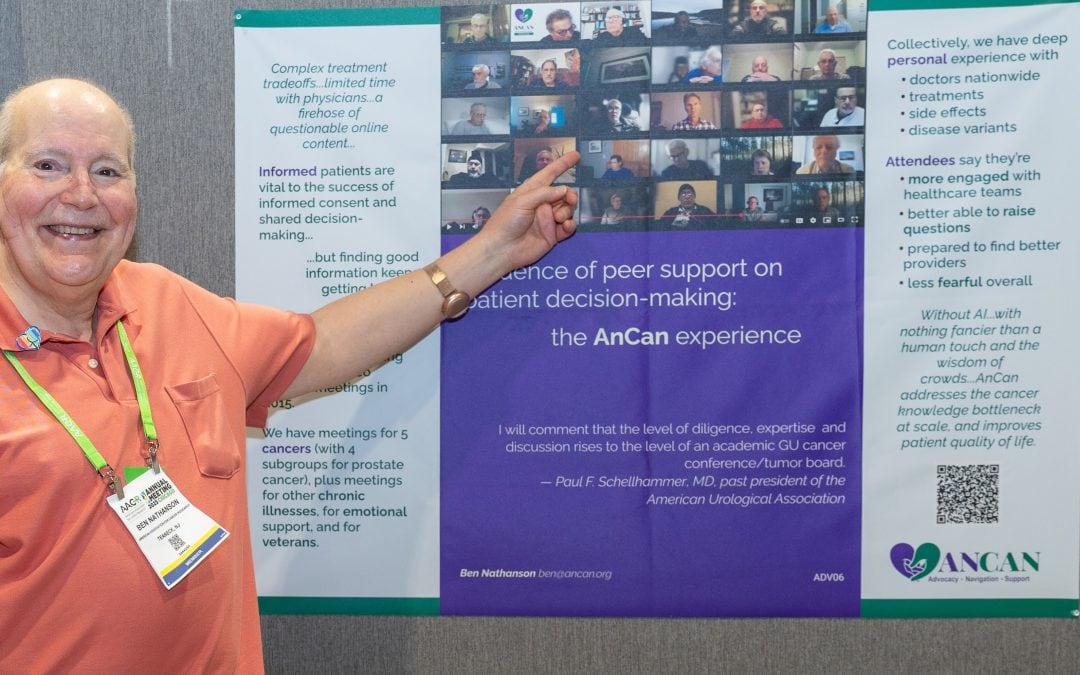
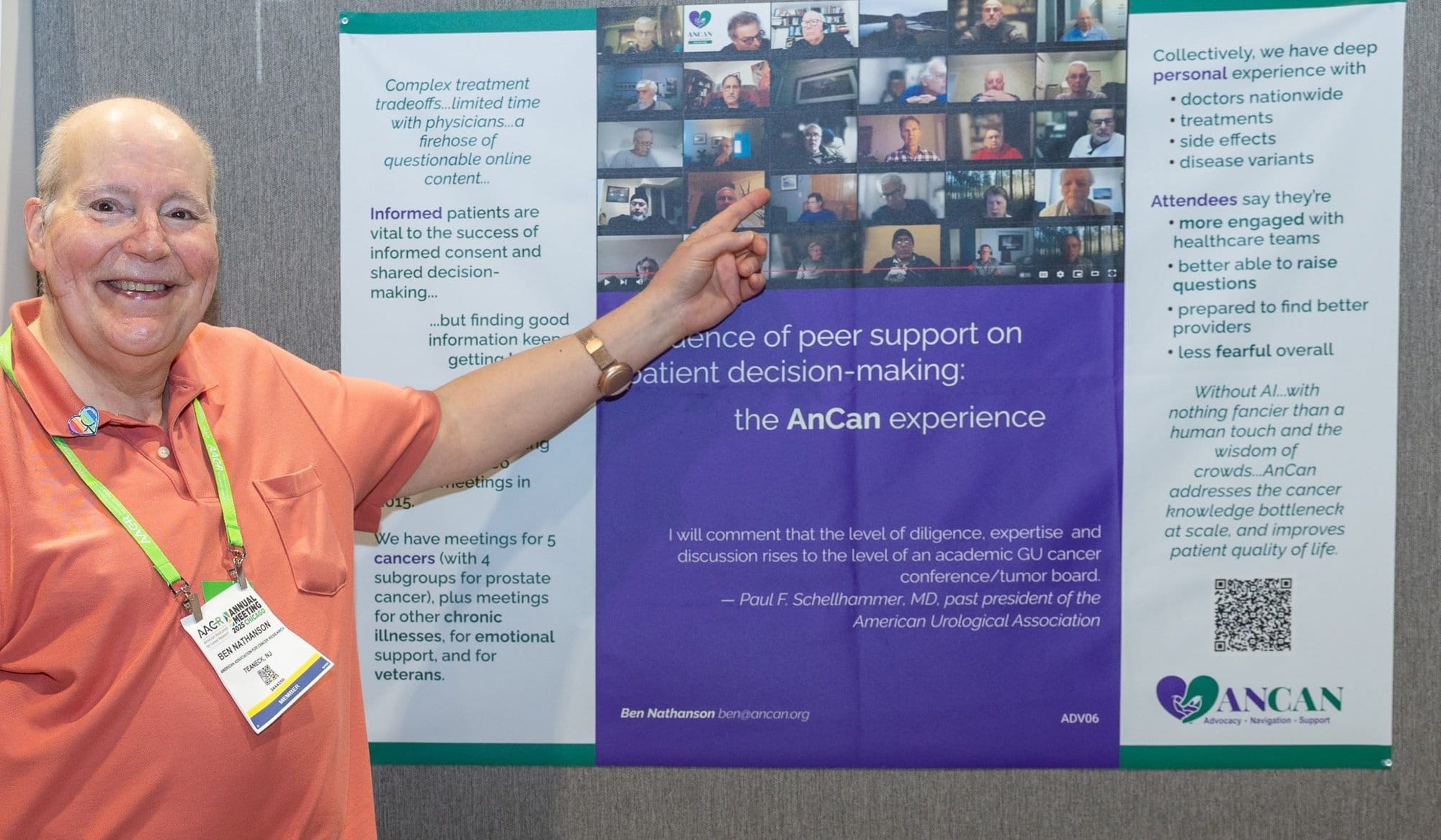
Advocates were required to present a poster at one of the general poster sessions. Mine showed AnCan’s unique benefit to cancer patients and others with chronic illness. Anchoring the poster was a quote from Dr. Paul Schellhammer, AnCan-er and past president of the American Urological Association:
I will comment that the level of diligence, expertise, and discussion rises to the level of an academic GU cancer conference / tumor board.
Most overwhelming for me was the passion and hard work of my fellow advocates, whose efforts included raising millions of dollars for research funding, helping create a research institute for a rare cancer, harnessing programming skills to codevelop AI with a cancer researcher, and initating an early-detection campaign for gay men at risk of anal cancer.