Inherited/Germline Mutations Video Chat Support Group – October 8th, 2026
Welcome to AnCan Foundation’s Inherited Mutations Virtual Support Group.
This is a quarterly, free, and drop-in video chat support group that takes place at 8 pm Eastern on the 2nd Thursday of October, January, April, and July at https://ancan.org/schmier
Our group is open to anyone touched by an inherited mutation of any type. That includes carriers, family members, and previvors. We are peer-led and discuss any and all issues surrounding inherited / germline mutations. Our group may include health care providers, but they’re always there as peers.
AnCan thanks Novartis for making this event and recording possible. Views expressed in this Recording are solely the opinion of AnCan Foundation, our Moderators, and Participants.
AnCan does not accept sponsored promotions. Any drugs, protocols, or devices discussed are based solely on anecdotal peer experience or clinical evidence. AnCan cannot and does not provide medical advice. We encourage you to discuss anything you hear in our sessions with your own medical team.
Chat Log:
David in Portland, OR 8:57 PM
UCSF exercise guide for prostate cancer patients: https://urology.ucsf.edu/sites/defaul…
Joel 9:00 PM
https://www.facingourrisk.org/researc…
David in Portland, OR 9:01 PM
Cancer Risks Associated With BRCA1 and BRCA2 Pathogenic Variants: https://ascopubs.org/doi/full/10.1200…
Rick Davis 9:15 PM
Cancer Risks Associated With BRCA1 and BRCA2 Pathogenic Variants: https://ascopubs.org/doi/full/10.1200…
Joel 9:37 PM
“hereditary conditions” or “inherited genetic conditions”?
David in Portland, OR 9:44 PM
According to ChatGPT, here are the top inherited diseases: Familial hypercholesterolemia, hereditary hemochromatosis, sickle cell disease, alpha-thalassemia, beta-thalassemia, G6PD deficiency, cystic fibrosis, alpha-1 antitrypsin deficiency, autosomal dominant polycystic kidney disease, neurofibromatosis type 1, Marfan syndrome, Huntington disease, Duchenne muscular dystrophy, myotonic dystrophy type 1, hemophilia A, phenylketonuria (PKU), spinal muscular atrophy, Tay-Sachs disease, Lynch syndrome, hereditary breast and ovarian cancer syndrome.
David in Portland, OR 9:44 PM
On a lighter note, I grew up reading comic books. It recently occurred to me that lots of comic book superheroes were mutants of one sort or another. They include: Marvel Comics — Mutants 1. Wolverine 2. Cyclops 3. Storm 4. Jean Grey (Phoenix) 5. Beast 6. Nightcrawler 7. Professor X 8. Magneto 9. Rogue 10. Iceman 11. Kitty Pryde (Shadowcat) 12. Colossus 13. Mystique 14. Gambit 15. Jubilee 16. Emma Frost 17. Psylocke 18. Cable 19. Bishop 20. Havok 21. Polaris 22. Banshee 23. Dazzler 24. Magik 25. Sunspot 26. Cannonball 27. Wolfsbane 28. Multiple Man 29. Forge 30. Angel (Archangel) Marvel Comics — Mutates 31. Spider-Man 32. Hulk 33. Mr. Fantastic 34. Invisible Woman 35. Human Torch 36. The Thing 37. Deadpool 38. Daredevil 39. She-Hulk 40. Luke Cage 41. Jessica Jones 42. Captain America 43. Cloak 44. Dagger 45. Spider-Woman DC Comics — Metahumans and Transformed Heroes 46. The Flash 47. Black Canary 48. Beast Boy 49. Firestorm 50. Static 51. Captain Atom 59. Halo 60. Thunder
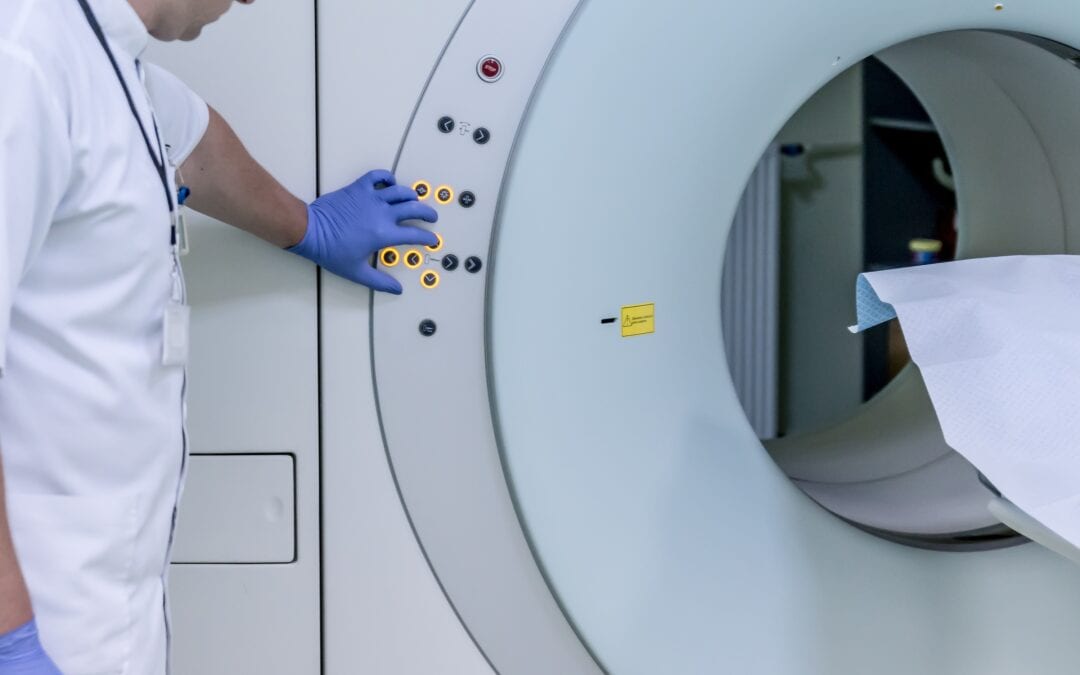
How I Got a Pancreatic MRI for Free – And How You Might, Too (or at a Reduced Cost)
By: David Sharp
Since finding out last year that I have a BRCA1 germline mutation, I’ve been keenly aware that it raises my lifetime pancreatic cancer risk to nearly 5%, compared with 1.7% for the general population.
The overall five-year pancreatic cancer survival rate is only about 13%, largely because this aggressive, stealthy cancer is often diagnosed after it’s already spread. For that reason, my medical oncologist recommended an annual pancreatic MRI to catch it early, just in case. That made abundant sense to me, so I scheduled the scan at OHSU, a major medical center here in Portland, Oregon. I assumed that between my BRCA1 mutation and pancreatic cancer’s lethality, original Medicare—my health insurer—would pick up the tab, which would otherwise cost me a few thousand dollars.
Turns out, Medicare probably won’t.
Why not? In part, Medicare relies on guidelines from major medical societies to determine what it will cover. Unfortunately, those societies have failed to reach the kind of strong scientific consensus that Medicare likes to see when deciding whether to pay for a procedure or test. The American Society for Gastrointestinal Endoscopy recommends pancreatic cancer screening for BRCA1 carriers regardless of family history, citing research suggesting that limiting screening to people with a family history could miss two out of three pancreatic cancer cases.
By contrast, NCCN guidelines recommend pancreatic screening for BRCA1 carriers only if they also have a close relative with pancreatic cancer. Having no family history of pancreatic cancer would normally be good news. But my lack of a family history worsens my chances of convincing Medicare to ante up.
What’s more, Medicare would view my pancreatic MRI as a “screening” rather than “diagnostic” test because I have no pancreatic cancer symptoms or diagnosis. Medicare automatically covers screening for several other cancers, including prostate, breast, and colon. But pancreatic cancer screening for a BRCA1 patient like me isn’t one of its specifically listed preventive benefits, further reducing the odds that Medicare will pay.
To double check that, I contacted many OHSU staff members and several experts in hereditary cancer and health insurance, including Pamela Munster, M.D., a top BRCA expert at Stanford University; Lindsay Byrne, a genetic counselor at The James Comprehensive Cancer Center (Munster and Byrne recently appeared in a highly informative AnCan webinar on genetic counseling for families: https://www.youtube.com/watch?v=2UvlUdKPKV8); Lisa Schlager, vice president for public policy at FORCE (an organization that assists people facing hereditary cancer); and Amanda Goodstadt, a senior staff attorney at Triage Cancer (which educates people about legal, insurance, and other issues that arise after a cancer diagnosis). Their view: Medicare isn’t likely to help.
I next looked into clinical trials that might provide a pancreatic MRI for free. Several are currently recruiting BRCA1 carriers, but I kept failing to qualify for the most ironic of reasons: I had either too much cancer or not enough. In some cases, my prostate cancer history excluded me; in others, I lacked the required family history of pancreatic cancer.
Then I tried another route: I canceled the MRI and applied for OHSU’s financial assistance program. My wife and I have little taxable income because we’re delaying Social Security to increase the size of future benefits and living on retirement savings and investments in the meantime. Two weeks after applying, I received a letter from OHSU stating that it had granted me 100% financial assistance for the next 12 months. After that, I can apply again. Medicare’s restrictions suddenly became irrelevant.
I celebrated for about five seconds. Then I read the fine print. OHSU’s policy had restrictions of its own, including certain services considered non-covered or medically unnecessary under Oregon Health Plan rules. I thought, “Oh, shit. Another bureaucratic quagmire.”
It took more than a dozen calls to find the right person, but eventually I spoke to OHSU’s revenue cycle operations manager for the Department of Surgery. Her title is a mouthful, but she turned out to be the key individual in the OHSU hierarchy who could help. I explained my predicament and told her I didn’t feel comfortable proceeding with the pancreatic scan without written confirmation that OHSU’s financial assistance program would cover it.
A few hours later, a written guarantee appeared in my patient portal. Success! My MRI is now rescheduled for December 4, and it’s on the house. Because BRCA1 also raises the risk of male breast cancer, I can use the same financial assistance for an oncologist-recommended mammogram, skin cancer check, and upper endoscopy.
Obviously, this solution won’t work for everyone. And it may not even work for me in a couple of years, once my wife and I start receiving Social Security and no longer qualify for financial assistance. But my hunt for a free pancreatic scan taught me the following seven strategies that may reduce my health care spending in the future—and may save you some bucks now:
1.) Ask hospitals about financial assistance and discounts. OHSU, for example, offers a self-pay rate that cuts 35% off the bill for uninsured patients. 2.) Look for clinical trials that cover the cost. I struck out, but you might not. 3.) Don’t rely on optimistic assurances from hospital employees that your insurer will pay; they’re often wrong. 4.) Don’t waste time seeking guidance through original Medicare’s live chat. I found it useless. 5.) If you’re promised free or discounted care, get it in writing before the procedure—and check the exclusions. 6.) Don’t assume your insurer will pay simply because your doctor strongly recommends a procedure. 7.) Most importantly, keep knocking until the right door opens.
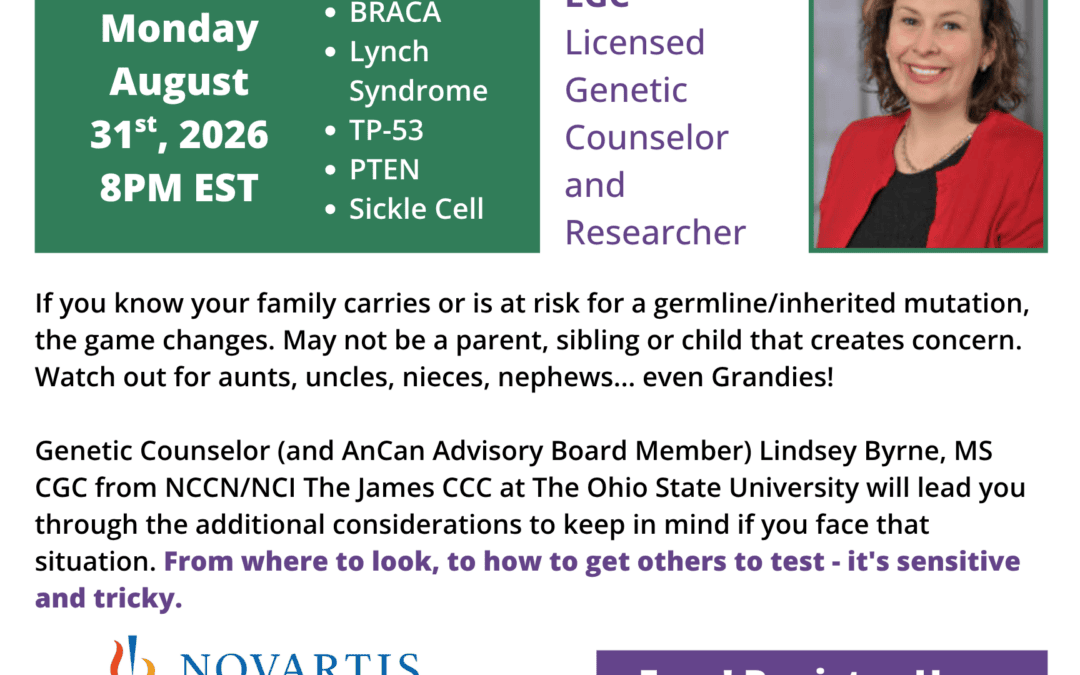
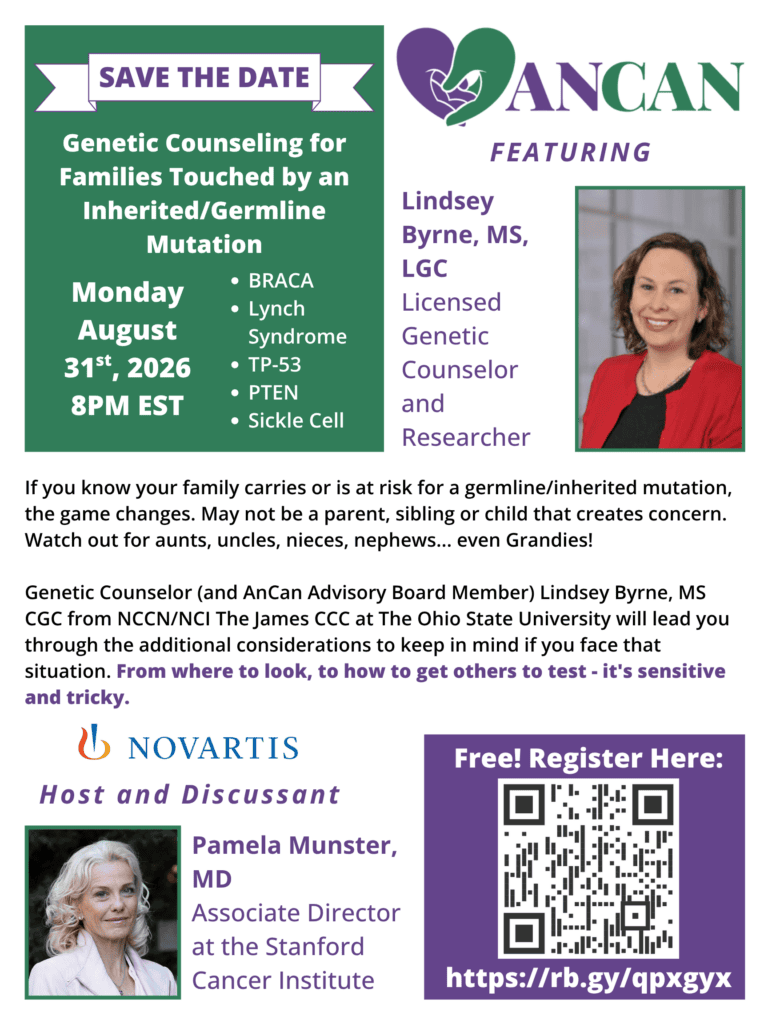
If you know your family carries or is at risk for a germline/inhetited mutation, the game changes. It may not be a parent, sibling, or child that creates concern…watch out for aunts, uncles, nieces, nephews, even grandparents! Genetic Counselor and AnCan Advisory Board Member, Lindsey Byrne, MSCGC from NCCN/NCI The James CCC at Ohio State University, will lead you through the additional considerations to keep in mind if you face that situation. Including where to look and how to get others to test. Alongside her, we will have Dr. Pamela Munster, now at Stanford, who will present and discuss. We’ll also have a panel featuring some faces you are sure to recognize!
Hi-Risk/Recurrent/Advanced PrCa Video Chat, Aug 11, 2026
Substack is coming to AnCan… or maybe AnCan is coming to Substack. We’ll be posting the best of all our Reminders. Watch our for more details.
COMING IN SEPTEMBER… AnCan Heart Group – new support group for all things cardio and open to all! To sign up for Reminder at https://ancan.org/contact-us/. For ProsCard mailing list, please write to rd@ancan.org.
AnCan thanks the following sponsors for making this recording possible: Novartis, Blue Earth Diagnostics and Foundation Medicine.
Views expressed in this Recording are solely the opinion of AnCan Foundation, our Moderators and Participants.
AnCan does not accept sponsored promotion. Any drugs, protocols or devices discussed are based solely on anecdotal peer experience or clinical evidence.
AnCan cannot and does not provide medical advice. We encourage you to discuss anything you hear in our sessions with your own medical team.
AnCan reminds all Participants that Adverse Events experienced from prescribed drugs or protocols should be reported to the pharmaceutical manufacturer or the FDA Adverse Event Reporting System (FAERS). To do so call 1-800-332-1066 or download interactive FDA Form 3500 https://www.fda.gov/media/76299/download
All AnCan’s groups are free and drop-in … join us in person sometime! You can find out more about our 12 monthly prostate cancer meetings at https://ancan.org/prostate-cancer/ Sign up to receive a weekly Reminder/Newsletter for this Group or others at https://ancan.org/contact-us/
Join our other free and drop in groups:
Men (Only) Speaking Freely…1st & 3rd Thursdays @ 8.00 pm Eastern https://ancan.org/men-speaking-freely/
Veterans Healthcare Navigation… 1st & 3rd Tuesdays @ 8.00 pm Eastern Schmier Room https://ancan.org/veterans/
Veterans Speaking freely… 4th Tuesday @ @ 8.00 pm Eastern Schmier Room
Editor’s Pick: Toss up between the silver lining in HT treatment, and slow T recovery.
Topics Discussed
Originally AS Newbie graduates to T3 maybe T4 treatment; mono daro working but dental issues arise; Alaska doc needs a solid GU QB; pros and cons of tolerating hormone therapy; post-RP PSA still going down; … and post RT/HT PSA declining for our Poet; whole body MRI vs PSMA scans for monitoring; still getting the runaround for GU MO at Sibley – but RO set; follow up PSMA now negative for younger Gent; leg pain and fatigue likely not from HT drugs; MRI on T10 prior to spot RT; heavy brain fog suggests switching ARSI but Pluvicto follows; T recovery slow but after 7 months – don’t panic
Chat
Steve Schuler (Seattle) sent: 3:30 PM
My Rad Onc at Fred Hutch was Jonathan Chen, and I felt like he provided competent care. My oncologist was Evan Yu; he’s been bumped up, and now it is Rajitha Sunkara. I like her.
Jim Ekrut, Ft. Worth TX sent: 3:33 PM
I recommend Biologics by McKesson or Onco360 as specialty pharmacies with access to financial aid. I received a grant from PAN through Biologics that covered all costs for one year of Orgovyx.
Steve L sent: 3:36 PM
UW Northwest is the location for Proton Therapy. They may also do other radiation treatment.
Steve Schuler (Seattle) sent: 3:45 PM
I talked to my oncologist (Rajitha Sunkara). and referenced the PATCH study.
Jim Marshall, Vet Sup Grp. Moderator sent: 3:58 PM
CASODEX = Bicalutamide Jim
Jim Ekrut, Ft. Worth TX sent: 4:12 PM
I finished eighteen months of Orgovyx June 19. It did exactly as intended alongside radiation, with my PSA <.01 and testosterone <10 for a full year. My PSA was measured Friday 8/7 , almost seven weeks post-treatment, still <.01 but testosterone has risen to 48. That said, I experienced every side effect listed on the Orgovyx website and more.
Sorry to leave, but I have another meeting commitment. Thanks for the support. All the best!
Jeffrey G sent: 4:21 PM
How old is he?
AnCan–John A sent: 4:21 PM
64
Dave Lied – Pittsburgh sent: 4:23 PM
Thank you all for the informative discussion tonight. Sorry to leave early.
Jim Marshall, Vet Sup Grp. Moderator sent: 5:12 PM
Was on ADT for 5 years, did not budge for 3+ years. Then and now less than 50, Jim
Steve Schuler (Seattle) sent: 5:15 PM
thank you for the feedback, exactly what I wanted!
Barry Blomquist sent: 5:15 PM
Thanks guys good information – next week.
Steve Schuler (Seattle) sent: 5:16 PM
I had been on Zometa when I had teeth removed, and my oral surgeon gave me Pentoxifylline 400mg + vitamin E 450mg for 60 days, which is apparently a protocol that increases blood flow (perfusion ?) and reduces risk of jaw necrosis
Jim Marshall, Vet Sup Grp. Moderator sent: 5:18 PM
When Abi caused Liver issues, I got dropped from 4 to 3 pills a day and good for the next 5years.
Steve Schuler (Seattle) sent: 5:19 PM
EMBR worked for me moderately well, but I dropped it when I started E2, which was a great help to me
Inherited/Germline Mutations Video Chat Support Group – July 9th, 2026
Welcome to AnCan Foundation’s Inherited Mutations Virtual Support Group. This is a quarterly, free, and drop-in video chat support group that takes place at 8 pm Eastern on the 2nd Thursday of January, April, July, and October at https://ancan.org/schmier.
Our group is open to anyone touched by an inherited mutation of any type. That includes carriers, family members, and previvors. We are peer-led and discuss any and all issues surrounding inherited / germline mutations. Our group may include health care providers, but they’re always there as peers.
Educational presentations are made separately – we are planning a webinar for Monday, Aug 31st, addressing “Genetic Counseling for Families Living with Inherited Mutations”. For more information on the group or upcoming webinar, please write info@ancan.org.
AnCan thanks Novartis for making this event and recording possible. Views expressed in this Recording are solely the opinion of AnCan Foundation, our Moderators, and Participants.
Topics Discussed:
Robust discussion around the experience of sharing a diagnosis with family members. How do you get others to test, especially offspring?
What follow-up is your Provider ordering? Is it sufficient?
Chat Log:
AnCan – Rick sent: 5:37 PM
We are definitely sponsored by Novartis as part of our Survivorship sponsorship. We’ll include it on the web page and the reminder.
David in Portland, OR sent: 6:20 PM
“Cancer Risks Associated With BRCA1 and BRCA2 Pathogenic Variants,” 2022https://ascopubs.org/doi/full/10.1200…
AnCan – Rick sent: 6:24 PM
From Bill H….. The BRCA1 mutation has an increased risk for breast, fallopian tube, ovarian, primary peritoneal, pancreatic, and prostate cancers. (from FORCE).
Finding out whether you’ve inherited a cancer-causing genetic mutation from a parent can add an important puzzle piece to your prostate cancer diagnosis. That information can affect whether you should be screened for other cancers, whether blood relatives should also consider getting tested, and even which prostate treatments you might want to pursue.
The genes most closely associated with harboring inherited mutations that cause prostate cancer include BRCA1, BRCA2, HOXB13, ATM, CHEK2, PALB2, TP53, PTEN, MSH2, and MSH6. As they pass from one generation of a family to the next, these harmful mutations (also called pathogenic variants) put recipients at increased risk of developing other types of cancers, such as breast, ovarian, endometrial, colorectal, pancreatic, and melanoma.
A germline (inherited) genetic test can reveal whether you carry any of these variants. The test will check your saliva, a cheek swab, or your blood for inherited mutations. If you have one, it exists in every cell of your body. Testing positive doesn’t mean you’ll necessarily develop another cancer, but it indicates that extra monitoring will be warranted. Aside from any cancer-causing variants you might have acquired from a parent, cancer cells can make their own mutations. A separate analysis of your biopsied tumor tissue—called a somatic test—can show if that’s happened in your case.
Learning that you have a germline variant is a red flag that other blood relatives who may have inherited the same mutation should consider getting tested, too. A positive result could also influence your treatment choices. If you carry a BRCA2 mutation, for instance, your treatment options may expand to include PARP inhibitors, drugs that tend to work best in prostate cancers with changes in that particular gene.
Having prostate cancer raises the chance that you carry an inherited variant. One analysis found germline BRCA1/2 variants in 4.47% of prostate cancer patients overall and 5.84% of those with metastatic disease, compared with roughly 0.25% to 1% in the general population.
Family history matters, too. If blood relatives have had prostate, breast, or other cancers linked to inherited variants, the case for testing is stronger. The same is true if your ancestry is associated with higher-than-normal rates of certain variants. For instance, the incidence of BRCA-related variants is significantly increased among Greenlandic Inuit, Ashkenazi Jews, and people with ancestry from Whalsay, Shetland, or Orkney in Scotland. Breast cancer studies also suggest elevated inherited BRCA1/2 rates among patients from the Bahamas, Nigeria, and Trinidad and Tobago.
If you test positive, AnCan is ready to help. We host a quarterly online support group for people with inherited pathogenic variants. It meets on the second Thursday of each quarter at 8 p.m. Eastern in the AnCan Schmier Room. AnCan also offers an email list that makes it easy for men with prostate cancer and inherited mutations to share information.