Interpreting Prostate Needle Biopsies in Today’s World
Interpreting Prostate Needle Biopsies in Today’s World
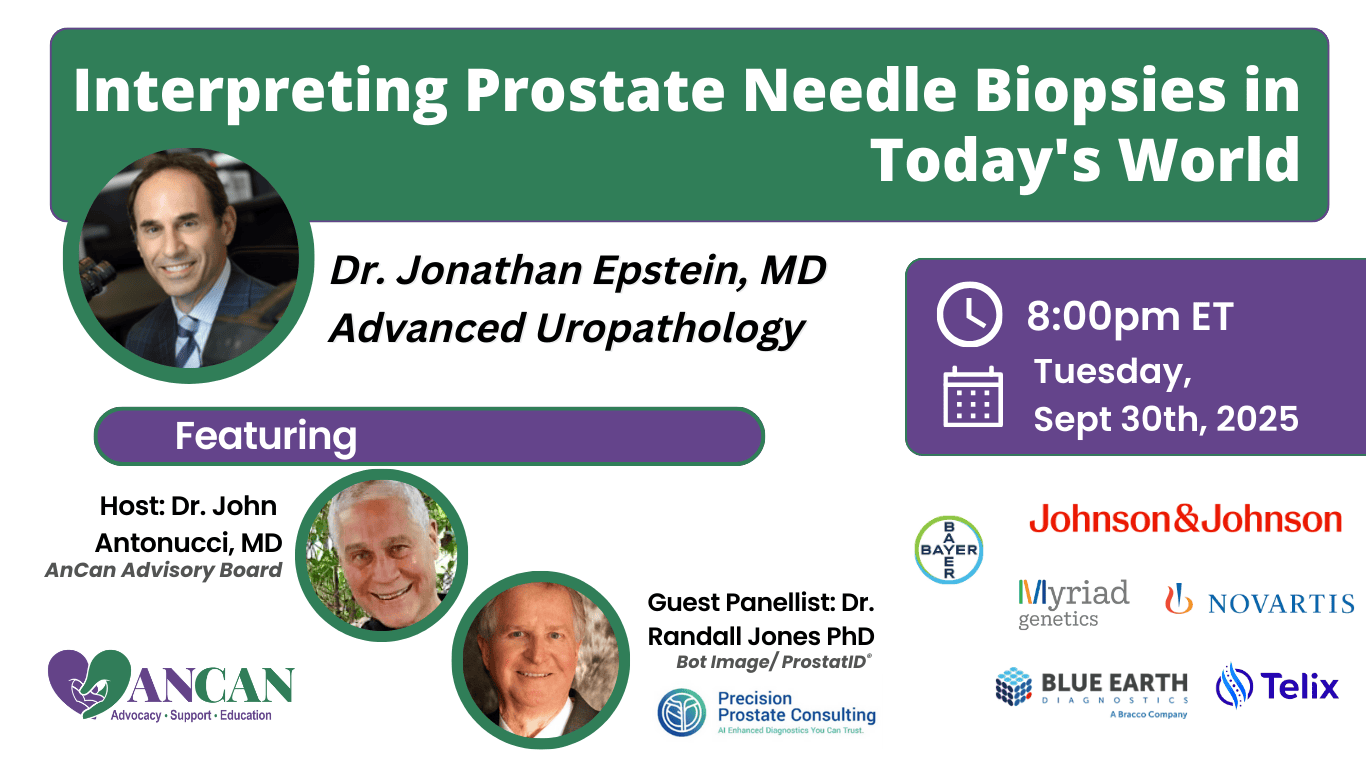
Dr. Jonathan Epstein, MD, Advanced Uropathology
Reliable biopsies are critical to selecting the right treatment at all stages of prostate cancer – we’re talking needle tissue, not blood, btw. Get it wrong and you may get too much or too little treatment.
Reading pathology is part art and part science! AnCan Advisory Board Member, Dr. Jonathan Epstein is globally acknowledged to have the best eye in the genitourinary pathology world. AnCan frequently refers men to him for a 2nd opinion. His presentation will include:
Getting the most out of a 2nd Opinion
The relevance of cribriform, intraductal, ductal, & small cells
What ASCO is to cancer doctors, AACR (American Association for Cancer Research) is to cancer researchers. When AACR held its annual convention in April, a small number of patient advocates were invited to participate as part of AACR’s Scientist-Survivor Program.
Representing AnCan, I was one of 42 advocates chosen from more than 200 applicants. The AACR has long recognized the need for patient involvement in cancer research — the SSP program began 28 years ago.
It’s a convention within a convention. Every day we heard from lucid and charismatic speakers, some of them presenting slides that they would later present at the convention. Talks included
State of the Art of Precision Oncology – Edward Kim, a chief physician at City of Hope
Very Early Cancer Detection Assays – Caris Life Sciences president David Spetzler
Drug Discovery and Development – Paul Workman, of the Institute of Cancer Research in London
Evolution of Resistance – Carlo Maley of Arizona State University
Each talk was inspiring, but my favorite was Workman’s. A legendary figure in cancer drug discovery, he argued that by probing deeply into how a drug works before clinical trials, researchers can identify in advance which patients are most likely to benefit. Many drugs written off as failures actually work remarkably well for a small subset of patients. Yet those patients will never get the treatment, because the drug was judged on its lack of effect in the wider population.
We were split into 6-person groups, each assigned a mentor scientist. In my group, that was Jeremy Mason, a young computational biologist at UCLA.
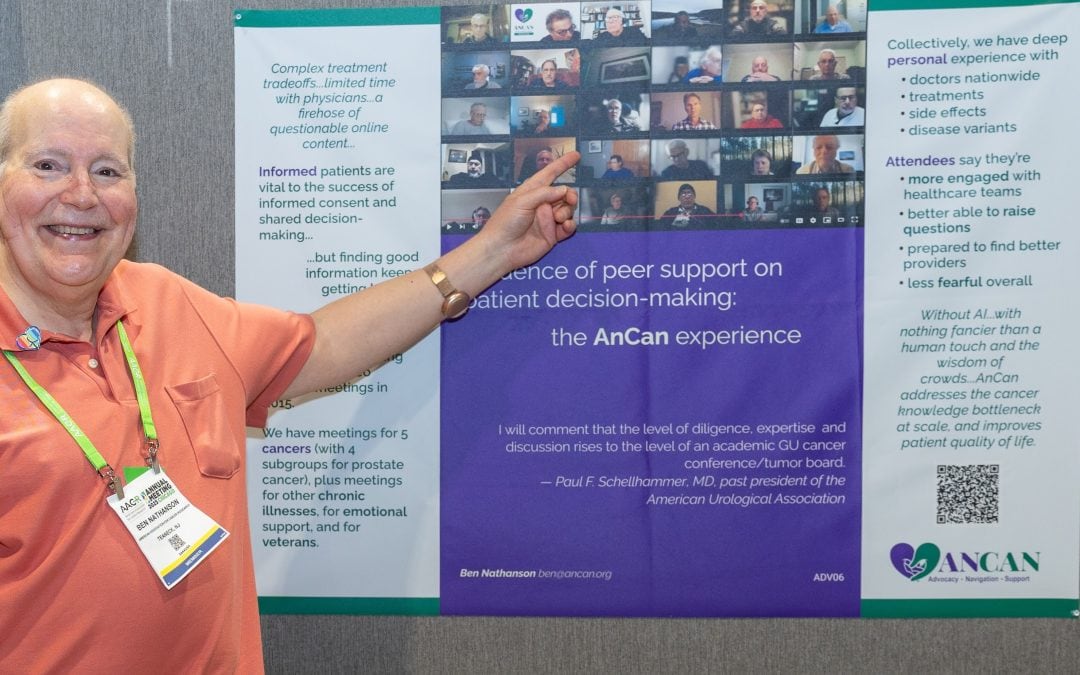
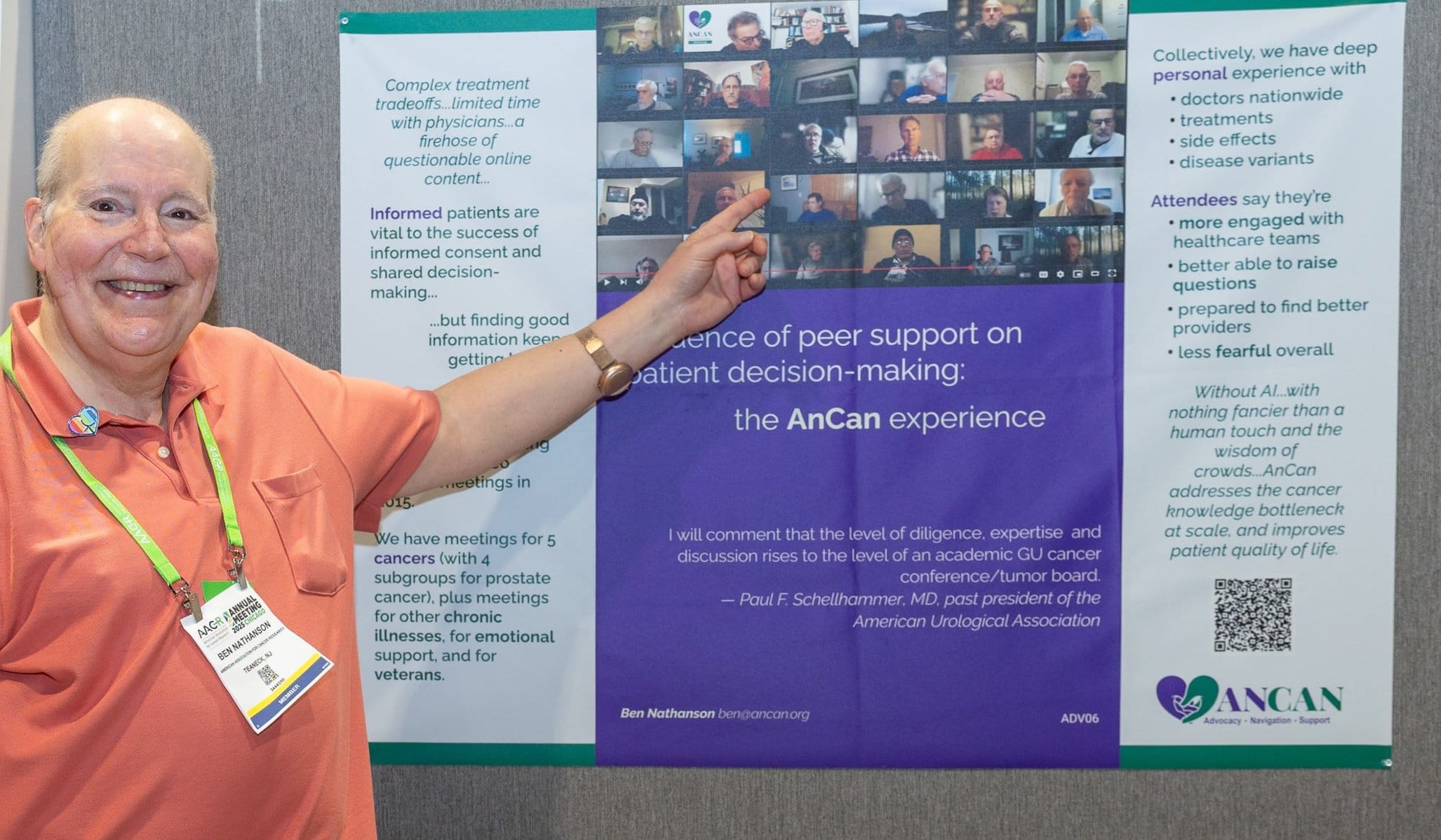
Advocates were required to present a poster at one of the general poster sessions. Mine showed AnCan’s unique benefit to cancer patients and others with chronic illness. Anchoring the poster was a quote from Dr. Paul Schellhammer, AnCan-er and past president of the American Urological Association:
I will comment that the level of diligence, expertise, and discussion rises to the level of an academic GU cancer conference / tumor board.
Most overwhelming for me was the passion and hard work of my fellow advocates, whose efforts included raising millions of dollars for research funding, helping create a research institute for a rare cancer, harnessing programming skills to codevelop AI with a cancer researcher, and initating an early-detection campaign for gay men at risk of anal cancer.
Who Should Consider HIFU as Treatment for Prostate Cancer?
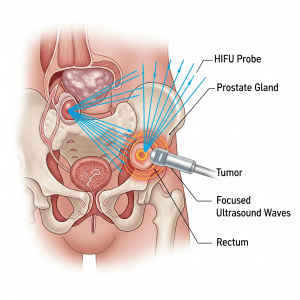
Focal therapies, and HIFU specifically, have been proposed as alternative therapy for intermediate prostate cancer. For a certain subset of intermediate prostate cancer cases, ones where the cancer is limited to a specific region of the prostate, the idea of a localized treatment that only targets the cancer and does not treat the rest of the gland is a possibly appealing option. HIFU and other focal treatments have been documented to be able to ablate the cancer tissue while also offering reduced side effects and quicker recovery.
But does HIFU really live up to its promise? Research has delivered mixed results on the effectiveness of the treatment and the risk of recurrence. Some studies have found it to be non-inferior to surgery or radiation (“non-inferior” is medical terminology for “no worse than”). Others have reported reduced side effects but with higher recurrence rates. This leaves the patient with the question of whether the benefit is worth the risk. The question of recurrence is an important one, and if you do some research, or ask various urologic oncologists, you will hear a wide range of rates of recurrence. So it was with great interest earlier this year that we learned UCSF was publishing results of a study they conducted to assess the use of HIFU and the risk of recurrence. For anyone considering HIFU as their treatment option, the report should be required reading. The report confirmed the desired reduction in side effects. But the recurrence results should be taken seriously. Their patients had an overall 54% recurrence rate, with a 41% in-field recurrence rate after 12 months. (“In-field recurrence” suggests that HIFU did not successfully eliminate the target cancer.) The study goes on to explore why they think their results were higher than some previous studies. The study also explores the correlation between pretreatment characteristics and ultimate results, suggesting that tight screening should be used in determining appropriate candidates. For me, the report was very interesting as it hits very close to home. Just 12 months ago I had been offered HIFU by my doctor as his recommended treatment option. Luckily for me, I learned to ask enough questions and took the time to research the risks. And in the end, I wasn’t ready to accept the risk of recurrence and chose to go for a more aggressive approach to reduce my risk of having to treat again. So if you are going to consider HIFU as a treatment option, be prepared to ask yourself the old Dirty Harry line: “Do You Feel Lucky?”
-Stuart Jordan
For more information or questions, please contact stuart@ancan.org.
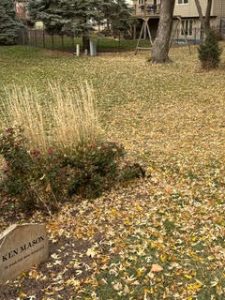
It’s always incredibly difficult to say goodbye to members of our AnCan community, as each person—whether a patient, survivor, carepartner, volunteer, moderator, or a board or advisory board member—means so much to us. We are deeply saddened by the passing of Ken Mason, who was one of those cherished individuals.
A true friend, Ken lived his life with an infectious zest that inspired everyone around him. His laughter was a melody that brightened the darkest days, and his kindness knew no bounds. Whether he was sharing a clever (or terrible) joke, offering a shoulder to lean on, or simply lending an attentive ear, Ken made everyone feel valued and loved. His sincerity was a rare gem, shining brightly through his genuine interactions with friends and strangers alike. A man of both humor and heart, Ken’s legacy will continue to touch lives and bring smiles for generations to come.
AnCan Founder Rick Davis said:
I loved this man.
News of Ken’s demise was just like one of his crummy jokes – no one wanted to hear it.
Ken cared so much for others. Gary described his beloved as ’empathy, silliness and love’ exuding ‘kindness’. I might add to those qualities his quick wit and sense of humor. I feel honored to have been frequently on the receiving end of Ricklesian insults.
I had the privilege of supporting Ken virtually from around 2013 onwards through his four cancers. While all relatively benign, Ken shouldered the anxiety like the trooper (or MP??) he always was. Whatever bothered Mason was never the cancer.
Mason, as he self identified, was a treasured moderator for our AnCan virtual support groups. He always empathized. If a pressing issue was not voiced, Ken surfaced and addressed it. Every Group he attended is grieving.
I will forever miss Ken’s homespun, invariably impractical advice offered with the very best of intentions. I became expert in dismissing them without offending him, and was comforted when I read he offered comparable suggestions to Howard Wolinsky.
We had the privilege of meeting several times, the first with Gary when they came to dinner. It’s timely that I recently opened the balsamic you both gave me. Ken, G-d Rest His Soul, lived so much of his life in the present right to the meditation retreat at the very end. I doubt he would have planned his demise better.
Myself as well as all who knew Mason at AnCan offer Gary and Family much comfort. For us and all who knew Ken, his memory will always be a blessing.
I loved Ken—most in the PCa world called him “Mason”—like a brother. We all did.
He kept me and everyone in stitches at support groups for men with low-risk PCa.
Ken also asked great questions—though he didn’t seem to know it. Communicating with Ken, especially privately, could create Zen moments—and laughter. He was the prototype Laughing Buddha, without the pot belly.
Ken wanted to be called Mason because as he stated he “was in witness protection (he was not) with warrants (false)” and the only way he was able to participate was to “use an alias”. While his husband Gary described him beautifully as ‘the purest, kindest soul I know’—full of empathy, silliness, and love—Ken also had a wonderful knack for delightful ‘BS,’ which, frankly, only made us love him even more.
We shared memories of Ken with Gary during the first part of our Active Surveillance meeting. If you did not get the privilege to meet Ken, we encourage you to listen to stories and some of his classic “Ken Jokes”
A Celebration of Life will be held on Sunday, October 26th, 2- 5pm at Barred Owl at the Scarlet Hotel, 2101 Transformation Dr 6th Floor,, Lincoln, NE 68508. The event will be streamed virtually – AnCan will provide details. Bring your worst jokes.
Thank you Ken for all the time you graciously shared, the love, support, and the laughs. May his memory always be a blessing!
Taking on the role of a care partner can feel overwhelming, but you don’t have to navigate it alone. Many experienced care partners will tell you that with a little guidance, it can also be a deeply fulfilling experience. To help you on your journey, we’ve compiled some helpful resources available online.
1.Leaning Into Grief: An Interview With Claire Bidwell Smith
Claire Bidwell Smith is a therapist, grief expert, and author. Click here for her interview about leaning into grief.
2. Cancer Today: Addressing Anger
Anger and Irritability are normal responses to a cancer diagnosis, and this article offers guidance for care partners of cancer patients.
3. NCCN Guidelines for Patients: Palliative Care
The National Comprehensive Cancer Network released an easy to read, patient-centric Palliative Care guidelines that you can view and download. Click here.
4. “Caregiver Life Hacks”
There’s no one-size-fits-all way to care for someone because every care partner and situation is different. What helps one person might not work for another, but many care partners deal with similar challenges. Click here for some simple “life hacks” that might make your day a little easier.
5. “Caregivers Need Care Too”
“However, primary care partners are also thrust into an unfamiliar world of medical treatments, terminology, and appointments. This is why mutual support between the patient and the primary care partner is important—it is a partnership through thick and thin because both the patient and primary care partner need to learn about the complexities of the disease and treatments needed, as well as make important decisions together.” Click here for the full article.
6. Triage Health Caregiver Resources
Click here for a full list of resources about legal and practical matters like taking time off from work, managing family finances and medical bills, replacing lost wages, estate planning, and other resources.
7. Cancer Straight Talk Podcast: Advice and Support for Cancer Caregivers
The podcast Cancer Straight Talk features host Dr. Diane Reidy-Lagunes speaking with Dr. Allison Applebaum, the founder of the Caregivers Clinic at Memorial Sloan Kettering Cancer Center (MSK). This episode covers navigating the healthcare system and managing the emotions of caregiving.
8. Patient Power: Power of Care Partners: Who Has your Back?
This article is about the crucial role of care partners for people with chronic illness. It distinguishes a “care partner” as a full member of the care team, not just a caregiver. The article also provides advice on practical matters, like having a designated care partner with access to medical records, and emphasizes the importance of care partners looking after their own well-being.



 Ken cared so much for others. Gary described his beloved as ’empathy, silliness and love’ exuding ‘kindness’. I might add to those qualities his quick wit and sense of humor. I feel honored to have been frequently on the receiving end of Ricklesian insults.
 Advisory Board Member Howard Wolinsky