As some of you may know, the liberal telehealth rules to conduct medical appointments remotely that were enabled during Covid, sunsetted late last year. AnCan was upset and vocal that many of our patient advocacy organizations active on The Hill did not campaign more widely to extend it. Organizations like ZERO (prostate cancer) have significant and expensive government relations groups precisely to address such issues on behalf of us patients. AnCan had to bring it to ZERO’s attention to move the ball at a time when ZERO’s high paid CEO was self-admittedly sleeping on the switch.
Telehealth was temporarily extended for those living in rural areas. Then one of our newly minted prostate cancer Moderators, David Sharpe, brought it to AnCan’s attention that legislation was passed on Feb 3, 2026 that has extended comprehensive telehealth through the end of 2027. We asked David to blog its welcome return to wider availability and tell his story around telehealth – thank you Mr. Sharpe!
Medicare Telehealth Coverage Is Extended
The federal government has restored Medicare coverage for telehealth until the end of 2027. That means you can now possibly consult with your doctors online rather than having to meet with them in-person.
Why did I say possibly? Because state medical licensing laws still apply. Often, they can undermine your doctor’s ability to join you on the call. Here’s why: (Don’t construe the following comments as legal or medical advice. This is general information only.)
Telehealth consultations are easiest to arrange when a patient and doctor are in the same state. For instance, if you live in Springfield, Illinois, and want to have a virtual chat with an oncologist in Chicago, no legal impediments are likely to stand in your way.
Things can get tougher if the doctor practices in another state. Physicians are typically required to be licensed in the state where the patient is physically located during the consult. Therein lies a common problem: the doctor is licensed in one state, and you’re in another.
But loopholes exist. According to the Center for Connected Health Policy (CCHP), “A few states have licenses or telehealth-specific exceptions that allow an out-of-state provider to render services via telemedicine in a state where they are not located, or allow a clinician to provide services via telehealth in a state if certain conditions are met (such as agreeing that they will not open an office in that state). Still other states have laws that don’t specifically address telehealth and/or telemedicine licensing, but make allowances for practicing in contiguous states. . . .” For specifics about your state’s rules, explore CCHP’s handy state-by-state guide: https://www.cchpca.org/topic/cross-state-licensing-professional-requirements/.
Despite those exceptions, many physicians and medical centers require patients to be in the same state as the doctor during telehealth appointments. I wish I’d known that last year, before trying to set up virtual consultations from my home in Portland, Oregon, with Fred Hutch (Washington), UCSF, City of Hope (both California), and MD Anderson (Texas0—all of whom turned me down. Oregon Health & Science University (OHSU, Oregon)) would have refused, too, if I had been in any other state.
But some physicians and hospitals were more relaxed about it. Despite remaining in Portland, I wrangled a telehealth visit with a UCLA specialist. Two AnCan buddies of mine in Oregon and Arizona did so as well. I had even better luck with out-of-state doctors in community practices. Two agreed to confer with me online, and one declined.
If you live near—but not in—the state where your doctor practices, perhaps the easiest option is to make a run for the border. One AnCan member has adopted that strategy as a convenient means of communicating with his faraway medical team in an adjacent state while also satisfying the legal requirements. To have that meeting, he travels a few miles from home to a casino just across the state line; the casino lets him conduct telehealth consultations there. That approach shaves hours off what would otherwise be a protracted road trip to talk with his doctors face-to-face. # # #
Living with Visual Snow – a Therapist’s Perspective with Dr. Paula Hechinger
“My approach to Visual Snow Syndrome was born from my own journey from being a depressed and isolated mother of two to becoming a resilient psychoanalyst. Today, I not only help individuals navigate VSS but also support those facing a wide range of mental health challenges, including depression, bipolar disorder, anxiety, borderline personality disorder, trauma, and more. What once felt like a limitation became the foundation of my purpose to guide others toward healing with empathy, depth, and lived understanding.” -Dr. Paula Hechinger
Join us for a special presentation with Dr. Paula Hechinger, a psychoanalyst who is living with Visual Snow Syndrome. She shares her personal journey, insights, and practical tips for managing VSS. Click Here to view her personal testimony and presentation.
For a list of resources on Visual Snow Syndrome (VSS), click here.
Most AnCan’rs have never participated in our Advanced Cancer Care Partners Support Group. While relieved that you’re not counted in this group, you are missing a gem. The group is chock-full of compassion and practical suggestions. One of the reasons for that was our remarkable Co-moderator, Pat Washburn, GRHS.
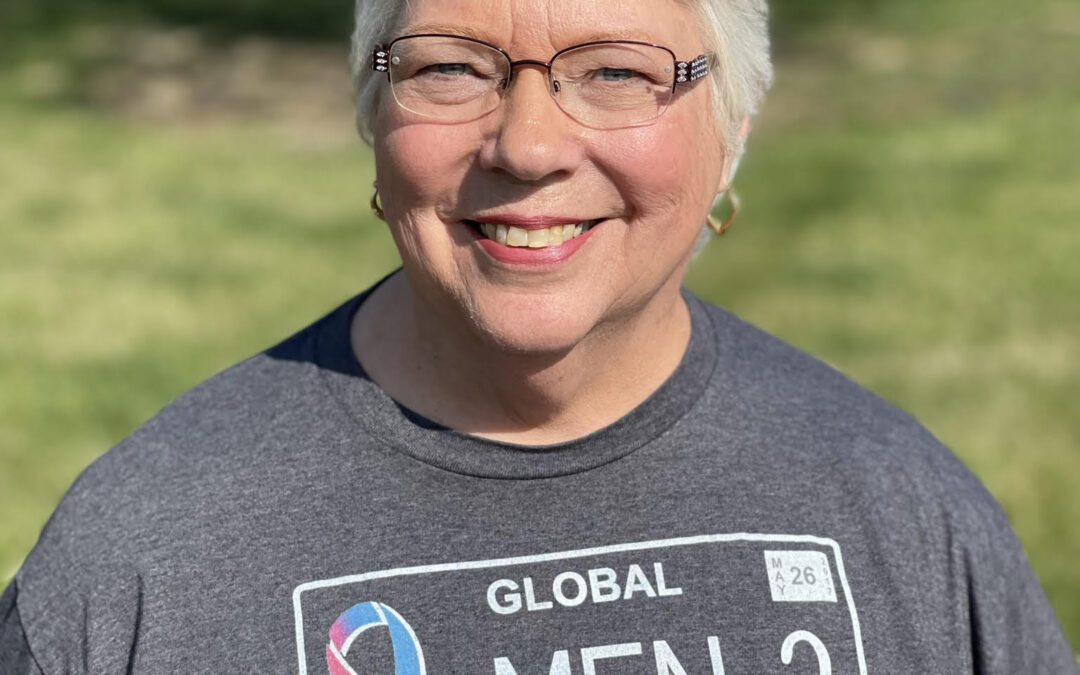
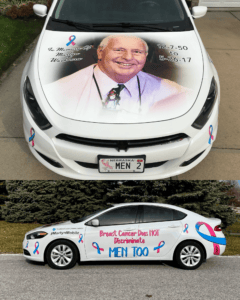
Pat absolutely radiated love and compassion while being none too short of gumption. That’s a polite Britishism for “piss and vinegar,” defined as ‘shrewd or spirited initiative and resourcefulness. ‘ After her dear husband, Marlyn, died in 2017, 5 months after being diagnosed with breast cancer, Pat made it her mission in life to make the world aware of Male Breast Cancer.
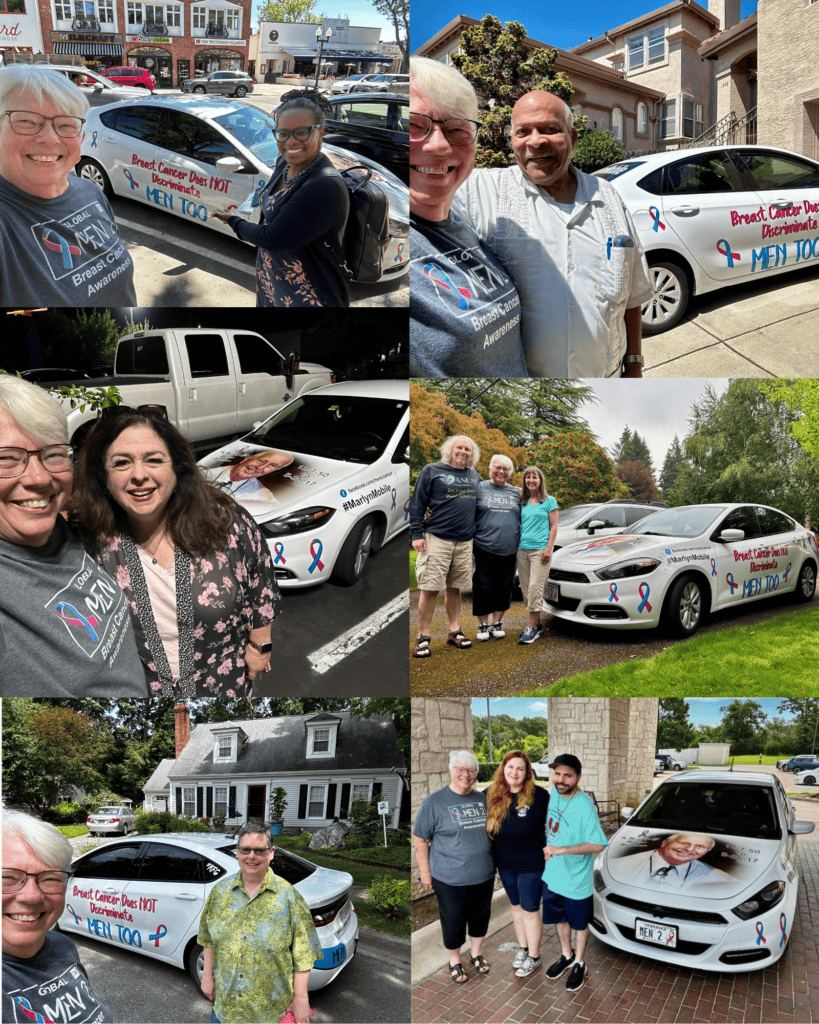
She took Marlyn’s car, had it decorated with his photo and Male BCa awareness icons, then took to the road. North, south, east, and west she travelled – every year. People stopped her at gas stations and restaurants; she made the local newspapers and TV stations everywhere. And always it was the same message. “Men get breast cancer, too!”
The world was her oyster, and Pat took the campaign to Europe on several occasions, including Spain and Scandinavia. Her travels were not just about awareness – she visited ‘her men’ and their care partners wherever she went. She also went out of her way to meet the AnCan’rs she’d met through our Group, most recently Alexa and Brian, on her way to Houston. See who else you can recognize below…
By and large, Pat paid for all her advocacy on her own dime. A couple of the male breast cancer organizations with whom she was affiliated did not treat her well. AnCan first met Pat when she reluctantly co-moderated our now-defunct Male Breast Cancer Support Group, disembowelled by one of those groups. Reluctant because Pat thought she’d be intruding on the men, BUT they loved her. At the time of her passing, AnCan was working with Pat and Bill Harris to reinstate the group – we still hope to in Pat’s memory (anyone interested, please reach out to me at rd@ancan.org).
Except when travelling or attending one of her Grandies’ or Great Grandies’ school or sporting events, Pat was always present to support Her Majesty, The Queen of DeNile – our Care Partner Lead Moderator, Susan Lahaie. So when she failed to show at a meeting on Aug 18, we reached out. Pat had been hospitalized after fainting on her face, diagnosed with multiple pulmonary embolisms; she looked like the Lone Ranger. During her hospital stay, those clots travelled to her brain, and Pat suffered a second, fatal stroke last week, elected hospice, and died on October 2nd.
All of us at AnCan are deeply saddened and wish her entire family much comfort. Pat’s entire family doesn’t do it justice. She was truly a matriarch with 35-40 Grandies and Great-grandies. In time, Pat’s memory will always be a warm, embracing memory to all who knew her.
Pat Washburn’s obituary can be found here.
Below is the Virtual Celebration of Life for Pat Washburn, held on November 2nd, 2025
Empowered Patient Podcast: Virtual Support Groups Remove Barriers Encourage Sharing Honest Experiences to Fight Misinformation with Rick Davis, AnCan
AnCan founder, Rick Davis, was recently featured in the Empowered Patient Podcast with Karen Jagoda. This show explores the cutting edge of healthcare, highlighting innovations in generative AI and the latest breakthroughs in therapeutics and vaccines, and explores a shifting landscape where providers, pharma, and payers are prioritizing patient empowerment.
Rick explains, “The mission is to make each person and each patient a better advocate for themselves. That’s really what we try to do, and we do that through empowering patients with peer knowledge. We introduce patients to other peers who have been through what these people are facing right now, not only patients, but also their care partners, and through their experience, we hope that these patients and care partners will become more expert in managing their own situation.”
“Many years ago, when I was facing similar realities, a very wise and understanding voice in cancer sat me down and said, “Hope shifts in cancer.” In the beginning, we are optimistic that our loved one will respond to treatment, and our HOPE is high….as some treatments work and then they don’t, our HOPE shifts to understanding what the outcome might be….and then as the cancer moves to overcome any possible response, HOPE shifts again..this time to comfort and peace for our loved one.”
–Laurie Singer (Care Partner & Pancreatic Cancer Support Group Moderator)


 By and large, Pat paid for all her advocacy on her own dime. A couple of the male breast cancer organizations with whom she was affiliated did not treat her well. AnCan first met Pat when she reluctantly co-moderated our now-defunct Male Breast Cancer Support Group, disembowelled by one of those groups. Reluctant because Pat thought she’d be intruding on the men, BUT they loved her. At the time of her passing, AnCan was working with Pat and Bill Harris to reinstate the group – we still hope to in Pat’s memory (anyone interested, please reach out to me at rd@ancan.org).