AnCan is grateful to the following sponsors for making this recording possible: Bayer, Foundation Medicine, Janssen, Myriad Genetics, Novartis, Telix & Blue Earth Diagnostics.
WELCOME all to our newly recorded Low/Intermediate Prostate Cancer Group. To receive notice when new recordings are posted, either follow us on this YouTube Channel or sign up to our Blog via https://ancan.org/contact-us/ – check New Blog box.
AnCan respectfully notes that it does not accept sponsored promotion. Any drugs, protocols or devices recommended in our discussions are based solely on anecdotal peer experience or clinical evidence.
AnCan cannot and does not provide medical advice. We encourage you to discuss anything you hear in our sessions with your own medical team.
AnCan reminds all Participants that Adverse Events experienced from prescribed drugs or protocols should be reported to the pharmaceutical manufacturer or the FDA Adverse Event Reporting System (FAERS). To do so call 1-800-332-1066 or download interactive FDA Form 3500 https://www.fda.gov/media/76299/download
AnCan’s Prostate Cancer Forum is back (https://ancan.org/forums). If you’d like to comment on anything you see in our Recordings or read in our Reminders, just sign up and go right ahead. You can also click on the Forum icon at the top right of the webpage.
All AnCan’s groups are free and drop-in … join us in person sometime!
Editor’s Pick: When deciding on a treatment plan, the most important thing a patient can do is having a medical team that you trust. Be wary of letting anxiety and uncertainty push drive selection of a treatment plan. Use the time you have to make an informed decision. (bj)
Topics Discussed New diagnosis and trying to decide between active surveillance and treatment based on high PSA and biopsy results; the importance of getting a second “reading” opinion on biopsy results; recommendations for genetic tests — to include the Prostate Cancer PROMISE, DECIPHER, and ArteraAI; seeking an opinion on a treatment plan after getting a random biopsy — getting a biopsy before the MRI; dealing with the anxiety and uncertainty associated with selecting a treatment plan; the importance of having a medical team that you can trust; EpiSwitch prostate screening; when to get a PSMA Pet Scan?; thiabendazole utility — better treatment options exist; healthy habits include diets that emphasize plants (i.e. low- or no meat) and exercise (150 – 210 minutes a week spread across 5 – 7 sessions, minimum session of 30 minutes).
Chat Log
AnCan – rick
PROMISE test https://www.prostatecancerpromise.org/?utm_campaign=ANCAN&utm_medium=link&utm_source=Webinar
AnCan – “Col” Boykin Jordan
Artera – https://artera.ai/for-patients
AnCan – “Col” Boykin Jordan
DECIPHER https://decipherbio.com/decipher-prostate/patients/decipher-prostate-overview/
Mark Perloe
Yes
AnCan – rick
FYI… Ep-STINE
Mark Perloe
just two retgurns
Mark Perloe
just one more.
AnCan – rick
Here’s the microultrasound article Friends, and I’ve sent it to Michael https://jamanetwork.com/journals/jama/fullarticle/2831985
AnCan – “Col” Boykin Jordan
EpiSwitch Prostate Screening https://www.urologytimes.com/view/episwitch-prostate-screening-blood-test-launches-on-us-market
Bill Allen
Mark- just to be clear-mI should speak w Dr D’Amico regarding Artera AI – is that spelling correct ?
Steve R
Regarding the Promise test: Did I understand your preference was to not share results with the doctor? Why or why not?
Bill Allen
Thank you Dr John.
AnCan – rick
Yup – just gets much more complicated and time consuming to get result. You can share when you get the results if needed
AnCan – “Col” Boykin Jordan
NCCN Prostate Cancer Guidelines https://www.nccn.org/guidelines/guidelines-detail?category=1&id=1459
Has eating become a challenge due to fatigue or a lack of interest in food? Have you noticed a significant change in your or your loved one’s appearance since starting treatment or diagnosis?
It’s a common misconception that weight loss during cancer treatment is solely due to treatment side effects. While this can certainly be a factor, a more serious condition known as cachexia (kuh·kek·see·uh) can significantly impact a patient’s health.
What is Cachexia and Who is at Risk?
Cachexia, often referred to as cancer cachexia or wasting syndrome, is a complex condition characterized by severe weight loss, muscle wasting, and loss of appetite. It’s not a direct side effect of cancer treatment but rather a consequence of the cancer itself. While it’s commonly associated with cancer, it’s important to note that cachexia can affect individuals with various chronic illnesses, including: Multiple Sclerosis, Sarcoidosis, heart failure, chronic kidney disease, COPD, and more. Certain types of cancer are more likely to lead to cachexia than others. These include: Pancreatic, Lung, Head and Neck, Colorectal, Ovarian, and Liver.
Signs and Symptoms of Cachexia: What Should You Look For?
Recognizing the signs of cachexia is crucial for early intervention and effective management. Here are some key symptoms to watch for:
Unexplained weight loss: A significant and unintentional decrease in weight.
Muscle loss: A noticeable loss of muscle mass, often leading to weakness and fatigue.
Decreased appetite: A reduced desire to eat, even when hungry.
Fatigue: Persistent tiredness and a lack of energy.
Metabolic changes: Alterations in metabolism, including changes in appetite, weight, and energy levels.
Changes in Routine: Unable to do the activities you once could.
If you or a loved one is experiencing these symptoms, it’s important to let your care team know your concerns as soon as possible.
Managing Cachexia
While there’s no one-size-fits-all solution, a multidisciplinary approach can help manage the condition. This may involve:
Dietary interventions: A registered dietitian can provide personalized meal plans to maximize nutrient intake.
Medical treatments: In some cases, medications may be prescribed to stimulate appetite or reduce inflammation.
Supportive care: This includes strategies to manage pain, fatigue, and other symptoms.
Psychological support: Counseling can help address emotional challenges associated with cachexia.
This may mean adding more people to your careteam to support you, such as a dietician (as shown above), physical or occupational therapist, endocrinologist, or palliative care (editors note: we hope you already have a palliative care doctor, AnCan loves them and they can offer you so much support during your treatment!)
Coping with the Emotional Impact
Cachexia can take a significant toll on both physical and emotional well-being for the patient, care-partner, and their families. It’s important to seek support to manage the emotional side effects of the condition. Consider:
Counseling: Individual, couples, or family therapy can provide guidance and coping strategies.
You can also ask your social worker (or for a social worker if you do not have one) for additional resources.
Want to Learn More?
We highly recommend this webpage and fact sheet from our friends at Cancer Support Community / Gilda’s Club. While it is cancer centric, all of the information will be of helpful no matter what your diagnosis is.
By understanding the complexities of cachexia and seeking appropriate support, individuals can significantly improve their quality of life. Effective management of cachexia can help alleviate debilitating symptoms, enhance overall well-being, and improve the ability to participate in daily activities.
Special thanks to CSC for their assistance and incredible resources with this blog post.
A couple of weeks back, we posted Medicare Health Insurance Choices that explained the differences and pitfalls between traditional Medicare Part A and B plus Medigap insurance plans to Part C, Medicare Advantage. Click the link earlier in the previous sentence if you missed it.
As many already know, there is a Part D that covers drug costs. It is either purchased as a separate plan or rolled into Part C Advantage. Drug coverage is significantly changing this year, and AnCan has learnt that many of our participants are not yet aware. Hardly surprising because CMS as well as the various stakeholders like Payers and providers have done very little to let us patients know. Why should they? – we’re only the ultimate consumer!
The same cannot be said of JnJ who started educating patient advocate organizations this past May. In October and November JnJ created more education that includes a webinar and a round table coming up hosted by NAMAPA, the National Association for Medication Access and Patient Advocacy. Likely you have never heard of them. I hadn’t and it hardly rolls off the tongue. Nonetheless, the webinar was very instructive and you can watch it here.
The BIG difference for us patients is that no matter what, out-of-pocket drug costs for 2025 cannot exceed $2000. You heard right – for those of you on specialty oral medications like Nubeqa (darolutamide for prostate cancer) or Aubagio (teriflunomide for MS), normally sourced via specialty pharmacies, you will meet this cap January. And you’ll even be able to spread the payment over 12 months! More on that to follow.
But first, how is this coming about. Well it tracks back tot he changes brought about by the Inflation Reduction Act signed by President Biden in 2022. He promised to make drugs more affordable, and this is a part of the plan. As you can see in the slide to the left comparing 2024 to 2025, the donut hole has been eliminated. In its place, the Payer (Plan Sponsor) and Pharma (manufacturer) are paying more. While the cost saving is very positive, it will likely impact us patients in other ways:
Your formulary choice may be reduced – so CHECK your medications before you renew.
Premiums for Part D may increase – even though out of pocket is capped. If you are unlikely to spend $2,000, look for a plan that defers your co-pay as long as possible
Higher premium plans should cover a larger portion of drug costs earlier. Your premium does NOT count towards the $2,000, so include premiums in your cost calculation to figure your exposure.
If you have a co-pay or co-insurance on your drugs, no matter if it’s Part C or D, it cannot exceed $2,000. However the amount you pay and who you pay it to may become a bit of a moving target. We mentioned earlier that you will now have the opportunity to spread your payments over the calendar year – or the remainder of it, if you sign up late or incur costs late in the year. The Medicare Prescription Payment Plan (M3P) takes your share of drug costs, up to a maximum of $2,000, and spreads them over the remainder of the year.
The simple example is for those on specialty pharmaceutical drugs like Nubeqa or Aubagio. Since your share of the drug cost is almost certainly going to be greater than $2,000 in January, if you opt in for M3P BEFORE going to the pharmacy or ordering from your mail order pharmacy, you’ll pay nothing on picking up/shipping the drugs. Subsequently, you’ll get a separate bill from your Payer for $167.67 monthly over 12 months, and pay no more for any of your drugs the rest of the year. There is NO interest, no late fee penalties, and you get a couple of months leeway, but there are penalties if you never pay. You can sign up for MP3 with your Medicare Payer/Plan Holder BUT not in the pharmacy for 2025. So if you arrive at the drug store prior to enrollment, you’ll be charged $2,000 to take your pills home. You can leave the pills, go home, enroll and return to the pharmacy 24 hours later and pick up without payment to the pharmacy..
If you don’t start this expensive drug until mid year, say September, and you’ve spent nothing on drugs prior, then the $2,000 is billed over the last 4 months at $500/month.
But what if your drug costs are more lumpy – they go up and down the whole year. In that case, the payments get recalculated each month and the monthly bill will vary.
There is a strange case too, if you know your co-pay is the same each month – say $55. This really throws M3P, and as you can see to the left, you’ll pay the same $660 (12x $55) either way but in different amounts each month if enrolled in M3P.
Finally, let’s address the Drug Benefit plans that many of you enjoy through PAN, PAF and others. Even the drug discount cards from Pharma that some receive. Whatever you receive, or however you receive it, does NOT reduce your $2,000 exposure. You advise the pharmacy that you have a benefit, and they bill the Benefit Provider (PAN, PAF, Pharma ??). The credit will be applied against your drug cost, although eventually you may still be liable for up to $2,000 co-pay when the benefit runs out.
Looking at the first slide, it seems to AnCan that these benefits that are often funded by Pharma, eventually flow back to Pharma and the Payer. How they will credit them against what the patient owes is not yet clear. Before you get too crazed, our guess is the system has to change. These benefits need to be channeled directly to patients who cannot afford $2,000 p.a. AnCan is on it and already reaching out to NAMAPA and others to promote more of a direct, income based subsidy possibly reaching more beneficiaries. One thing we have heard – APPLY EARLY for 2025 in the event you are in line to receive a subsidy.
PLEASE BE SURE TO SIGN UP FOR THE M3P PROGRAM UPFRONT. EVEN IF YOU OWE $2,000 IT WILL BE BILLED IN 12 INSTALLMENTS. WE STILLL HAVE TO FIGURE HOW YOU WILL BE REIMBURSED IF YOU RECEIVE ASSISTANCE.
IF YOU HAVE A GRANT BE SURE TO PROVIDE DETALS TO THE PHARMACY ASAP. NOTWITHSTANDING, ALSO REACH OUT TO YOUR GRANTOR TO FIND HOW THEY WANT TO COORDINATE THE GRANT. IT’S STILLL A MOVING TARGET!
With Open Enrollment starting on October 15, two AnCan’rs asked for advice this week on Medicare plans – and yes it’s complicated. AnCan recommends you watch the webinar we held last October to help understand the difference between traditional Medicare and Medicare Advantage. The dollar details are different for 2025 but not the principles.
Lastly, my own health insurance broker, Kim Umphres, is licensed to write in 15 States. He offered his help to all in last year’s webinar, so take him up umphres100@yahoo.com
Since the same questions are likely in the mind of many others, I have written this Blog Post. I am no expert but this may illustrate how I think about my own health insurance. Sadly, I cannot help you all individually – consult with your own Medicare health insurance for the best advice.
Onward & upwards, rick
Many of us on Medicare are faced with renewing our plans – or buying a plan for the first time. If you choose not to buy a plan to supplement Medicare, it leaves you exposed to roughly 20% of your medical costs. That can amount to very big bucks!
The main choice is whether to opt for Traditional Medicare + a Supplement (Medigap) Plan + a Drug Plan. Alternatively, a Medicare Advantage Plan can look attractive but comes with warts.
If you are low income and cannot afford the available plans, there are Medicaid alternatives for Medicare supplements.
Advantage Plans (Plan C) restrict your choice of Health Care Providers since they are based on Provider Networks. If you need a particular type of specialist, for example a genitourinary medical oncologist, or a neurologist who specializes in MS, this can be a problem with Advantage. Community Standard of Care is often the byword. If you choose an Advantage Plan, be sure it covers HCPs who practice at a Center of Excellence.
Advantage Plans usually have small monthly premiums, sometimes zero. They also include co-pays when you visit a Provider. Co-pays can be anywhere from Zero dollars to several hundred for fancy scans like PSMA, so you have to look carefully at the coverage. The more you use the plan, the more you pay. Some may include coinsurance – avoid those altogether. It’s a nuance we won’t get into here.
You can also go out of network to a Provider of your choice, but copays will be significantly higher. For example, you may pay $50 for a visit to a specialist in-network. Out-of-network, the cost can be significantly higher – often 40% of the approved Medicare fee for the service sought.
Advantage Plans often have a Gatekeeper who must approve any referral. You may not be able to self refer. Also there can be stricter intervention by the Plan to pre-approve procedures.
Drugs are included, however there is also a co-pay for some generic and all branded drugs that depends on the tier in which they are classified in the Plan’s drug formulary. List the drugs you use and find the cost. That said, the good news in 2025 is that drug out-of-pocket costs cannot exceed $2,000.
Traditional Medicare with a Supplement (Plans F,G,K,L,M,N) may not restrict your choice of HCPs – you can go anywhere in or out of state provided the Provider accepts Medicare.
Traditional Medicare Supplement Plans cover the 20% not covered by Medicare A and B. You pay a monthly premium that varies according to the plan chosen. The different supplement plans have different features. The more you pay in monthly premium, the less the restrictions and the lower the deductibles.
In addition you will need drug coverage (Plan D). Again that includes a monthly premium, plus a charge for each drug, so you have to shop plans against your Rx. For 2025, drug out-of-pocket costs cannot exceed $2,000.
As long as your chosen Provider accepts self-referrals, there may be no Gatekeeper. Procedures and protocols may still be subject to pre-approval.
Since Advantage Plans can be more profitable for the Payer, they offer lots of bells and whistles to sell the plan – for example subsidies for OTC products. One plan I was offered recently, actually pays the Holder $5/month!
I’m trained as an economist so I look at risk reward. I compare the annual maximum out-of-pocket cost between the Advantage Plan and the Traditional Medicare Plans (inc. the drug plan).
For traditional Medicare There is a required monthly premium for both the Supplement and the Drug Plan. Add those together and multiply by 12. In addition you can have out-of-pocket drug costs, especially if you are using expensive cancer drugs, but that cannot exceed $2,000 in 2025. Btw, the $2000 will decrease in subsequent years.
Each Advantage Plan has a stipulated maximum out-of-pocket cost for in-network and out-of-network Providers. In-network will be less. I look at the out-of-network max, and add to that any monthly premiums that are usually minimal. Drugs are included with a co-pay, but that co-pay cannot exceed $2,000 in 2025.
Now that I know what I HAVE to pay with Traditional + Supplement vs what I could pay with Advantage depending on my usage, I can compare whether I want to roll the dice to save money.
If the Traditional route costs me $500 in monthly premiums, I know I am out-of-pocket $6,000 plus my drug copay costs capped at $2,000.
Say my Advantage Plan has a monthly premium of $25, then for sure I am out of pocket $300. The rest depends on how much medical care I use. Assume ( the economist’s favorite word) the out-of-pocket for out-of-network in my plan is $8,000, that is my max. I still have to consider up to $2,000 for drugs.
Let’s compare!
IN THE WORST CASE I am spending $6,000 (+ drugs) for Traditional Supplement versus $8,300 (+ drugs) for Advantage. The Advantage could be $2,300 more pricey.
IN THE BEST CASE, I am out-of-pocket $300 (+ drugs) for Advantage vs $6,000 (+ drugs) for Traditional Supplement, so I could save $5,700 with Advantage.
Risk-Reward… do I want to roll the dice to save up to $5,700 that could cost me an extra $2,300??
Each person has to make that decision.
There’s more to it than this. For example HMO’s like Kaiser Permanente may make it even harder to go out of network. And with KP, you are guarantied to only get community Standard of Care medicine . As I often say, KP is great as long as you don’t get seriously ill.
AnCan strongly suggests finding a local Medicare Health Insurance Agent to help you sort through this morass. Plans change by State, so your agent must be licensed in your State.
And one last thing. The first time you enter Medicare there is NO underwriting. No matter your preconditions, you are accepted to any Traditional supplement or Advantage Plan. In subsequent years, you may be subject to underwriting should you choose to switch plans. You can be restricted from changing between an Advantage and Traditional Supplement Plan.
AnCan recommends watching our webinar from last October to help understand the difference between traditional Medicare and Medicare Advantage. 2025 details are different but not the principles.
We also recommend you visit the Triage website and attend its free webinars. Many of their Medicare resources can be found at https://triagecancer.org/medicare-cancer
For differences between the Traditional Supplement Plans, consult with a specialized Medicare Health Insurance agent. F and G are the best options. There are also high deductible options. An agent can also help you compare Advantage plans by various criteria, like maximum out-of-pocket for out-of-network care.
For men facing cancer treatment, the risk of infertility is a major concern that is often overlooked. While fertility preservation options exist, studies consistently show that a significant proportion of patients are not adequately informed or offered these choices by their healthcare providers before undergoing potentially sterilizing cancer treatments.
The main barriers to men being aware of fertility preservation include limited knowledge and training among providers, discomfort discussing the sensitive topic, low referral rates to reproductive specialists, logistical challenges, time constraints before treatment initiation, perceptions about appropriateness based on prognosis, and patient-related factors like lack of awareness and financial concerns.
It is crucial for men to understand their options for preserving fertility, which include:
Sperm Cryopreservation (Sperm Banking)
This standard and most effective method involves collecting and freezing sperm samples before treatment for future use through assisted reproductive techniques like intrauterine insemination (IUI) or in vitro fertilization (IVF) with intracytoplasmic sperm injection (ICSI). It is well-established and successful for post-pubertal males.
Testicular Tissue Cryopreservation
An experimental approach where testicular tissue is removed and frozen before cancer treatment. The frozen tissue may potentially be used later to extract sperm stem cells for reimplantation or to induce in vitro spermatogenesis. However, no live births from this method have been reported in humans yet.
Gonadal Shielding
Protecting the testicles from radiation damage by using lead shields during radiotherapy. Its effectiveness is limited by patient anatomy and radiation field requirements.
Sperm Retrieval
For males who cannot produce a semen sample, sperm can be surgically retrieved from the testicles or epididymis through techniques like testicular sperm extraction (TESE) or percutaneous epididymal sperm aspiration (PESA). Retrieved sperm can then be used for IVF/ICSI. This invasive option is appropriate when a male cannot produce a semen sample due to conditions like anejaculation, obstructive azoospermia, or prior to puberty.
While sperm cryopreservation is the most established and successful fertility preservation method, sperm retrieval combined with IVF/ICSI can be an option when cryopreserved sperm is unavailable or inadequate. However, IVF/ICSI is more invasive, costly, and has lower success rates compared to using cryopreserved sperm for insemination.
Overcoming barriers to awareness and utilization of fertility preservation options requires improved education and adherence to clinical guidelines from organizations like the American Society of Clinical Oncology (ASCO) and the American Society for Reproductive Medicine (ASRM). Establishing formal fertility preservation programs with multidisciplinary teams, patient navigators, and educational initiatives can help ensure that men with cancer have the opportunity to make informed decisions about preserving their fertility before undergoing cancer treatments.
For questions, please contact Mark Perloe at mperloe@outlook.com
Are you ready to get the inside scoop on clinical trials? Get ready to delve deep with former clinical trial nurse coordinator Marni Tierno. We know it can be a complex and overwhelming topic, but don’t worry – we’re here to break it down in a way that’s easy to understand.
Also featuring the vast professional experience of Wendy Garvin Mayo, we’ll tackle the myths and misconceptions that often surround clinical trials, giving you the facts and insights you need to make informed decisions.
Whether you’re a patient, carepartner, or simply curious about clinical trials, this webinar is for you! Our aim is to empower you with a deep understanding, allowing you to make the best choices for yourself or your loved ones.
Some of the topics we will cover include:
Description of the types and phases of clinical trials
Examples of pivotal clinical trials that have changed how we treat cancer
What to expect when participating in a clinical trial (including potential risks and benefits)
Addressing common questions about clinical trial participation
and more!
Watch here: (closed captioning is provided for this webinar, click the CC button at the bottom next to the gear.)
To view the slides from this webinar, please click here.
Additional Resources
Written, Narrated and Produced by AnCan’s own Pancreas Cancer Moderator, Laurie Singer for Johns Hopkins:
Special thanks to Bayer, Novartis, Johnson & Johnson, Foundation Medicine, Myriad Genetics, Telix, and Blue Earth Diagnostics for sponsoring this webinar.
And very special thanks to Illumina and Collaborative Cancer Care for letting us have two of their absolute best people present for us!
.
To SIGN UP for any of our Virtual Support groups, visit our Contact Us page.


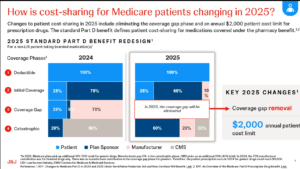 and this is a part of the plan. As you can see in the slide to the left comparing 2024 to 2025, the donut hole has been eliminated. In its place, the Payer (Plan Sponsor) and Pharma (manufacturer) are paying more. While the cost saving is very positive, it will likely impact us patients in other ways:
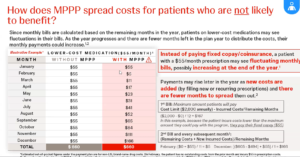 But what if your drug costs are more lumpy – they go up and down the whole year. In that case, the payments get recalculated each month and the monthly bill will vary.










 .