St. Pete High School’s Senior Service Project Supports AnCan
This past December, the seniors from St. Petersburg High School’s International Baccalaureate program came together to make a difference through their annual senior service project. The students organized a community run to raise funds for AnCan.
The event was a success, with over 50 participants joining in to support the cause. Together, they raised over $700 to contribute to AnCan’s mission of empowering people through connection, support, and shared experiences.
“We find pride and joy in the fact that we could bring our community together for a run and spread awareness about the great efforts of the AnCan foundation,” said one of the organizers.
AnCan is grateful to the students, participants, and everyone who contributed to this incredible effort. Initiatives like this not only provide financial support but also help spread awareness about the importance of peer-led support.
Thank you, St. Pete High School IB seniors, for your hard work, creativity, and commitment to making a difference.
Hi-Risk/Recurrent/Advanced PCa Video Chat, Jan 6, 2024
It’s AnCan’s Annual Fundraiser – just once a year is the only time we ask for donations. FYI, we’ve received a mere 70 donations from this group, even though we have almost 300 regular participants, and 700 who receive the Reminder. Time to step up and show appreciation and gratitude if you watch these videos and find them helpful. Donate now at https://ancan.org/donate/
IF YOU’RE WATCHING THIS VIDEO, PLEASE COMPLETE OUR SHORT, 7-MINUTE ANCAN 2024 SURVEY… https://docs.google.com/forms/d/e/1FA… AnCan needs your feedback and we also hope to take the results to medical conferences. We will be closing out in the next couple of weeks, so no more procrastinating please!
AnCan is grateful to the following sponsors for making this recording possible: Bayer, Foundation Medicine, Janssen, Myriad Genetics, Novartis, Telix & Blue Earth Diagnostic.
AnCan respectfully notes that it does not accept sponsored promotion. Any drugs, protocols or devices recommended in our discussions are based solely on anecdotal peer experience or clinical evidence.
AnCan cannot and does not provide medical advice. We encourage you to discuss anything you hear in our sessions with your own medical team.
AnCan reminds all Participants that Adverse Events experienced from prescribed drugs or protocols should be reported to the pharmaceutical manufacturer or the FDA Adverse Event Reporting System (FAERS). To do so call 1-800-332-1066 or download interactive FDA Form 3500 https://www.fda.gov/media/76299/download
All AnCan’s groups are free and drop-in … join us in person sometime!
Editor’s Pick: ctDNA can play an important role when scans don’t see cancer and PSA is rising (rd)
Topics Discussed
Denovo Mx gent on triplet therapy needs some tweaks; newly diagnosed intraductal, cribriform man needs 2nd opinion on pathology; ultrasensitive PSA creeping up; ctDNA is just the job when we can’t see recurrence any other way; as suspected, signs of small cell, neuroendocrine like cancer; cancer is very stable, but new shoulder may be in order; PSA patterns after RT and coming off ADT; prednisone taper smoother with pred. resumption, but iron could be an issue; is testicular pain from ADT/HT common?; how feasible is T. replacement with advanced PCa?
Gotta go guys. Thanks again for the new info and welcome to the new guys! Will catch the rest of the meeting on the cast. Remember that: ANYTHING IS POSSIBLE!!
Harry, I can tell you that Dr. Thomas Hope at UCSF says that there is no reason for anyone to be ordering conventional bone scans in the era of PSMA-PET.
Peter M sent: 7:53 PM
Good night gents!
Doug D sent: 8:00 PM
Luther, Nno, I will be seeing Maxwell Poole
Thomas sent: 8:09 PM
Thanks for the feedback, gents. Got to scoot. Next time.
Birdability: Accessibility and Inclusiveness in The Outdoors
If you’ve ever been to one of the AnCan art classes, you might know me as the art/ painting instructor. It’s me, hi! I’m the kind of person who likes to make it my business to remind everyone to take a deep breath and smell the roses. Maybe paint the roses, too. Do something you love to do. That’s easy to say to an able-bodied person. What if you’re not quite an able-bodied person, but you still adore outdoor activities, like bird-watching?
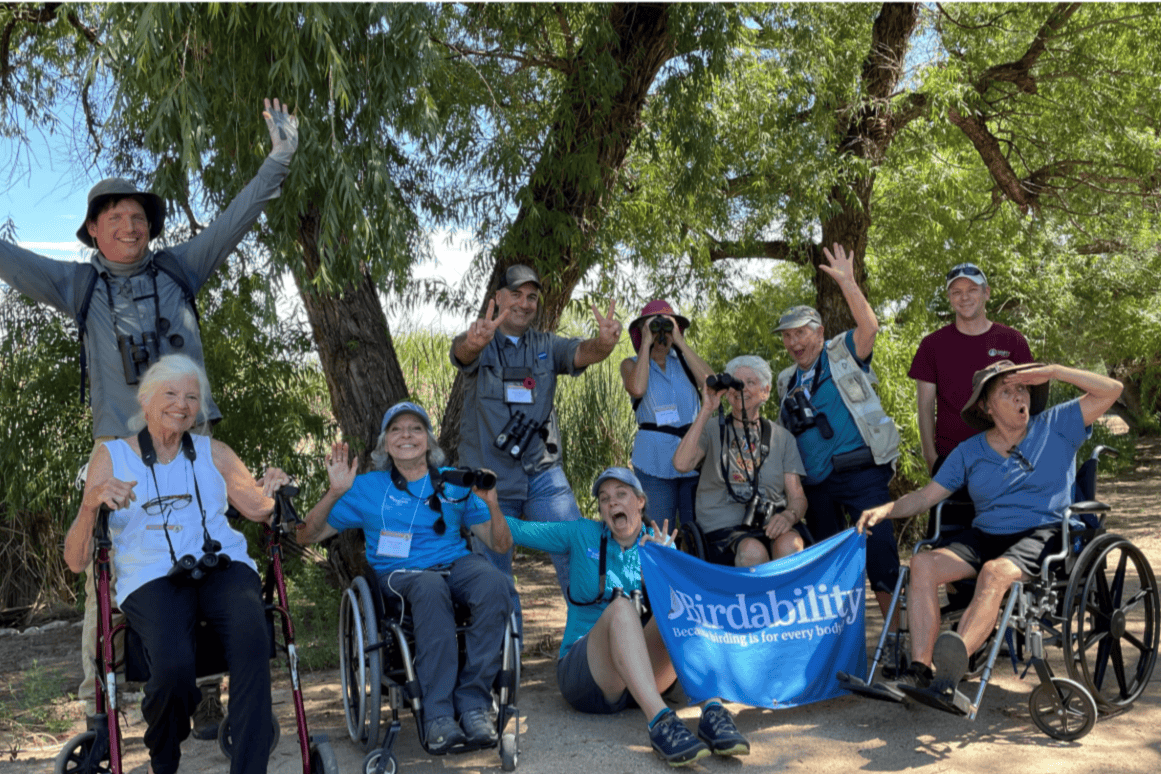
That’s where Birdability comes into the picture! Meet Virginia Rose; Birdability’s Founder and Chair Emeritus. Virginia fell off a horse when she was a teenager, and has been a wheelchair user ever since. She and Rick Davis had a chance encounter at the grocery store recently when he helped her reach a bottle of champagne from the shelves. That’s where he learned all about Birdability and Virginia’s passion for merging accessibility with her love for birds and natural spaces.
Birdability works hard to call attention to the need for accessible spaces and an inclusive mindset in places that aren’t traditionally thought of as accessible: the outdoors.
“Often it is the environment that is disabling, rather than the person who is disabled” – Birdbility
Their entire mission is to bring the joys of birding and the outdoors to those who may not otherwise be able to experience it. Birding was a hobby that Virginia really leaned into and it helped her to “discover her best self in nature”. Birding can be for anybody and and body; it’s up to the abled to be welcoming to those who may not be as abled.
Even if you, or a friend, have some visual impairments, there are guides on how to bird watch with limited vision; including using sounds and tools to help with your identification. Maybe some of our VSS people can benefit?
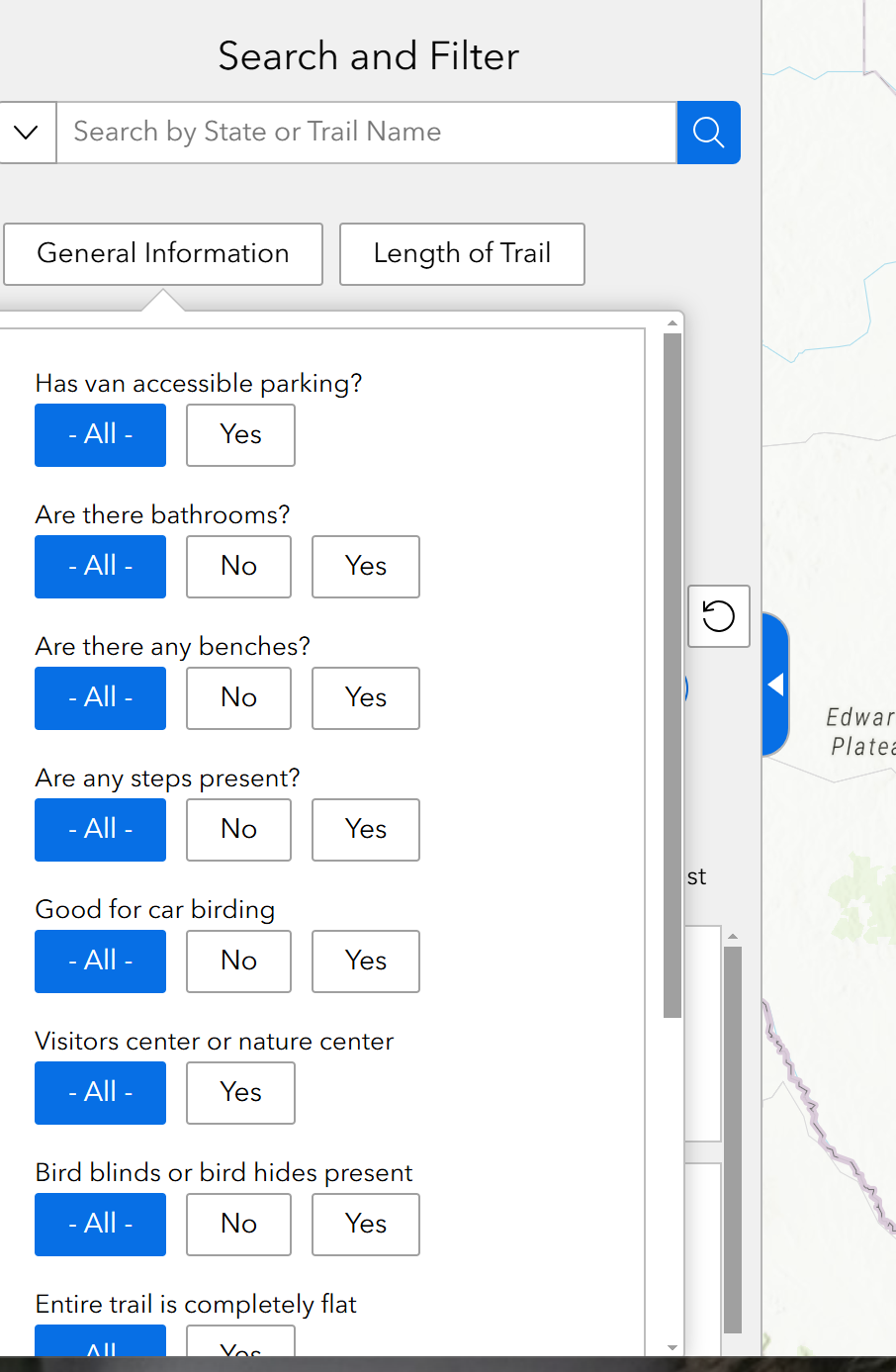
Probably my favorite feature, however, has to be the birding map, which was made in partnership with the National Audubon Society and local contributors. It’s a map intended to help locate accessible trails and outdoor spaces throughout the world. You can filter through so many different features, including surface type (asphalt, concrete, gravel, etc), bathrooms along a trail, parking fees, car birding, and so much more.
I scrolled through other continents just to see what’s out there. I’m sad (but not surprised) to see that there’s not much in he way of accessibility outside the United States, Canada, and Europe. I’m sure there are more parks and places that can be added. I think this just shows how much of a necessary resource that this organization provides. Honestly, I may even use this tool myself to find accessible trails for my own outdoor activities, like painting outside in the park.
“Websites and recommendations from park staff are frequently incomplete — and so unreliable — sources of a location’s true accessibility, and what is accessible for one user may not be accessible for another.”
So many of us want to be outside, but just can’t find reliable information about how to just exist outside. It’s easy to say that an outdoor area has accessible pavement, for example, but is the concrete well-managed and actually accessible for a wheelchair or cane user? Is it on a slope? Are there van-accessible parking spaces? Is there enough shade from the sun? Are there food trucks or other snack/food options? So many things to consider.
That’s where you, if you’re interested in birding, can come in and organize a fun local meetup. You have the tools you need right here!
Anyway, hopefully it isn’t too cold for you to be outside just yet! Go check out Birdability and their Blog and tell us what you think!
Why Your Practice Should Join the Veterans Administration (VA) Community Care Network
The health and well-being of Veterans are of the utmost importance, and community healthcare providers play a vital role in ensuring they receive the timely and high-quality care they deserve. The VA Community Care Network (CCN) bridges the gap between Veterans and community practices, offering an invaluable opportunity for providers to expand their impact while supporting those who served.
What is the VA Community Care Network (CCN)?
The VA CCN is a program established under the VA MISSION Act of 2018 to ensure that Veterans can access care outside of VA facilities when it is in their best interest. Whether a Veteran lives too far from a VA medical center or needs a service not available within the VA, the CCN provides them access to a broad network of community-based healthcare providers.
By partnering with the VA, community practices gain the ability to treat Veterans while ensuring seamless coordiation of care, referrals, and reimbursement. It should be noted the program is structured to reimburse the providers at a MEDICARE Reimbursement rate for any scheduled procedure or service, and the two payers who manage the program have kept a record of repayments within 30 days of proper billing. Through their contracts with the VA, they have been incentivized properly to ensure providers are properly reimbursed for the valuable service provided.
Why Should Your Practice Join the CCN?
Serve Those Who Served Us
Veterans have made sacrifices for our country, and healthcare providers have the chance to give back by ensuring they receive the care they need, closer to home.
Many Veterans face barriers to accessing VA facilities due to location, schooling, capacity, or specific care requirements. By joining the CCN, your practice can play a critical role in removing these barriers.
Expand Your Patient Base
Participation in the CCN opens the door to a steady stream of patients referred by the VA, providing stability and opportunities for growth in your practice.
Veterans represent a large and diverse group of patients with a variety of healthcare needs, from routine check-ups to specialized treatments.
Streamlined Reimbursement
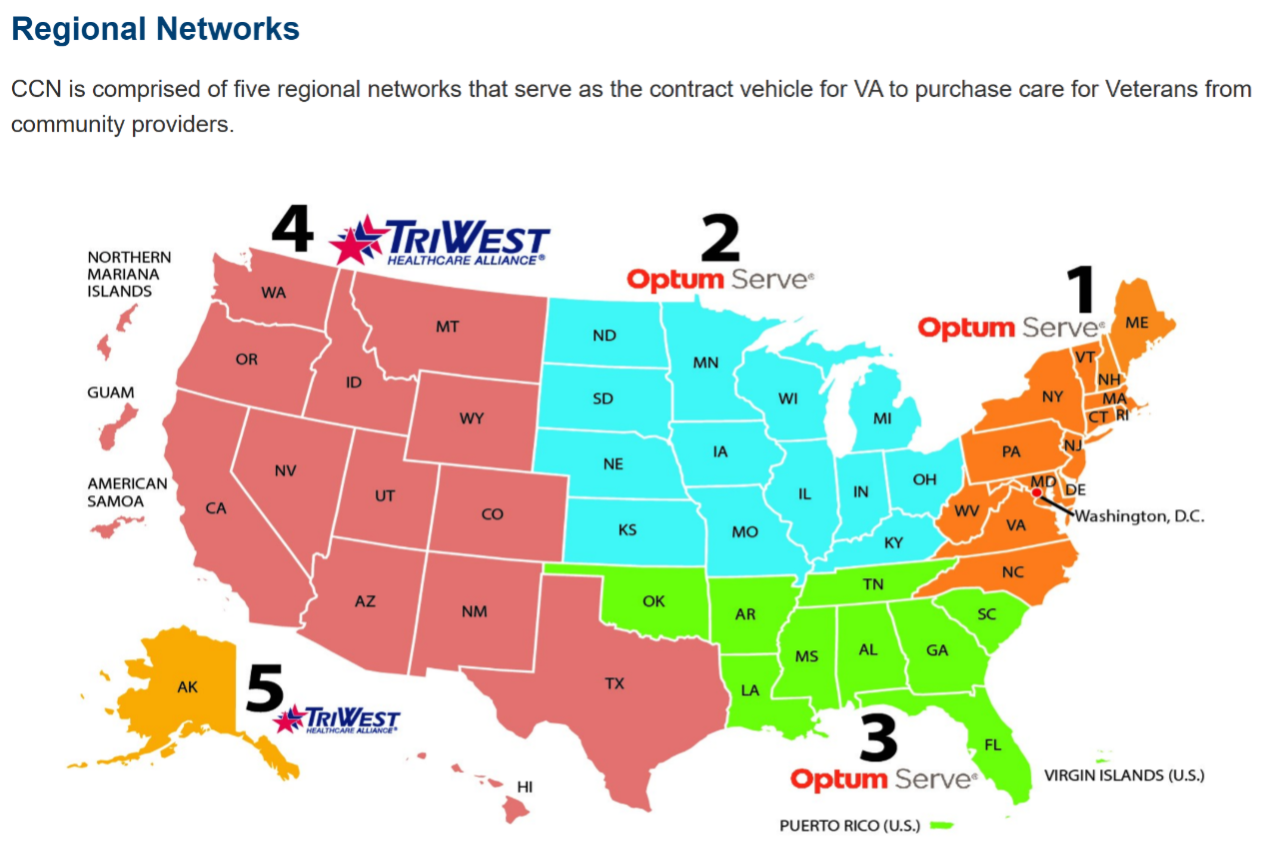
The VA CCN ensures that providers are reimbursed for the care they deliver through its partnership with regional administrators like Optum and TriWest.
By meeting CCN requirements, your practice can enjoy smooth billing processes and prompt payment for services rendered.
Improve Veteran Health Outcomes
Veterans often face unique health challenges, such as higher rates of certain chronic illnesses and service-related conditions. As a CCN provider, you can contribute to improving their quality of life through timely, high-quality care.
Simplified Enrollment Process
Joining the CNN is straightforward. Practices need to determine their region, ensure they meet Medicare reimbursement standards, and establish a Veterans Care Agreement (VCA). Once enrolled, your practice will be equipped to provide care to Veterans in your area.
How to Join the VA Community Care Network
Determine your region (Regions 1-3 are managed by Optum, and Regions 4-5 are managed by TriWest.)
Contact the appropriate regional adminsitrator to initiate the enrollment process:
Optum Regions (1-3): Call 800-901-7407 or visit their provider page.
https://vacommunitycare.com/provider
TricWest Regions (4-5): Call 1-855-722-2838 or visit their provider page.
https://www.triwest.com/en/veteran-services/
Review requirements for a Veterans Care Agreement (VCA) and complete your enrollment.
A Veteran’s Journey Through CCN
A Veteran seeks care through their VA provider.
The VA determines the Veteran qualifies for community care and refers them to an in-network provider.
The community provider delivers care and submits medical records back to the VA.
The provider bills Optum or TriWest for reimbursement.
By joining the CCN, your practice becomes an essential part of this seamless process, ensuring Veterans get the care they deserve.
Conclusion
Joining the VA Community Care Network is more than a business opportunity—it’s a chance to make a meaningful difference in the lives of Veterans. By enrolling, your practice can contribute to a healthier future for those who served while benefitting from increased patient volume and streamlined processes.
Take the next step today and learn how your practice can make a difference.
By : Mike “Bing” Crosby, Veterans Prostate Cancer Awareness Inc, mike.crosby@vpca.vet
100% Free VA Healthcare Entitlement per the TERA Memo
For all Vietnam, Gulf War, Middle East and Southwest Asia veterans covered under the PACT Act of 2022, you are now entitled to FREE VA Healthcare with the exposure to toxic materials because of TERA (Toxic Exposure Risk Activity). Sep 20, 2023 — In August 2022, the PACT Act was signed and expanded benefits and services for veterans with toxic exposures during service. Even if you have a VA Disability rated at 10%-40% or never, ever applied for any VA Disability Rating, the veteran is now eligible for free healthcare.
A TERA memorandum, or toxic exposure risk activity report, is a document that the VA medical examiner reviews when a veteran files a disability claim that references the PACT Act. The PACT Act, or Honoring our PACT Act of 2022, expanded benefits and services for veterans who were exposed to toxins while serving in the military.
Presently VA FREE Healthcare is available for those who:
CATEGORY 1: Veterans who participated in a toxic exposure risk activity (as defined by law) while serving on active duty, active duty for training, or inactive duty training.
Note: many stateside & overseas military posts and bases have been declared Toxic Waste Sites. These are not automatic and must be Service-Connected.
CATEGORY 2: Veterans who were assigned to a duty station in (including airspace above) certain locations during specific periods of time.
On or after August 2, 1990, in: Bahrain, Iraq, Kuwait, Oman, Qatar, Saudi Arabia, Somalia, or the United Arab Emirates
On or after September 11, 2001, in: Afghanistan, Djibouti, Egypt, Jordan, Lebanon, Syria, Yemen, Uzbekistan, or any other country determined relevant by VA.
CATEGORY 3: Veterans who deployed in support of Operation Enduring Freedom, Operation Freedom’s Sentinel, Operation Iraqi Freedom, Operation New Dawn, Operation Inherent Resolve, or Resolute Support Mission and other designated locations.
EFFECTIVE ON ENACTMENT (AUGUST 10, 2022):Veterans who served in the Republic of Vietnam (from 1/9/62–5/7/75), Thailand at any US or Royal Thai base (from 1/9/62–6/30/76), Laos (from 12/1/65–9/30/69), certain provinces in Cambodia (from 4/16/69–4/30/69), Guam, or American Samoa or their territorial waters (from 1/9/62–7/31/80), or the Johnston Atoll or a ship that called there (from 1/1/72–9/30/77) may enroll in VA health care.
BETWEEN OCTOBER 1, 2022, AND OCTOBER 1, 2023: Veterans who served on active duty in a theater of combat operations during a period of war after the Persian Gulf War or in combat against a hostile force during a period of hostilities after November 11, 1998, and who were discharged or released between September 11, 2001, and October 1, 2013, may enroll in VA health care. Enrollment is free, there are no annual costs, and healthcare may be free as well.
In addition a Veteran is eligible for a TERA Memorandum placed into their medical records if the participated in a TERA activity which includes:
Handling, maintain or detonating Nuclear Weapons
Working with radioactive material
Using calibration and measurement sources
Being exposed to X-rays
Being exposed to radiation from military occupational exposure
Being exposed to warfare agents
Being exposed to nerve agents
Being exposed to chemical and biological weapons
As of March 5, 2024, veterans who meet the basic service and discharge requirements and participated in a TERA are eligible to enroll in VA health care, FREE, without applying for VA benefits; meaning applying for some disability rating.
Contact your local Veteran Service Officer (VSO) offer for details. Be aware the benefit is through the Veterans Healthcare Administration (VHA) and is not the same as applying for disability with the Veterans Benefit Administration (VBA) a Disability rating entitling you to money. There is VA Form 10-10EZ to get and read the instructions. When this form is submitted along with any supporting documentation usually on the VBA-21-4138 it goes off to a separate address in Janesville, WI. Although you should think about applying for VA Disability Benefits ($$$) because you may well be entitled to it.
VA Added More Presumptive Conditions for Military Conflicts Since 1990
The VA has added Male Breast Cancer, Urethral Cancer and Cancer of the Paraurethral glands to the list of illnesses presumed connected to military service in conflicts since 1990. The policy change covers veterans who served in Southwest Asia. Veterans whose claims are approved may also be eligible for benefits back to August 2022 when the PACT Act of 2022 was signed. Survivors of those with these cancers maybe automatically granted financial payouts. (AirForce Times – July 2024)
More Disabilities Added to What the VA Will accept
This spring the VA announced an update to the VA Schedule for Rating Disabilities (VASRD) specifically pertaining to digestive conditions. The changes add or modify rating criteria for 55 medical conditions in the rating schedule that incorporate medical advancements for treating certain disabilities and modern medical knowledge to compensate Veterans more accurately.
The three biggest changes that will impact you, as Veterans, include the new evaluations for Celiac Disease, Irritable Bowel Syndrome (IBS) and Hemorrhoids.
Beginning May 19, Celiac Disease—an autoimmune disorder that impacts how the body processes gluten—will have its own rating criteria specifically designed to address its disabling effects. Veterans with this condition were previously granted service connection and evaluated by analogy using rating criteria that ranged from zero to 30 percent. Now under a specific diagnostic code, Veterans will be eligible for an evaluation ranging from zero to 80 percent.
VA will also adjust the rating criteria for evaluating Irritable Bowel Syndrome, also known as IBS. Previously, VA offered zero, 10 and 30 percent evaluations for the condition. Under the new criteria, Veterans may be entitled to 10, 20, or 30 percent evaluations based on the frequency of symptoms; therefore, new rating criteria will always offer a compensable evaluation.
Finally, VA addressed the evaluations for both internal and external Hemorrhoids. Previously, VA assigned a zero percent evaluation if the condition was identified as mild or moderate. For more severe findings a 10 or 20 percent evaluation was warranted. With the new rating criteria set in the rating schedule, mild or moderate hemorrhoids will now qualify for the 10 percent evaluation.
A couple of weeks back, we posted Medicare Health Insurance Choices that explained the differences and pitfalls between traditional Medicare Part A and B plus Medigap insurance plans to Part C, Medicare Advantage. Click the link earlier in the previous sentence if you missed it.
As many already know, there is a Part D that covers drug costs. It is either purchased as a separate plan or rolled into Part C Advantage. Drug coverage is significantly changing this year, and AnCan has learnt that many of our participants are not yet aware. Hardly surprising because CMS as well as the various stakeholders like Payers and providers have done very little to let us patients know. Why should they? – we’re only the ultimate consumer!
The same cannot be said of JnJ who started educating patient advocate organizations this past May. In October and November JnJ created more education that includes a webinar and a round table coming up hosted by NAMAPA, the National Association for Medication Access and Patient Advocacy. Likely you have never heard of them. I hadn’t and it hardly rolls off the tongue. Nonetheless, the webinar was very instructive and you can watch it here.
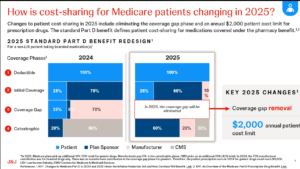
The BIG difference for us patients is that no matter what, out-of-pocket drug costs for 2025 cannot exceed $2000. You heard right – for those of you on specialty oral medications like Nubeqa (darolutamide for prostate cancer) or Aubagio (teriflunomide for MS), normally sourced via specialty pharmacies, you will meet this cap January. And you’ll even be able to spread the payment over 12 months! More on that to follow.
But first, how is this coming about. Well it tracks back tot he changes brought about by the Inflation Reduction Act signed by President Biden in 2022. He promised to make drugs more affordable, and this is a part of the plan. As you can see in the slide to the left comparing 2024 to 2025, the donut hole has been eliminated. In its place, the Payer (Plan Sponsor) and Pharma (manufacturer) are paying more. While the cost saving is very positive, it will likely impact us patients in other ways:
Your formulary choice may be reduced – so CHECK your medications before you renew.
Premiums for Part D may increase – even though out of pocket is capped. If you are unlikely to spend $2,000, look for a plan that defers your co-pay as long as possible
Higher premium plans should cover a larger portion of drug costs earlier. Your premium does NOT count towards the $2,000, so include premiums in your cost calculation to figure your exposure.
If you have a co-pay or co-insurance on your drugs, no matter if it’s Part C or D, it cannot exceed $2,000. However the amount you pay and who you pay it to may become a bit of a moving target. We mentioned earlier that you will now have the opportunity to spread your payments over the calendar year – or the remainder of it, if you sign up late or incur costs late in the year. The Medicare Prescription Payment Plan (M3P) takes your share of drug costs, up to a maximum of $2,000, and spreads them over the remainder of the year.
The simple example is for those on specialty pharmaceutical drugs like Nubeqa or Aubagio. Since your share of the drug cost is almost certainly going to be greater than $2,000 in January, if you opt in for M3P BEFORE going to the pharmacy or ordering from your mail order pharmacy, you’ll pay nothing on picking up/shipping the drugs. Subsequently, you’ll get a separate bill from your Payer for $167.67 monthly over 12 months, and pay no more for any of your drugs the rest of the year. There is NO interest, no late fee penalties, and you get a couple of months leeway, but there are penalties if you never pay. You can sign up for MP3 with your Medicare Payer/Plan Holder BUT not in the pharmacy for 2025. So if you arrive at the drug store prior to enrollment, you’ll be charged $2,000 to take your pills home. You can leave the pills, go home, enroll and return to the pharmacy 24 hours later and pick up without payment to the pharmacy..
If you don’t start this expensive drug until mid year, say September, and you’ve spent nothing on drugs prior, then the $2,000 is billed over the last 4 months at $500/month.
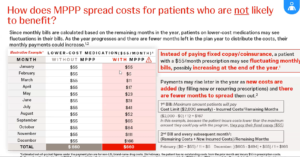
But what if your drug costs are more lumpy – they go up and down the whole year. In that case, the payments get recalculated each month and the monthly bill will vary.
There is a strange case too, if you know your co-pay is the same each month – say $55. This really throws M3P, and as you can see to the left, you’ll pay the same $660 (12x $55) either way but in different amounts each month if enrolled in M3P.
Finally, let’s address the Drug Benefit plans that many of you enjoy through PAN, PAF and others. Even the drug discount cards from Pharma that some receive. Whatever you receive, or however you receive it, does NOT reduce your $2,000 exposure. You advise the pharmacy that you have a benefit, and they bill the Benefit Provider (PAN, PAF, Pharma ??). The credit will be applied against your drug cost, although eventually you may still be liable for up to $2,000 co-pay when the benefit runs out.
Looking at the first slide, it seems to AnCan that these benefits that are often funded by Pharma, eventually flow back to Pharma and the Payer. How they will credit them against what the patient owes is not yet clear. Before you get too crazed, our guess is the system has to change. These benefits need to be channeled directly to patients who cannot afford $2,000 p.a. AnCan is on it and already reaching out to NAMAPA and others to promote more of a direct, income based subsidy possibly reaching more beneficiaries. One thing we have heard – APPLY EARLY for 2025 in the event you are in line to receive a subsidy.
PLEASE BE SURE TO SIGN UP FOR THE M3P PROGRAM UPFRONT. EVEN IF YOU OWE $2,000 IT WILL BE BILLED IN 12 INSTALLMENTS. WE STILLL HAVE TO FIGURE HOW YOU WILL BE REIMBURSED IF YOU RECEIVE ASSISTANCE.
IF YOU HAVE A GRANT BE SURE TO PROVIDE DETALS TO THE PHARMACY ASAP. NOTWITHSTANDING, ALSO REACH OUT TO YOUR GRANTOR TO FIND HOW THEY WANT TO COORDINATE THE GRANT. IT’S STILLL A MOVING TARGET!








 and this is a part of the plan. As you can see in the slide to the left comparing 2024 to 2025, the donut hole has been eliminated. In its place, the Payer (Plan Sponsor) and Pharma (manufacturer) are paying more. While the cost saving is very positive, it will likely impact us patients in other ways:
 But what if your drug costs are more lumpy – they go up and down the whole year. In that case, the payments get recalculated each month and the monthly bill will vary.