Most AnCan’rs have never participated in our Advanced Cancer Care Partners Support Group. While relieved that you’re not counted in this group, you are missing a gem. The group is chock-full of compassion and practical suggestions. One of the reasons for that was our remarkable Co-moderator, Pat Washburn, GRHS.
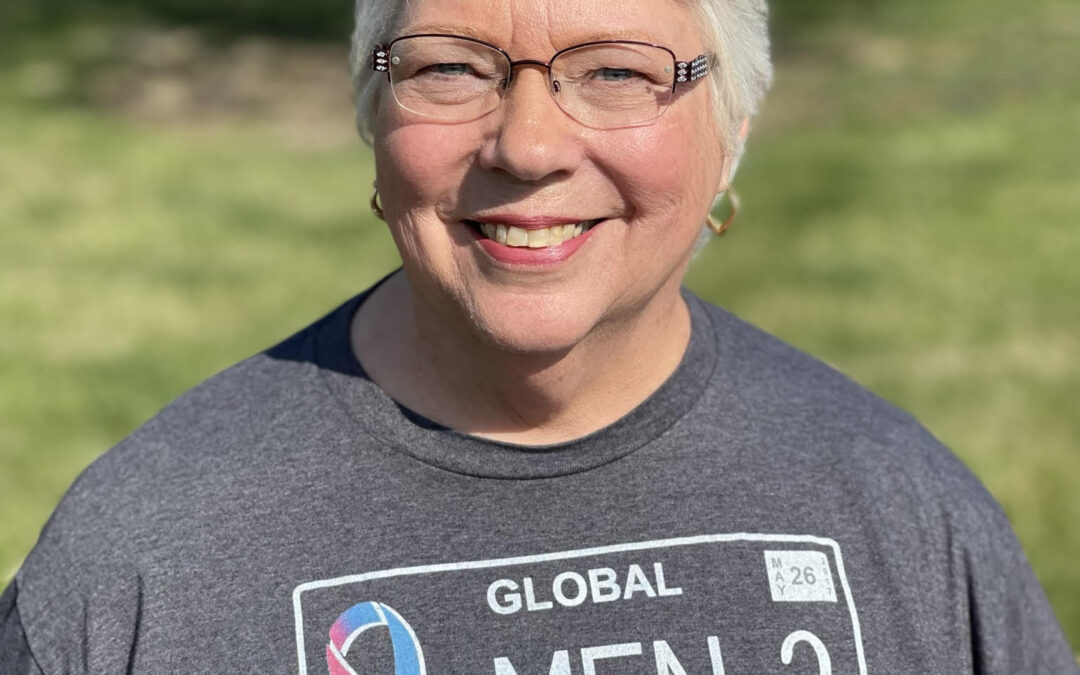
Pat absolutely radiated love and compassion while being none too short of gumption. That’s a polite Britishism for “piss and vinegar,” defined as ‘shrewd or spirited initiative and resourcefulness. ‘ After her dear husband, Marlyn, died in 2017, 5 months after being diagnosed with breast cancer, Pat made it her mission in life to make the world aware of Male Breast Cancer.
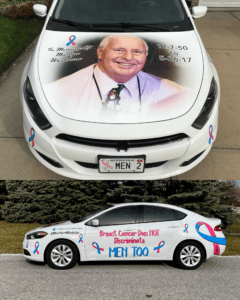
She took Marlyn’s car, had it decorated with his photo and Male BCa awareness icons, then took to the road. North, south, east, and west she travelled – every year. People stopped her at gas stations and restaurants; she made the local newspapers and TV stations everywhere. And always it was the same message. “Men get breast cancer, too!”
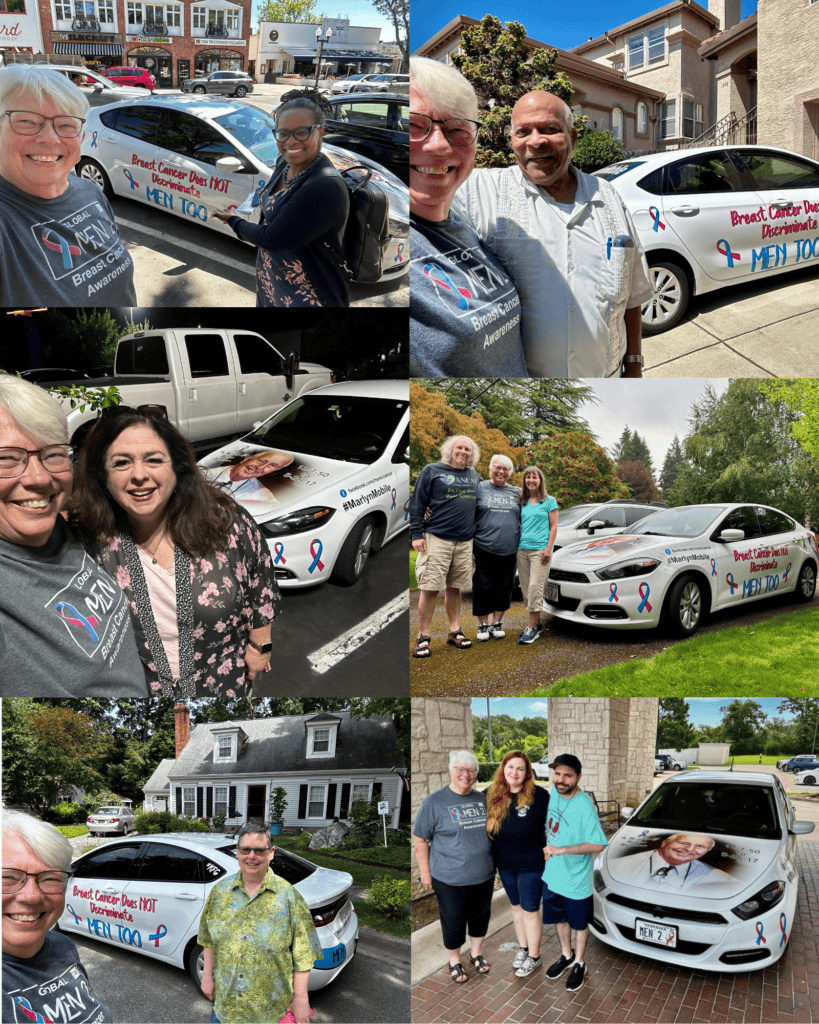
The world was her oyster, and Pat took the campaign to Europe on several occasions, including Spain and Scandinavia. Her travels were not just about awareness – she visited ‘her men’ and their care partners wherever she went. She also went out of her way to meet the AnCan’rs she’d met through our Group, most recently Alexa and Brian, on her way to Houston. See who else you can recognize below…
By and large, Pat paid for all her advocacy on her own dime. A couple of the male breast cancer organizations with whom she was affiliated did not treat her well. AnCan first met Pat when she reluctantly co-moderated our now-defunct Male Breast Cancer Support Group, disembowelled by one of those groups. Reluctant because Pat thought she’d be intruding on the men, BUT they loved her. At the time of her passing, AnCan was working with Pat and Bill Harris to reinstate the group – we still hope to in Pat’s memory (anyone interested, please reach out to me at rd@ancan.org).
Except when travelling or attending one of her Grandies’ or Great Grandies’ school or sporting events, Pat was always present to support Her Majesty, The Queen of DeNile – our Care Partner Lead Moderator, Susan Lahaie. So when she failed to show at a meeting on Aug 18, we reached out. Pat had been hospitalized after fainting on her face, diagnosed with multiple pulmonary embolisms; she looked like the Lone Ranger. During her hospital stay, those clots travelled to her brain, and Pat suffered a second, fatal stroke last week, elected hospice, and died on October 2nd.
All of us at AnCan are deeply saddened and wish her entire family much comfort. Pat’s entire family doesn’t do it justice. She was truly a matriarch with 35-40 Grandies and Great-grandies. In time, Pat’s memory will always be a warm, embracing memory to all who knew her.
Pat Washburn’s obituary can be found here.
Below is the Virtual Celebration of Life for Pat Washburn, held on November 2nd, 2025
(Here is my take on this article Therapeutic Use of Cannabis and Cannabinoids A Review JAMA Network, 11/26/25. On a personal side, I use CBD to help me sleep, and with a little (5%) addition of THC, it is a great anxiety calmer – Sally Torgeson, AnCan Blood Cancer Moderator & Multiple Myeloma Coach)
Unapproved Cannabis
The FDA has NOT approved the cannabis plant (botanical marijuana) for any medical use or indication.
Because it is classified as a Schedule I controlled substance under federal law, the FDA has not found it to be safe or effective for the treatment of any disease or condition [1.1, 1.7].
It is currently illegal to market CBD by adding it to food or labeling it as a dietary supplement in interstate commerce [2.1, 2.5].
FDA-Approved Cannabinoid Drugs
The FDA has approved a small number of prescription drugs containing either a purified cannabis-derived compound or synthetic cannabinoids:
Epidiolex (Cannabidiol or CBD): The only FDA-approved drug that contains a purified substance derived directly from the cannabis plant. It is approved to treat seizures associated with Lennox-Gastaut syndrome, Dravet syndrome, and Tuberous Sclerosis Complex in patients one year of age and older [1.8, 2.1].
Marinol and Syndros (Dronabinol): Contain synthetic Δ9-tetrahydrocannabinol (THC). Approved for:
Nausea and vomiting associated with cancer chemotherapy in patients who have not responded to conventional antiemetic treatments [2.2, 2.3].
Anorexia associated with weight loss in patients with HIV/AIDS [2.3].
Cesamet (Nabilone): Contains a synthetic substance that is chemically similar to THC. Approved for chemotherapy-induced nausea and vomiting [1.1, 2.3].
Regulatory Context
The FDA maintains its authority to regulate products containing cannabis or cannabis-derived compounds, even those derived from hemp (cannabis with less than 0.3% THC), under the Federal Food, Drug, and Cosmetic (FD&C) Act [1.4].
The FDA supports the development of new drugs through proper clinical trials to ensure they meet standards for safety and effectiveness [1.1, 2.4].
FDA-Approved Cannabinoid Drugs and Their Conditions
* Nausea and vomiting caused by cancer chemotherapy (when other antiemetics have failed) * Anorexia (loss of appetite) associated with weight loss in patients with HIV/AIDS
Cesamet (Nabilone)
Synthetic cannabinoid (similar to THC)
* Nausea and vomiting caused by cancer chemotherapy (when other antiemetics have failed)
Key Takeaway
Epidiolex is the only drug approved that contains a substance derived directly from the Cannabis plant (CBD). It represents the strongest evidence for cannabinoid efficacy in reducing seizure frequency in certain rare forms of epilepsy [1.1, 1.2].
The synthetic THC compounds (Dronabinol and Nabilone) are used primarily as a last resort for severe nausea/vomiting related to chemotherapy and for appetite stimulation in AIDS patients [1.2, 2.8].
The FDA has not approved the use of the whole cannabis plant for any medical condition, stressing the importance of standardized, tested pharmaceuticals for patient safety and proven effectiveness [1.7].1
Off-Label Use vs. Unapproved Use
1. Off-Label Use (Legal and Regulated)
This applies only to drugs that the FDA has already approved.
What it is: Using an FDA-approved drug (like Epidiolex, Marinol, or Cesamet) for a condition, dose, or patient population that is not specifically listed on the drug’s official label.
Legality: It is legal for a licensed physician to prescribe an approved drug for an off-label use if they believe it is medically appropriate for their patient.
FDA Position: The FDA does not regulate the practice of medicine; however, the manufacturer cannot market or promote the drug for the off-label use. The safety and efficacy for the off-label use have not been verified by the FDA’s rigorous testing process.
Example: A doctor prescribing Marinol (Dronabinol), which is approved for nausea from chemotherapy, to a patient for chronic pain. The drug is approved, but the condition (chronic pain) is not on the label.
2. Unapproved Use (Non-FDA Approved Products)
This applies to the cannabis plant itself and most CBD/cannabinoid products on the market.
What it is: Using the whole cannabis plant (botanical marijuana) or non-FDA-approved cannabis-derived products (like most CBD oils, edibles, or topicals) for any medical purpose.
Legality:
Federal: The whole plant is a Schedule I controlled substance and is not federally approved for any medical use.
State: Use may be legal under state medical or recreational cannabis laws, but this does not change its status as an unapproved drug under federal FDA law.
FDA Position: The FDA considers these products unapproved drugs and/or illegally marketed products (especially when CBD is added to food or marketed as a dietary supplement), as they have not been tested for safety, effectiveness, or quality assurance.
Example: A patient using a CBD tincture (which is not Epidiolex) to treat anxiety, or using THC flower to help with multiple sclerosis symptoms.
To correspond with Sally, please send an email to info@ancan.org, and we’ll be sure to send along.
For those that have been around AnCan for a while, the name Lindsey Byrne should be familiar. Lindsey is a Genetic Counselor at The Ohio State University (James) Comprehensive Cancer Center who specializes in prostate cancer. Click this link, and you’ll see everything she has done with AnCan!
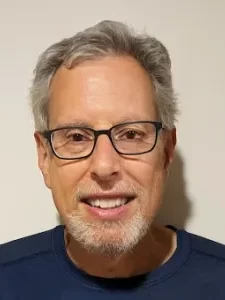
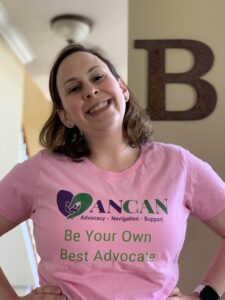
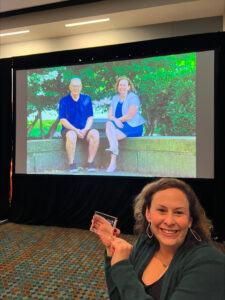
Lindsey recently participated with Janssen Biotech, soon to be referred to as just Johnson & Johnson (JnJ), to make 3 short videos on the implications of the BRCA gene mutation for prostate cancer. This is part of a non-branded education effort as JnJ introduces its newly approved single pill, AKEEGA, that combines PARP-Inhibitor niraparib with ARSI, abiraterone acetate. Lindsey doesn’t just talk the talk; she walks the walk – ask her patient, frequent AnCan participant, Frank Fabish pictured together right. AnCan, btw, is also indirectly connected to panelist GU med onc Cora Sternberg, who went to grade school with one of our gents, and was a good family friend of another.
If the video seems a little stiff, that’s because it has to be fully scripted to meet FDA requirements for the manufacturers. That said, the information is good, understandable and accurate – although it may leave out important additional information AnCan would impart. So if you know very little about BRCA, and want to understand it better, we recommend watching these 3 short videos that you can do in les than 20 minutes. Clickhttps://www.uncoverbrca.com/expert-video-series/index.html
Two short caveats:
even if you don’t have prostate cancer, but your condition has a risk for BRCA mutations, the videos may be helpful. PARP-Inhibitors alone are often a treatment option when BRCA is present in any cancer.
in full disclosure, JnJ is a significant AnCan financial sponsor. However, JnJ neither requested nor required us to promote these videos.
AnCan takes a holistic approach to your physical and mental health. AnCan also recognizes that a healthy mouth contributes to a stress free life… and all too often your condition, or the meds you take for it, can disrupt dental health. Some of our groups speak frequently about dry mouth (xerostomia), loss of taste (ageusia) and ONJ … osteonecrosis of the jaw.
When, Dr. Bob Gurmankin DMD, a recently retired dentist living with advanced prostate cancer, noticed the frequency with which these dental topics came up in his group, he suggested a two-step support program – 1) a handout on our website, and 2) a dental health webinar in 2024… watch out for this int he New Year.
One handout alone was not going serve all needs so Dr. Bob graciously prepared THREE to kick start our effort to help you maintain a healthy mouth.
Please download whatever is appropriate and spread the word to others who you think may benefit. Dr. Bob Gurmankin can be reached at dr.bob@rickd13.sg-host.com ; if you have questions he has kindly agreed to assist… THANK YOU DR. BOB!!!
Please participate in our Groups where you’ll find more support… onward & upwards.
This could be scary…It’s almost open enrollment season for Medicare!
A dreaded time to receive multiple communications in untold ways that often read like a foreign language. It’s only fitting that we talked about it the day before Halloween.
Join AnCan as we bring experts Amanda Goodstadt, Esq. from Triage Cancer, and Medicare Insurance Broker Kim Umphres to explain all things confusing around 2024 Medicare insurance options, and make this enrollment season a little less spooky and intimidating.
Our panel will explain the whole menu from alphabet soup plans to doughnut holes! Learn the difference between Traditional and Advantage plans and if you can switch between them, what HMOs and PPOs mean, how to sign up to see any doctor anywhere and much more.
Click here for a special handout from Triage Cancer with Medicare resources.
Special thanks to Bayer, Pfizer, Myovant Sciences, Foundation Medicine, Myriad Genetics, Janssen – Johnson & Johnson, Telix, and Blue Earth Diagnostics for sponsoring this webinar.
To SIGN UP for any of our Virtual Support groups, visit our Contact Us page.

 By and large, Pat paid for all her advocacy on her own dime. A couple of the male breast cancer organizations with whom she was affiliated did not treat her well. AnCan first met Pat when she reluctantly co-moderated our now-defunct Male Breast Cancer Support Group, disembowelled by one of those groups. Reluctant because Pat thought she’d be intruding on the men, BUT they loved her. At the time of her passing, AnCan was working with Pat and Bill Harris to reinstate the group – we still hope to in Pat’s memory (anyone interested, please reach out to me at rd@ancan.org).
 Off-Label Use vs. Unapproved Use
 For those that have been around AnCan for a while, the name Lindsey Byrne should be familiar. Lindsey is a Genetic Counselor at The Ohio State University (James) Comprehensive Cancer Center who specializes in prostate cancer. Click
  gents, and was a good family friend of another.
 AnCan takes a holistic approach to your physical and mental health. AnCan also recognizes that a healthy mouth contributes to a stress free life… and all too often your condition, or the meds you take for it, can disrupt dental health. Some of our groups speak frequently about dry mouth (xerostomia), loss of taste (ageusia) and ONJ … osteonecrosis of the jaw.